
Abandoned Mail-Order Bride Waited Alone at the Station, Unaware the Lone Cowboy Was Approaching Her

The Station at the Edge of the World
The letter did not merely break her heart; it erased her future.
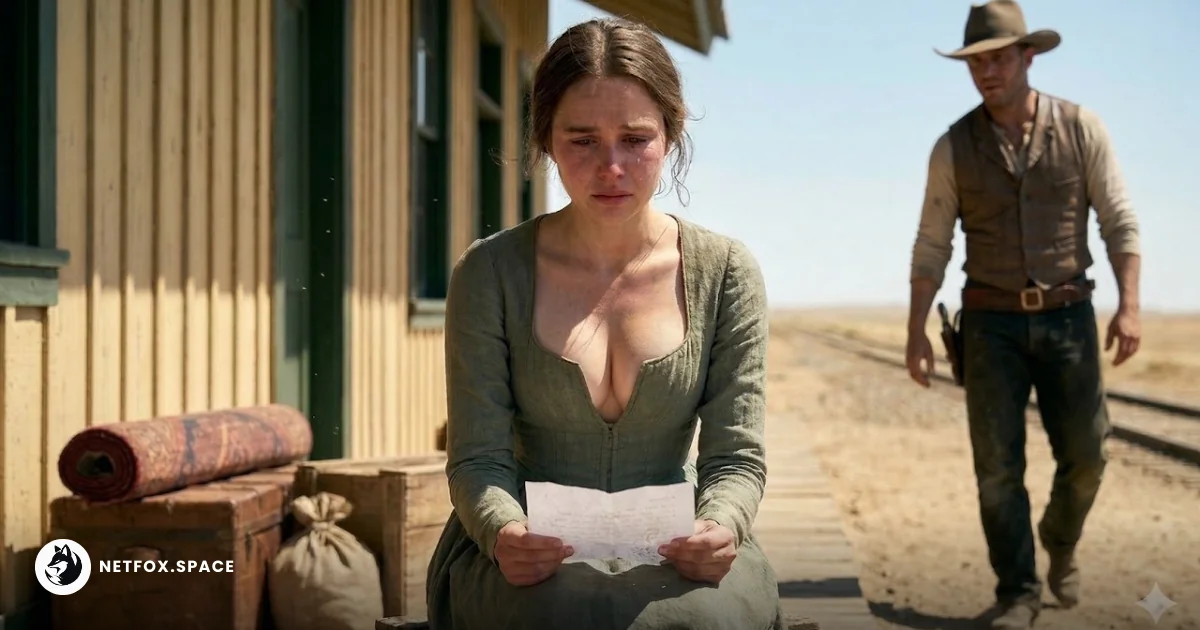
Clara Whitmore read the twelve words again, her thumb tracing the jagged edges of the parchment. She stared at the ink until the letters blurred into spindly black insects crawling across the page. “Upon further consideration, I find that our arrangement no longer suits my circumstances.” No apology. No explanation. Just a cold, iron door slammed shut in the face of a woman who had sold everything she owned to buy a one-way ticket to Willow Creek.
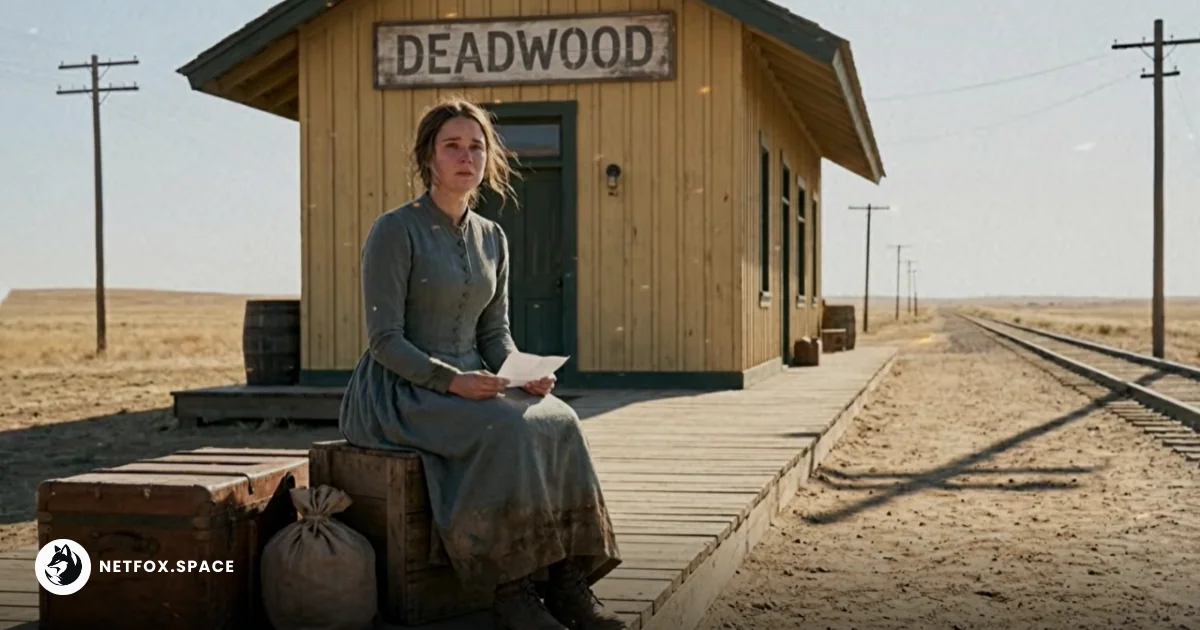
The locomotive had departed three hours ago, leaving behind a fading plume of charcoal smoke and a silence so profound it made Clara’s ears ring. She sat on her oak trunk the sum total of her existence on the weathered platform of a station that barely deserved the name. Willow Creek was a skeletal collection of sun-bleached boards and a single telegraph machine that clicked inside the station office like a frantic, trapped heartbeat.
The Kansas sun was a physical weight, pressing against the back of her neck. She had chosen a blue calico dress for this day, remembering a line from one of his letters: “I’ve always had a partiality for modest colors, like the sky before a storm.” Now, the fabric was a cruel irony, clinging to her damp skin in the sweltering heat.
She folded the letter with trembling precision and tucked it into her pocket. That same pocket had once carried his first correspondence the one that spoke of rolling pastures, a sturdy homestead, and the laughter of children. She had burned that particular letter in the potbelly stove of the train somewhere west of St. Louis. She didn’t want to carry the weight of a liar’s ghost.
“Mighty long wait for a short day, miss.”
Clara looked up. An elderly man stood a few feet away, his skin the color and texture of an old saddle. A tarnished tin badge hung crookedly from his vest.
“I thought I had folks coming,” Clara said, her voice cracking like dry timber.
The station master, a man named Buford, nodded slowly. He had seen this play out before. The West was a graveyard for the expectations of Eastern women. He handed her a tin cup of water. It was tepid and tasted of iron, but Clara sipped it with the reverence of a desert traveler.
A black, polished carriage suddenly thundered past the station, kicking up a wall of choking dust. On the door was a crest she recognized from the wax seals on her letters: a bold H flanked by cattle horns. The Harrison Ranch.
For a heartbeat, her pulse leaped. But the carriage didn't slow. The driver didn't even glance toward the platform. It disappeared into the shimmering heat haze of the horizon.
He wasn't coming. He had never intended to.
Clara didn’t cry. At twenty-six, she had learned that tears were a luxury for those who still had someone to comfort them. She had four dollars sewn into her glove, three dresses, and a splinter in her palm from gripping her trunk too hard. She was a woman stranded at the edge of the world.
Across the dusty expanse of the main street, leaning against a hitching post in the shadow of the saloon, a man was watching.
Silas Turner had come to town for salt and hemp rope. He was a man of few words and even fewer friends, a ghost who lived on the fringes of Willow Creek. He had been standing there for an hour, watching the woman in blue. He saw the way her shoulders stayed square even as the carriage rolled past. He saw the way she folded herself inward, trying to occupy as little space as possible.
He knew that look. He had seen it in his own reflection the winter he buried his father in the frozen earth behind their barn.
Inside the saloon, the air was thick with the smell of cheap rye and unwashed men. Silas stepped up to the bar.
“Who’s the lady on the platform?” Silas asked.
The bartender snorted, wiping a glass with a rag that was filthier than the floor. “Harrison’s mail-order bride. Came all the way from Philly. Harrison sent a rider in this morning saying he changed his mind. Said she ‘wasn’t worth the upkeep.’ Reckon she’ll be on the eastbound train tomorrow if she has the coin for it.”
Silas looked at his whiskey. He didn't drink it. He thought of the empty house three miles west. He thought of the silence that sat at his dinner table every night like an uninvited guest.
He walked out.
The sun was dipping lower, casting long, bruised shadows across the dirt when Silas reached the platform. Clara stood by her trunk, attempting to lift it. It was too heavy. It slipped from her hands, thudding onto the wood. She stumbled, her knees hitting the boards.
Silas stopped a few feet away, removing his sweat-stained hat. “Miss Whitmore.”
She looked up, her eyes wide and guarded. “Do I know you, sir?”
“No, ma'am. Name’s Silas Turner. I got a spread about half a day’s ride west. Cattle and a bit of corn.”
Clara stood, brushing the dust from her skirts, her chin lifting in a gesture of tattered pride. “If you’ve come to tell me the news, Mr. Turner, don’t bother. It seems the whole town is well-acquainted with my misfortune.”
“I didn't come to gossip,” Silas said quietly. “I heard you’re looking for a place. I could use a hand. Cooking, cleaning, keeping the dust from winning. It ain't a grand life, and I make no promises of what comes after. Just room, board, and a bit of honesty.”
Clara studied him. He didn’t look like Harrison there was no silver on his spurs, no polish on his boots. He had a scar near his thumb and eyes that looked like they had seen too much horizon.
“Why?” she asked. “Why offer this to a stranger?”
Silas looked out toward the empty tracks. “Because I know what it’s like to sit in the dark waiting for someone who’s never coming. It’s a hard way to spend a life.”
Clara looked at the empty station, then at the man. The station master stepped out, nodding toward Silas. “He’s a decent man, Clara. Quiet. But decent.”
The choice was simple: the cold floor of the station or the unknown road with a stranger.
“All right,” she whispered.
Silas reached down and hoisted her trunk onto his shoulder as if it weighed nothing at all. He helped her into the buckboard, his hand steady and warm against hers. As they pulled away, Clara looked back only once. The station was a speck against the vast, golden belly of the prairie. She was no longer waiting. She was moving.
The journey was a symphony of creaking wood and rhythmic hoofbeats. The prairie stretched forever, an ocean of grass that rippled in the evening breeze.
“You live alone?” Clara asked after an hour of silence.
“Since my folks passed. It’s a quiet life. Maybe too quiet for a city lady.”
“I’ve had enough noise to last a lifetime, Mr. Turner.”
They reached the homestead as the first stars began to pierce the purple velvet of the sky. It wasn't the mansion Harrison had described in his lies. It was a humble cabin of weathered cedar with a sagging porch and a stone chimney. But as they approached, Clara saw a small light in the window a lantern Silas had left burning.
Inside, the house smelled of dry earth and old wood. It was a man’s house functional, sparse, and neglected.
“It’s yours to do with as you see fit,” Silas said, gesturing to the small side room.
That night, Clara cooked a simple meal of salt pork and beans. They ate in a silence that wasn't uncomfortable, but heavy with the things they weren't yet ready to say.
As the weeks turned into months, the house began to change. Clara scrubbed the floorboards until the natural grain of the wood sang. She sewed curtains from flour sacks and polished the windows until the sunlight poured in like melted honey.
Silas, in turn, began to change. He started coming home earlier from the fields. He fixed the leaking roof. He built a small enclosure for a garden. One evening, he brought her a handful of seeds.
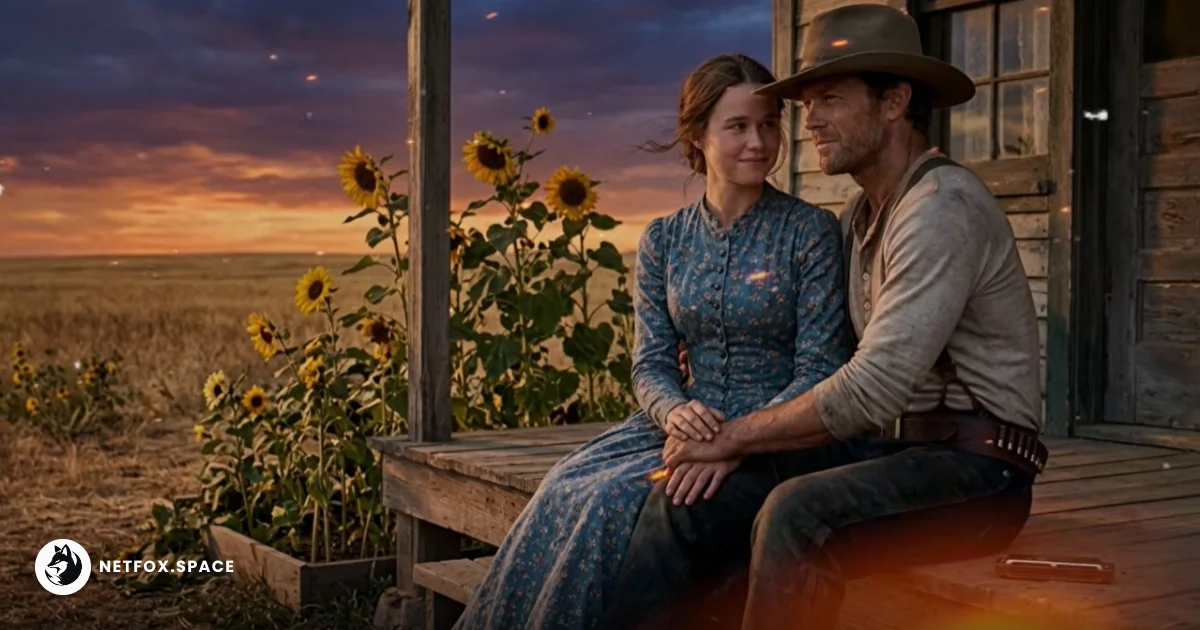
“Found these in town,” he said, his voice rough. “Sunflowers. Basil. Sage. Thought you might want to put down some roots.”
Clara took the seeds, her fingers brushing his. For the first time, she saw a flicker of something in his eyes—not pity, but a profound, aching kinship.
The turning point came on a Tuesday. A rider from the Harrison Ranch appeared, his horse lathered in sweat. He wore the silver horn crest.
“Miss Whitmore!” he shouted. “Mr. Harrison sent me. He says he’s had a change of heart. The lady he was courting in St. Louis proved... unsatisfactory. He’s prepared to honor the original agreement. He’s sent a carriage for you. It’s waiting at the crossroads.”
Clara stood in the garden, her hands stained with the dark, rich soil of Silas’s land. She looked at the rider, then at the small, sturdy house she had made into a home. She looked at the fence Silas had spent three days mending just so she would feel safe.
“Tell Mr. Harrison,” Clara said, her voice like iron, “that I am no longer available for his ‘circumstances.’ Tell him I found a man who knew my value before he knew my name.”
The rider scoffed. “You’d choose this? This dirt and this shack over the biggest ranch in the territory?”
“I’d choose the truth over a gilded lie any day,” she replied.
When the rider galloped away, Silas emerged from the barn. He had heard. He stood there, his chest heaving, his eyes searching hers.
“You stayed,” he said. It wasn't a question; it was a realization.
“I’m not staying because I have nowhere else to go, Silas,” she said, stepping toward him. “I’m staying because I’ve already arrived.”
Silas didn't give her a speech. He simply stepped forward and took her hand the hand of a woman who was no longer a discarded bride, but the heart of a home.
That evening, as the sun set in a blaze of violet and gold, the sunflowers she had planted stood tall and defiant against the wind. Silas pulled a harmonica from his pocket and played a tune not the mournful dirge of a lonely man, but a bright, soaring melody that carried across the plains.
Clara leaned her head against his shoulder. The train tracks were far away, and the letters were ash, but here, in the middle of the vast and silent West, two people who had been left behind had finally found a way to lead.
Comments (0)
Please login to comment
Sign in to share your thoughts and connect with the community
Loading...