
A Cowboy Found Her with No Food, No Roof, No Kin Then Whispered ‘Be My Bride Forever’

The prairie did not just want her dead; it wanted her forgotten.
Under a sky the color of a bruised plum, the wind howled across the high plains of Wyoming, carrying the dry, crystalline scent of an early winter. It was a wind that bit through wool and leather alike, yet the girl had neither. She moved like a specter, a silhouette of frayed linen and desperation, her feet leaving shallow, frantic prints in the dusting of frost.
She carried a small gunny sack over her shoulder. Inside was the sum of a human life: a broken comb with half its teeth missing and a single copper button.
For two days, she had sought refuge in a collapsed root cellar, huddled in the dark while the world above turned white. Hunger wasn't a sharp pain anymore; it was a hollow, echoing ache that made her lightheaded. When the cramps became unbearable, she chewed on a strip of salt-cured leather from a discarded harness, her jaw aching, her mind drifting. On the third morning, the silence of the cellar felt too much like a grave.
"Walk," she whispered to herself. The sound of her own voice was raspy, strange, and terrifyingly small. "Just walk."
She followed a thin, grey ribbon of smoke rising into the frigid air. She didn't know if it led to salvation or a different kind of death, but she lacked the strength to care.
At the Bray Ranch, the blue heeler named Catch was the first to know the world had shifted. He didn’t bark at the wind or the coyotes; he gave a sharp, directional yelp toward the east fence.
Lyall Bray stepped onto his porch, a Winchester cradled in the crook of his arm. At forty-one, Lyall was a man carved out of cedar and granite. He lived alone, spoke more to his Herefords than to the townspeople, and carried a reputation for being as cold as the ground he farmed. He expected a predator. He found a miracle of stubbornness.
She stood at the edge of his field, so thin she looked translucent. Her black hair was a matted nest of briars; her lips were split and bleeding from the dehydration of the frost. Her dress was a rag that barely reached her knees, and her arms were crisscrossed with the angry red welts of thorn bushes.
"Who sent you?" Lyall called out. His voice was hard, a reflex of a man used to the treachery of the frontier.
The girl didn't speak. She didn't beg. She simply looked at him with eyes that had seen the end of the world, and then her knees buckled.
The Weight of Silence
Lyall didn't hesitate. He dropped the rifle and reached her before she hit the frozen dirt. She weighed nothing—no more than a bundle of dry kindling. He carried her into the house, the warmth of the woodstove hitting them like a physical blow. He laid her on the rug and wrapped her in a heavy wool blanket that smelled of cedar and old tobacco.
For the first forty-eight hours, he fed her broth one spoonful at a time, as if he were watering a dying seedling. She swallowed with a grimace, her throat constricted by weeks of starvation. At night, he moved his cot to the kitchen to watch her. When she whimpered in her sleep a low, melodic sound of pure terror Lyall would go outside. He would chop wood until his muscles screamed and his breath came in ragged gasps, using the rhythmic thwack of the axe to drown out the sound of a broken woman's dreams.
By the third week, she was a ghost no longer. She began to move. She swept the floors with a fierce, quiet intensity. She hung laundry in the biting wind, her fingers turning blue, refusing to come inside until the work was done.
They existed in a strange, peaceful vacuum. No names were exchanged. Names carried history, and history was a weight neither wanted to bear.
One morning, she found a pair of small, sturdy leather boots by the stove. They were old, likely belonging to a long-gone sister or mother, but they were oiled and supple. She stared at them for an hour before putting them on. They fit like a promise.
 The Question of Survival
The Question of Survival
On a Sunday in December, the sky turned a brilliant, brittle blue. Lyall was in the barn, struggling with a rusted gate latch. He didn't hear her enter, but the air changed the scent of lye soap and woodsmoke followed her.
She stood in the doorway, her silhouette framed by the blinding white snow outside. Her eyes were clear now, the clouded haze of exhaustion gone.
"You fix things," she said. It was the first time she had spoken a full sentence to him.
"I try," Lyall replied, his back still to her.
She walked deeper into the barn, her fingers trailing over a leather bridle. "I don't remember my birthday," she murmured.
Lyall finally turned. "That makes two of us. I reckon the day you stop walking is more important than the day you started."
She looked at him, her gaze unwavering. "Am I your orphan... or your wife?"
The question wasn't born of romance. In the high plains, a woman alone was prey; a woman in a house was either a ward or a partner. She was asking for a definition of her safety.
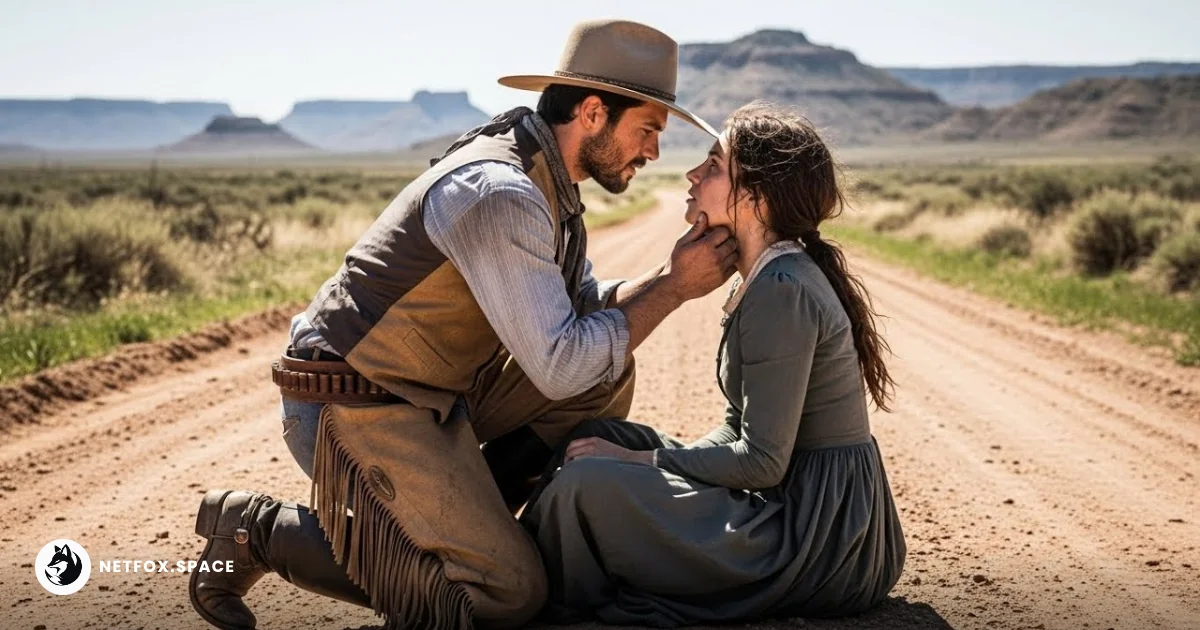
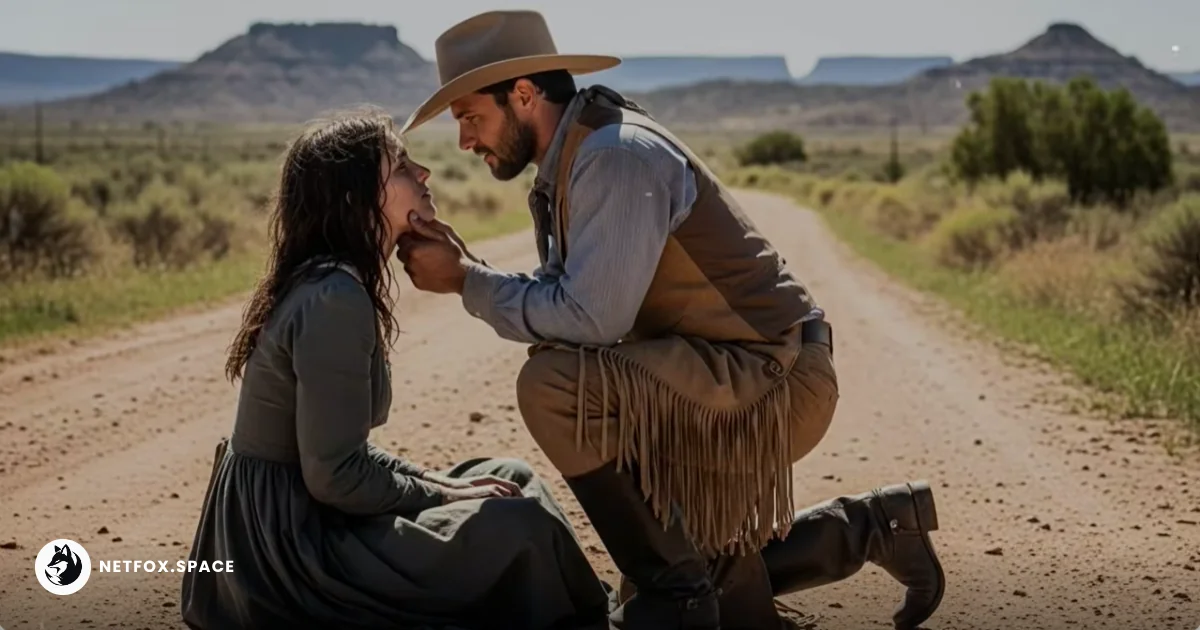
Lyall felt something in his chest, a long-dormant ache, crack wide open. He stepped toward her, his large, calloused hands reaching out to gently lift her chin. He looked into the depths of her hazel eyes eyes that had survived the dark and whispered, "Be my bride forever. I won't touch you till you ask. But the world will know you're mine."
She nodded. It wasn't a fairy tale "yes." It was a pact of survival, signed in the cold dust of a Wyoming barn.
The Forging of June
When they rode into town to see the postmaster, Lyall didn't ask her name. He simply looked at the ledger and said, "This is June. June Bray."
Seeing her name written in ink not as a casualty, but as a living soul changed something in her. She wasn't just a girl who had survived a root cellar; she was a woman with a hearth.
But the past is a persistent hunter.
That evening, Lyall cleaned out the very root cellar where she had once hidden. He scrubbed the walls, laid down a fresh mattress, and hung a lantern. He built a door with a heavy bolt that worked from the inside.
"You're safe down here," he told her. "If you ever feel the need to disappear again."
She didn't thank him. She simply slept there for a week. Safety, for June, was a habit that had to be unlearned.
As winter deepened, June transformed. She was no longer the porcelain doll Lyall had rescued. She watched him handle the Winchester; she watched how he tracked the wolves. One morning, while Lyall was in town for salt, she took the rifle to the back fence. When he returned, he found six holes in a fence post, clustered so tightly a silver dollar could cover them.
He didn't scold her for wasting ammunition. He simply handed her a box of shells the next day.
The Shadows Return
The trouble arrived with the March thaw. Three men rode onto the property, their horses lathered and their eyes restless. They wore the expensive, clean duster coats of men who made their living from the misery of others.
"Looking for a girl," the leader said, his voice a oily drawl. "Dark hair. Belongs to a Mr. Hanley over in Crooked Run. Stole some property on her way out."
Lyall stood on the porch, the Winchester held low. "Ain't seen anyone like that. Only people here are me and my wife."
"You harboring a runaway, mister?" the man asked, his hand drifting toward his holster.
Lyall’s voice turned to ice. "I’m burying fence posts today. I’ve got six more to put in the ground. I don’t mind making it nine."
The silence that followed was a physical weight. The men looked at the grim set of Lyall’s jaw, then at the curtain moving in the window where the barrel of a second rifle was subtly visible. They turned their horses and rode off, but the air felt tainted.
That night, June stood by the fire. "If they come back," she asked, "will you kill them?"
"Yes," Lyall said.
She walked to him and, for the first time, touched him of her own volition. She rested her forehead against his shoulder. "They won't just come for me. They'll come for the ledger."
The story spilled out then. Hanley wasn't just a rancher; he was a monster who ran a human trafficking ring out of a stable in Crooked Run. June hadn't just run away she had stolen his ledger, a record of every bribe, every buyer, and every girl sold into the mining camps.
"Where is it?" Lyall asked.
"Buried under the cedar stump in the north pasture."
Lyall nodded. He went to his gun cabinet and pulled out a Colt Dragoon, a heavy, brutal piece of iron. "Then we stop waiting for them to come to us."
The Storm Breaks
June didn't want a protector; she wanted a partner. She spent the next month training with a ferocity that frightened even Lyall. She mapped the trails; she learned to ride a horse until she and the animal moved as one.
"I’m going back," she said one evening. "Not to hide. To burn it down."
"I'll ride with you," Lyall replied.
They didn't go as husband and wife. They went as a two-person army.
They reached Crooked Run under a moonless sky. The town was a jagged collection of false-front buildings and whispered sins. June moved through the shadows like the ghost she used to be, but this time, she carried fire.
She found the stable where the girls were kept. She found the trapdoors and the rusted chains. With a match and a jar of kerosene, she turned the site of her nightmares into a funeral pyre for the past.
The confrontation with Hanley happened in the town’s main office. He was a man who thought gold could buy off the devil. When June stepped into the light, his face went the color of ash.
"You," he wheezed, reaching for a desk drawer.
June didn't miss. She shot him through the shoulder, the force of the Dragoon spinning him out of his chair.
"You sold us," June said, her voice steady and cold. "You starved us. You thought we were cattle."
Lyall stood in the doorway, holding off Hanley’s guards. He didn't interfere. This was her reckoning.
"Wait!" Hanley pleaded, clutching his shattered arm. "I can give you money! I can give you names!"
"I already have the names," June said. She pulled the ledger from her coat and tossed it onto his lap. "And now, so does the Federal Marshal in Laramie. I sent the copies yesterday."
She didn't kill him then. She did something worse. She left him alive to face the men whose secrets he had kept—men who would now kill him to keep him quiet.
The Harvest of Peace
The ride back to the ranch took three days. They rode through a spring rain that washed the soot from their clothes and the bitterness from their hearts.
By the time summer hit the high plains, the Bray Ranch was no longer a place of isolation. It was a sanctuary. June had used the reward money from the Marshal's office to expand the house. She built a room with a large window that faced the sunrise a room with a door that never needed to be locked.
One afternoon, a letter arrived. It was from Clara, a girl June had freed from the Crooked Run stables. I am in Wyoming now, it read. I am learning to read. I am alive.
June folded the letter and walked out to the north field where Lyall was working. The grass was waist-high, waving like a green sea.
Lyall stopped his work and looked at her. He saw the way she carried herself no longer a ghost, but a woman forged in fire and tempered by grace.
"The neighbors are asking about the ranch," Lyall said, wiping sweat from his brow. "They say a place this big needs a proper name."
June looked at the horizon, where the mountains met the sky. "Then give it mine."
Lyall smiled a rare, genuine thing that reached his eyes. He took her hand, his thumb tracing the scars on her knuckles.
"June’s Hope," he whispered.
He looked at the woman who had walked out of a root cellar and into his soul. When the townspeople eventually asked who she was, he never mentioned the starving girl or the gunny sack. He simply stood tall, looked them in the eye, and said the only truth that mattered:
"She is my bride forever. And the storm is over."
Comments (0)
Please login to comment
Sign in to share your thoughts and connect with the community
Loading...