
He Found the Only Survivor And the Killer Is Coming for Her

The Cottonwood Vigil
Caleb Mallister had not held another human being in three long, hollow years. Not since the gray autumn morning he had carried his wife, Ruth, out of their cabin and buried her beneath the skeletal white branches of the cottonwood tree. He had dug the grave himself, his hands blistering and bleeding until the physical pain finally numbed the howling void in his chest. Since then, the world had gone quiet. The chair across the table remained tucked in; the bed stayed cold on the left side.
He told himself he had made peace with the silence. He told himself that being a ghost among the living was a fair price for a life without further loss.
Then, on a shimmering, suffocating Tuesday in July, Caleb rode straight into hell.
He smelled it before he saw it the sharp, acrid bite of burnt canvas and the metallic tang of spent gunpowder. Then came the smoke, rising in slow, black ribbons against the bruised Montana sky. Out here, smoke was never a social call. It was a scream.
Caleb narrowed his eyes, shifting his weight in the saddle. He checked the action on his Winchester, a habit as natural as breathing, and urged his horse forward. The closer he got, the heavier the air felt, thick with a scent he didn't want to name.
He crested a low rise and stopped. Below him, the trail was a graveyard.
Four wagons sat broken, their wheels shattered like kindling, wood still smoldering with a low, orange glow. Goods were scattered across the dirt china plates smashed into white teeth, bolts of fine silk unspooled and trampled into the mud as if some titan had shaken the world and let the pieces fall where they may.
Caleb dismounted, his boots crunching on glass. He found the first man near the lead wagon, face down in the dirt, his hat still perched mockingly on his head and a single, professional bullet hole between his shoulder blades. Further on, a woman lay near a dead fire pit, her arms stretched wide as if she’d tried to catch the wind, or perhaps stop the inevitable.
He moved with a grim, practiced slowness, checking for pulses he knew he wouldn't find. Six. Seven. Eight.
It wasn't the sickness that had taken Ruth. This was a different kind of plague one made of lead and malice. Someone had wanted these people erased.
He was turning to leave, his stomach churning, when he heard it.
It was a sound so fragile he almost mistook it for the wind whistling through the spokes of a broken wheel. A ragged, hitching breath.
Caleb froze. He listened, his own heart hammering against his ribs. There.
He rounded the rear of the last wagon. Tucked behind a heavy, brass-bound trunk was a woman. She was curled into a ball, half-hidden by the wreckage. Her dark hair was matted with dried blood, and the left side of her face was a map of deep, angry purple bruises. Her dress, made of a fabric far too fine for the rugged Montana trail, was torn at the shoulder.
In her arms, she clutched a leather satchel to her chest with a white-knuckled grip, as if it were the only thing keeping her soul tethered to her body.
Caleb dropped to his knees. "Ma’am?" he said, his voice rusty from disuse.
Her fingers twitched. He leaned in, pressing his ear to her chest. Through the grime and the terror, he heard it: a heartbeat. Faint, erratic, but stubborn.
"You’re alive," he breathed.
He checked her quickly a deep gash above her ear, likely from a pistol whip, and scraped, bloody hands that suggested she had tried to crawl away before losing consciousness. Whoever had done this had left her for dead.
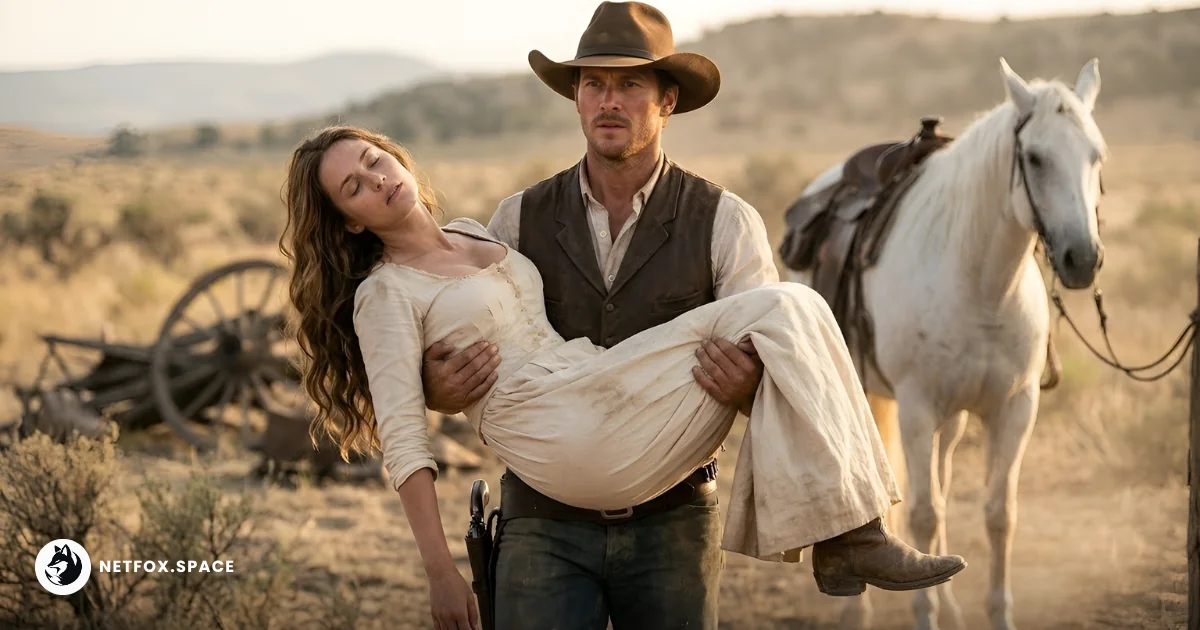
Caleb didn't hesitate. He lifted her, marveling at how light she felt. It was as if grief had already hollowed out her bones. As he stood, the satchel slipped from her weakening grasp. He caught it before it hit the dirt, feeling its unexpected weight, but he didn't open it. He simply tucked it against her side and carried her to his horse.
The five-mile ride back to his cabin was a blur of golden grass and shimmering heat. He kept her head tucked against his chest, her shallow breaths warming his skin the first human warmth he had felt in three years. It felt like a heavy, dangerous gift.
The cabin sat in the shadow of a low hill, protected by the very cottonwoods that guarded Ruth’s grave. Caleb had built it himself after the funeral, hammering every board with a desperate violence to keep his hands from shaking.
He laid the stranger on the cot in the spare room. With a basin of cool water, he washed the trail grit from her skin and the blood from her hair. He worked in a focused, monastic silence, the way a man does when he is afraid that if he stops moving, the weight of what he's doing will crush him.
He sat in a chair by the door all night, a ghost watching a shadow.
She woke at dawn. Her eyes flew open gray-green and sharp as flint. She let out a jagged gasp and tried to bolt upright, but her body betrayed her. She collapsed back, hissing in pain.
"Don't move," Caleb said softly, keeping his hands visible on his knees. "You’re safe. You’re in my home."
She scanned the room, her gaze darting from the log walls to the small, sun-streaked window, finally landing on the rifle leaning in the corner. "The wagons?" she whispered, her voice a dry rasp.
Caleb swallowed the truth, but it went down hard. "They're gone. Everyone."
Something in her face shifted. It wasn't the sudden collapse of tears; it was a deeper, structural breaking. A silence fell over her that reminded Caleb of the woods just before a storm.
"There's water on the table," he said, standing up. "I'll be outside."
He gave her space. He knew that grief was a wild animal; if you cornered it, it would bite. For two days, she remained in that room, a phantom in his house. He left plates of salt pork and hardtack by her bed and asked no questions.
On the third evening, she emerged. She was wrapped in a wool blanket despite the July heat, standing on the porch as the sun began to dip.
"Why did you bring me here?" she asked, her voice stronger now.
Caleb was cleaning his boots. He didn't look up. "Because you were breathing."
"That’s not a reason."
"It’s the only one I needed."
She studied him, her eyes narrowed with a suspicion that looked like it had been earned in blood. "You could have left me. It would have been easier. Safer."
"Could have," he agreed. "Didn't."
Her jaw tightened. "Men don't do things for no reason, Mr...?"
"Mallister. Caleb Mallister. And I ain't most men."
She let out a breath, the tension in her shoulders dropping an inch. "Margaret," she said. "Margaret Holloway."
She looked out toward the southern horizon, where the trail vanished into the haze. "But my husband will come looking for me. And you should know, Caleb Mallister Edmund Holloway does not leave things unfinished."
Caleb paused, his brush mid-air. "Things?"
"People," she corrected. "I have something he wants. Something that could ruin him, and the men he pays for." She gripped the porch railing. "The massacre... it wasn't bandits. It was a cleaning of the ledger."
The wind sighed through the cottonwood leaves, a lonely, haunting sound. Caleb looked at the dark silhouette of the tree where Ruth slept. For three years, he had been waiting for the world to end. He realized, with a sudden, sharp clarity, that it had already ended for Margaret and yet, she was still standing.
"You should leave," she said, her voice trembling. "This isn't your fight."
Caleb stood up and leaned against the railing. He looked at her really looked at her seeing the fire behind the fear. "I've sat in this chair for three years waiting for nothing," he said. "I reckon I'm tired of waiting."
"You don't even know me."
"I know someone tried to kill you," Caleb replied. "In my book, that’s all the introduction I need."
The next morning, the air was too still. It was the kind of silence that precedes a landslide.
Caleb was on the porch before the sun touched the hills, his Winchester across his lap. Margaret stepped out, wearing one of his spare work shirts with the sleeves rolled up. The bruise on her jaw had faded to a sickly yellow, but her eyes were clear.
"We need to leave," she said.
"Not yet," Caleb replied. "You can barely sit a horse, let alone outrun a posse."
"I can ride."
"You can ride," he conceded. "But you can't fight. Not yet."
He walked to the barn and returned with a second rifle a Henry repeater. He handed it to her. Her hands shook as she took the weight of it.
"I watched my brothers hunt," she whispered. "My husband... he said it wasn't a lady’s concern."
"Well, your husband isn't here," Caleb said grimly. "Shoulder firm. Don't jerk the trigger. Breathe out when you squeeze."
He set three tin cans on the fence rail. Margaret took her stance. The first shot kicked hard into her shoulder, the bullet kicking up dirt ten feet wide. She bit her lip, blinked away the shock, and fired again. And again.
By the sixth shot, the can spun off the rail and danced into the dust.
"You learn fast," Caleb noted.
"I learn because the alternative is a grave," she snapped, though her eyes shone with a grim sort of pride.
By midday, the dust appeared.
It was a thin, rising line far to the south. Margaret saw it first, her breath hitching in her throat. Caleb stood, shading his eyes. "Two riders. Maybe three. They’re making good time."
He moved her inside the cabin, but he didn't hide her. He didn't lock her in the cellar. He stood her by the window with the Henry, while he stepped out onto the porch to meet the world.
The riders slowed as they entered the yard. They were well-dressed men, wearing boots that hadn't seen enough miles to justify the dust on their coats. The leader, a man with a smile that didn't reach his cold, predatory eyes, tipped his hat.
"Afternoon," he called. "Name's Warren Briggs. I'm looking for a lady my employer’s wife. She’s been... unwell. Ran off in a state of confusion."
Caleb didn't move. "Ain't seen no confused women."
Briggs’ gaze drifted past Caleb, locking onto Margaret as she stepped into the doorway. The smile widened, turning razor-thin. "Now, Margaret. There you are. We’ve been so worried."
"My name is Margaret Holloway," she said, her voice ringing out like a bell. "And I am not going anywhere with you, Briggs. Tell Edmund the marriage is over. Tell him I’m keeping the satchel."
Briggs sighed, the weary patience of a professional killer. "Mrs. Holloway, you’ve stolen important documents. This is a legal matter. Don't make this difficult for Mr. Mallister here."
He looked at Caleb. "You’re interfering in a lawful marital dispute, friend. Move aside."
Caleb’s jaw tightened. "You rode onto my land, uninvited, to claim a woman who says she don't want you. In Montana, that ain't a dispute. That’s trespass."
The second rider’s hand drifted toward his holster.
Click-clack.
Margaret leveled the Henry at the man’s chest. "Don't," she said. Her hands were as steady as the mountains behind them.
For a long, agonizing minute, the only sound was the jingle of a bridle bit. Briggs studied them, his eyes jumping from Caleb’s weathered face to Margaret’s fierce resolve. He realized he had underestimated the farmer, and he had certainly underestimated the prey.
"You’ll regret this," Briggs said softly.
"Maybe," Margaret replied. "But not today."
Briggs nodded to his partner, and they turned their horses. They rode away slowly, maintaining a mocking pace until they hit the main trail and disappeared into a gallop.
Margaret lowered the rifle, and the tremors finally took her. She leaned against the doorframe, her chest heaving.
"He'll be back," she whispered. "He'll bring more men next time. Dozens."
"I know," Caleb said.
She turned to him, her eyes wide. "You should have let them take me. You’re going to die because of a woman you found in the dirt."
Caleb walked over to her. He looked past her, toward the cottonwood tree and the small mound of earth beneath it. "I was already dead, Margaret," he said quietly. "I’ve spent three years in a grave of my own making. For the first time since Ruth died, the air feels like it’s worth breathing."
He held her gaze, and in that moment, the silence between them changed. It was no longer the silence of two strangers, but the silence of two soldiers waiting for the horn to blow.
"Why?" she asked. "Why risk it all for me?"
"Because," Caleb said, looking out at the horizon where a new, much larger cloud of dust was beginning to rise. "Everybody deserves to stand somewhere without being afraid. And because this is my land. And you’re under my roof."
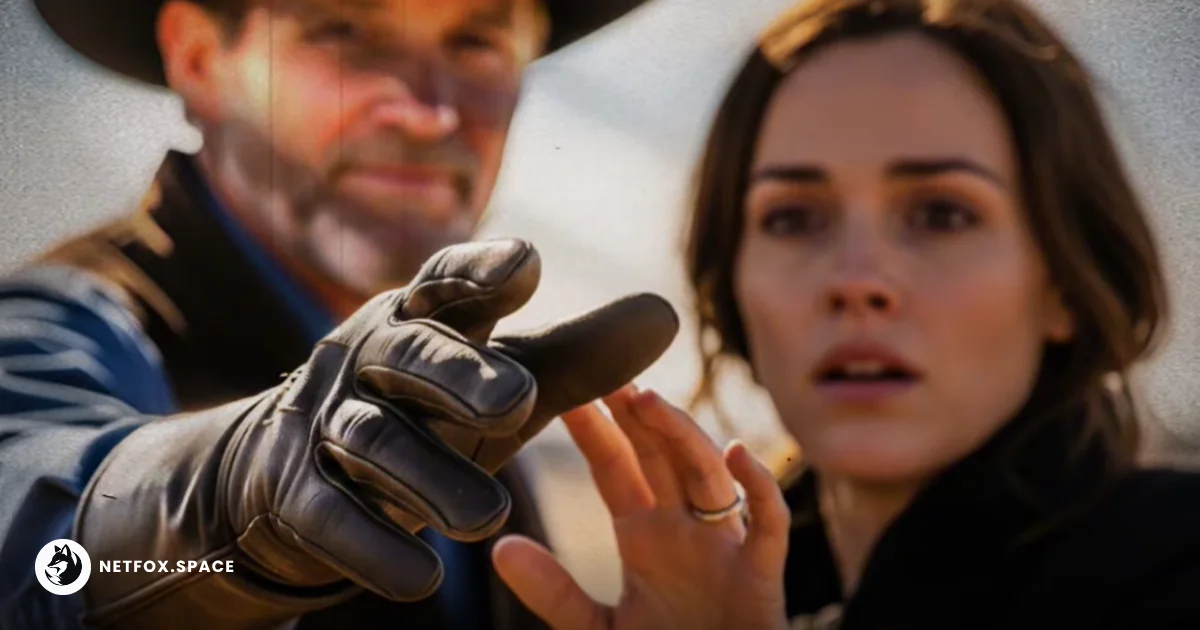
He reached out a hesitant, sweeping motion and for the first time in three years, he took a human hand in his. Her fingers were cold, but her grip was iron.
"Get the ammunition," Caleb said, his voice dropping into a low, steady growl. "They’re coming back. And this time, they aren't coming to talk."
On the horizon, the sun began to bleed crimson, casting long, sharp shadows across the valley. The storm was coming, but as Caleb Mallister stood on his porch, rifle in hand and a reason to fight by his side, he realized he wasn't a ghost anymore.
He was a man. And he was home.
Comments (0)
Please login to comment
Sign in to share your thoughts and connect with the community
Loading...