
"Please.. Don't Make Me Do That." - What The Rancher Did Shocked The Whole Region|Wild West Archives

The Debt of the Wicked: A Tale of the Sapphire Foothills
The sun over the Montana Territory in 1888 didn't just shine; it punished. It turned the bunchgrass into brittle gold and the wagon ruts into puff-clouds of choking powder. In the heart of this heat, a woman lay broken.
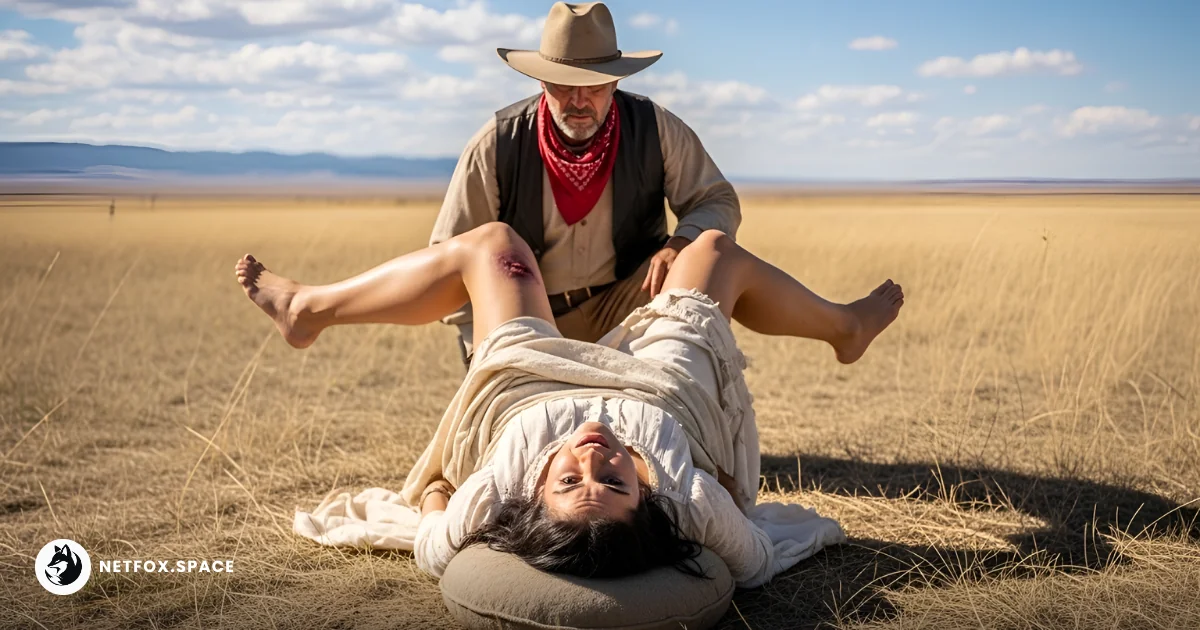
Clara Ren was twenty-five, but her soul felt a century old. She lay flat in the burnt summer grass, her dark hair a tangled web among the weeds. Her dress, once a modest calico, was twisted and caked with the grey grime of the trail. Her knees were raw, weeping red into the thirsty soil, and her bare legs trembled with a rhythmic, primitive terror.
"Please don't... don't make me do that," she wheezed. The plea wasn't addressed to the sky or to God, but to the shadow looming over her.
Behind her stood a man who looked as though he had been carved from the very rimrock of the Sapphire Foothills. Elias Mercer was fifty-two, with shoulders broad enough to carry the weight of a winter and eyes the color of a storm-tossed river. He was a mountain man, a rancher who spoke the language of horses better than the dialects of men. He dropped to one knee, his sun-faded hat casting a sliver of shade over Clara’s face. To a distant observer, it looked like a predator cornering its prey a hard man about to drag a woman back to a life she had literally crawled away from.
But Elias wasn't reaching for her to hurt her. He took her arm with a grip that was firm but lacked the bite of malice. He saw the terror in her eyes the kind of look a doe gives when the winter wolves are closing in.
"Drink," he said, his voice a low rumble. He held a canteen to her parched lips.
Clara gulped the water, sobbing between swallows. Elias didn't rush her. He pulled a red bandana from his pocket and began to wrap her ruined knee. His hands were calloused, scarred by rope burns and midwinter frostbite, yet they moved with the startling tenderness of a man who had spent a lifetime birthing foals.
"We have to go back, Mrs. Ren," he said quietly.
Clara recoiled as if he’d struck her. Tears carved clean channels through the dust on her cheeks. "If I go back, he’ll kill me. You don't know Silas. He’ll kill me for running."
Elias looked toward the horizon. A thin, umbilical cord of dust was rising in the distance. Someone was coming. "If you don't go back," Elias said, his voice turning as hard as flint, "they’ll take your girls before sundown. Every one of 'em."
The Devil’s Ledger
The story of Silas Ren was a common tragedy in the West, though no less bitter for its frequency. Silas was a man who saw the world as a series of things to be owned, used, or gambled away. When Clara bore him five daughters instead of sons to work the dirt, he didn't see a family; he saw a curse. He traded his affection for the bottle and his responsibility for the card table.
The man across from him at that table had been Jeb Pike.
Pike was a man of "soft" power. He wore silk vests and polished boots, and he never raised his voice. He didn't need to. He specialized in the "legal" theft of lives. Silas had racked up a debt that the small Ren farm could never cover. So, Pike had offered a trade a contract for "labor."
In Pike’s ledger, Clara was to be sent to a "boarding house" in Missoula a place where questions weren't asked and women were sold by the hour. The five girls, the oldest barely ten, were to be scattered among Pike’s properties as indentured help.
Clara had jumped from the wagon when it hit a washboard rut near the Bitterroot River. She had run until her lungs burned like embers, finally collapsing where Elias found her.
The Shelter of Silence
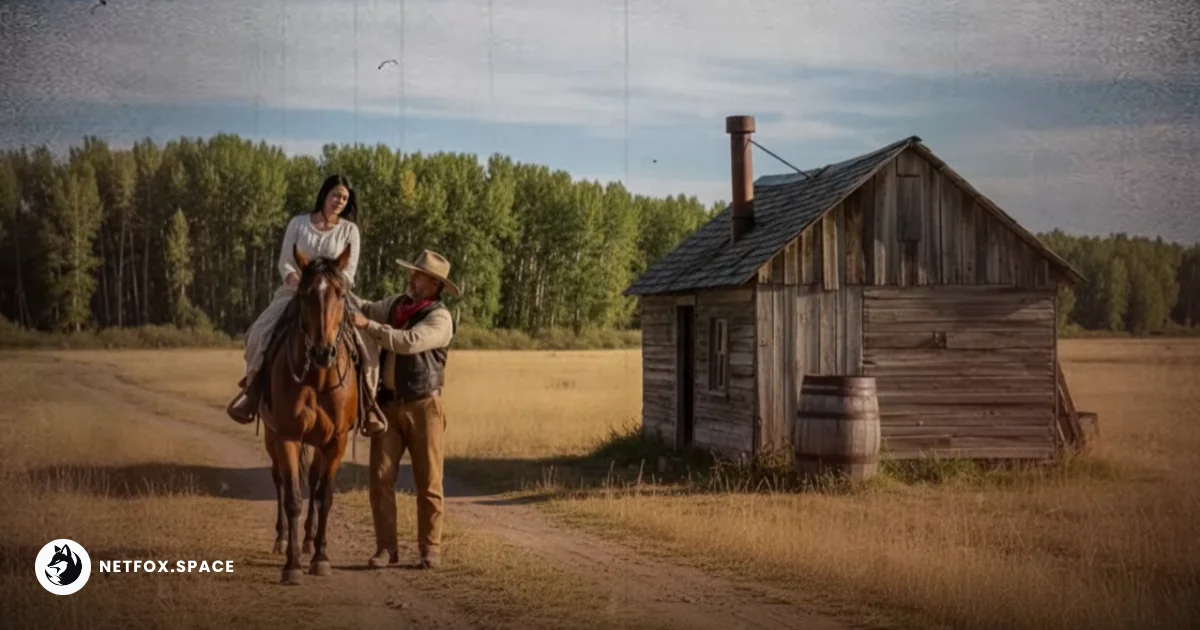
Elias knew that a frightened creature couldn't be driven; it had to be led. He lifted Clara she weighed no more than a bundle of dry kindling and set her upon his bay mare. He didn't take her to the main road. Instead, he led her to a forgotten trapper’s shack tucked into a bend of the river.
Inside the shack, the air was stale, but the shade was a mercy. Elias gave her more water and let the silence sit between them. Silence was a tool Elias used well; it allowed a person to find their own footing.
"He called them a curse," Clara whispered, her voice cracking. "Five little girls. He said the Lord was punishing him. But he’s the one who sold them. He signed the papers, Mr. Mercer. He signed them away like they were cattle."
"I know Pike," Elias said, leaning against the doorframe. "He doesn't want cattle. He wants people who are too broken to fight back. He builds his wealth on the silence of good people."
Suddenly, the rhythmic thud of hoofbeats vibrated through the floorboards. Clara froze, her breath hitching in her throat.
Elias peered through a gap in the door. Two riders. One was a lanky, hollow-eyed hired hand of Pike’s. The other was Silas Ren. Silas sat in his saddle with a slumped, arrogant posture the look of a man who blamed the world for his own failures.
"They're here," Elias whispered. He turned to Clara, his expression grim. "If they find you here, Pike wins. He'll claim you’re unstable, that you abandoned your children. He’ll disappear those girls before the Sheriff can even read a warrant."
"Please," she begged, the old terror returning. "Don't make me face him."
"I’m not asking you to face him for yourself," Elias said, his voice ringing with a sudden, sharp clarity. "I’m asking you to face him for the girls. Because if you don't stand up now, they’ll never have the chance to stand up later."
The Confrontation at the Cabin
Elias stepped out of the shack, closing the door firmly behind him. He didn't draw his Winchester, though it was within reach.
"Mercer," Silas shouted, pulling his horse to a halt. "You're holding my property. Give her over."
"I don't see any property, Silas," Elias said, stepping into the sunlight. "I see a woman you’ve bruised and a debt you’re too much of a coward to pay yourself."
The hired hand didn't wait for talk. He lunged from his horse, thinking the older man would be slow. He was wrong. Elias moved with the economy of a mountain lion. He caught the hand mid-rush, driving a fist into his solar plexus and swinging him headfirst into the water barrel.
Silas, emboldened by whiskey, lashed out with a riding crop. The leather whistled through the air, catching Elias across the shoulder. Elias didn't flinch. He reached out, grabbed the crop, and yanked Silas clean out of the saddle. Silas hit the ground hard, but Elias dragged him up by the collar, slamming him against the cabin’s cedar posts.
"Listen to me, you pathetic excuse for a man," Elias hissed. "You're going to ride into Stevensville. And you’re going to tell the truth."
"No one will believe a mountain hermit over a landowner!" Silas spat, blood blooming on his lip.
"They won't have to believe me," Elias replied. "They're going to hear it from her."
The Verdict of the Town
They entered Stevensville at high noon. It was a calculated move. Elias rode his bay mare with Clara behind him, her hands white-knuckled as she gripped his waist. Silas and the hired hand followed, shamed and bound by the sheer presence of the man leading them.
The town square was busy. Farmers were loading grain; women were exiting the mercantiles. Elias rode straight to the steps of the church, the highest ground in the center of town.
"Marshal Rohr!" Elias bellowed.
The crowd began to gather. Jeb Pike emerged from the shadows of the land office, his smile as bright and false as a counterfeit coin. "Elias? What is the meaning of this disturbance? Silas, why is your wife on this man's horse?"
Clara looked at the crowd. She saw the judgmental stares of the town biddies and the indifferent glances of the men. She felt the urge to hide, to vanish into the grass again.
"Please," she whispered to Elias’s back. "Don't make me do this."
Elias didn't look back. "Look at the road, Clara."
In the distance, a small wagon was being driven toward the north trail Pike’s wagon. In the back, two small heads were visible. One of them wore a fraying blue hair ribbon.
The sight of that ribbon acted like a spark in a dry forest. Clara’s fear didn't vanish, but it was consumed by something much larger: rage.
She slid off the horse, her injured knee buckling for a moment before she caught herself. She stood in the dust, a battered, bleeding woman, and she began to speak.
She didn't just tell them about the gambling. She told them about the nights spent hiding in the barn. She told them about the "labor contract" Jeb Pike had drawn up to sell a mother into a brothel and her children into slavery. She spoke until her voice was a roar, her finger pointed directly at Pike’s silk-covered heart.
"He didn't just take my home!" she cried, her voice echoing off the storefronts. "He took my children! He’s taking them right now!"
The town shifted. It was a subtle thing at first a murmur, a scowl directed at Pike. Then, the widow Miller stepped forward. "He tried the same paper-trick on my brother's homestead," she said loudly.
The silence that had protected Pike for years began to shatter. Marshal Rohr, a man who usually preferred the path of least resistance, saw the tide turning. He didn't wait for a judge. He signaled his deputies, and they galloped toward the north road, intercepting the wagon before it could leave the county line.
The Sapphire Sunset
By sunset, the girls were back in Clara’s arms. Silas Ren was in a cell, waiting for a circuit judge who had little patience for men who sold their families. Jeb Pike had retreated into his office, but the "respectability" he prized was gone forever; the town no longer looked at him with envy, but with the cold eyes of a predator being watched.
Elias Mercer didn't stay for the cheers. He loaded Clara and her five daughters into his own sturdy ranch wagon.
"Where are we going?" the oldest girl asked, clutching her mother’s hand.
"To the high country," Elias said, flicking the reins. "Where the air is clean and the fences are strong."
Life didn't become perfect that day. There were still nightmares, and the winters in the Sapphire Foothills were long and unforgiving. But as the girls grew, they didn't learn the language of fear. They learned how to ride, how to heal a wound, and how to stand their ground.
Clara Ren never forgot that afternoon in the burnt grass. She realized that Elias hadn't been a hard man trying to break her; he was a good man trying to forge her. He knew that the only thing more dangerous than a villain’s greed is a victim’s silence.
And in the quiet evenings, as the sun dipped behind the peaks, Clara would look at her five daughters playing in the yard and know that some debts are paid in blood, but freedom is paid for in courage.
Comments (0)
Please login to comment
Sign in to share your thoughts and connect with the community
Loading...