
Sold at 18 to a Lonely Rancher But His Twin Kids Loved Her Before He Did

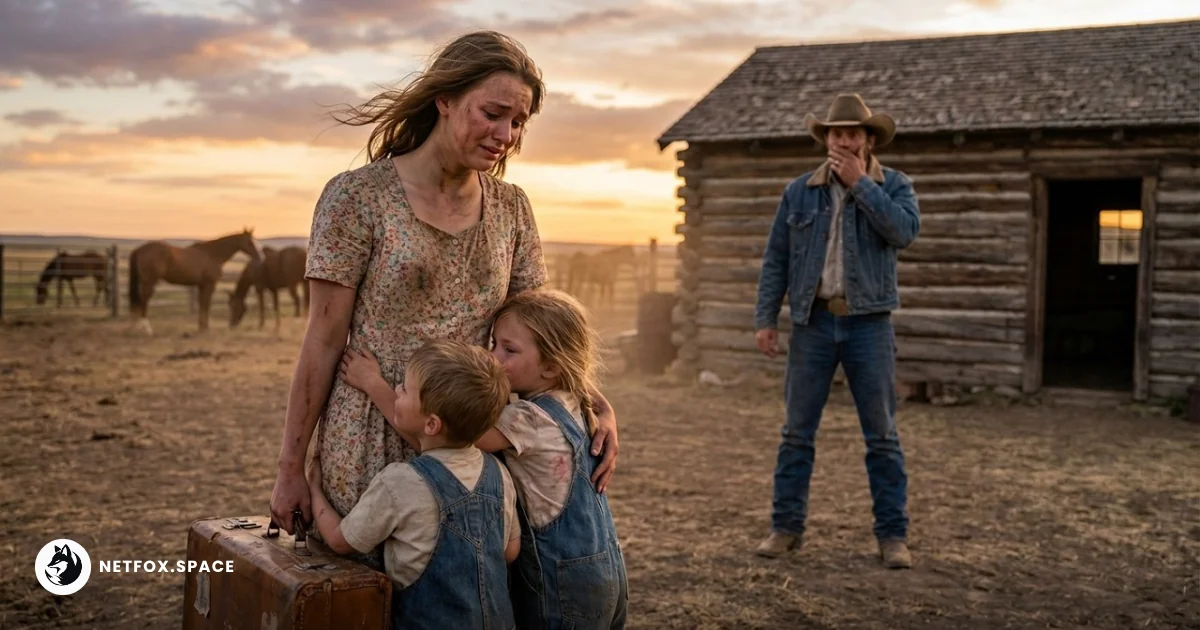
The gavel fell with a sound like a bone snapping, and in that instant, Norah Finch’s life was no longer her own.
The afternoon heat in Cold Water Ridge was a physical weight, thick with the smell of unwashed bodies, livestock, and the metallic tang of desperation. Norah stood on the raised wooden platform, her chin tilted at an angle that suggested a defiance she didn’t truly feel. Beneath the hem of her faded blue cotton dress the last decent thing she owned her knees were vibrating.
Three days ago, she had watched the bank’s men haul away the remnants of her childhood. She had watched her mother’s Bible, the hand-stitched quilts, and the brass locket containing the only image of her father vanish into the back of a wagon to pay off the debts he’d accrued before the law or the drink had finally taken him.
Now, she was the final lot.
“Eighteen years old! Healthy, strong, and capable!” the auctioneer bellowed, his voice cracking through the humid air. “Starting the bid at fifty dollars!”
Norah fixed her gaze on a knot hole in the timber of the livery stable across the square. She refused to look at the men in the front row. She could feel their eyes greasy, speculative, and predatory crawling over her skin like insects. To them, she wasn’t a girl who liked poetry or a woman who knew how to heal a fever with willow bark; she was a labor-saving device. A horse that could cook. A plow that could mend.
“One hundred!” a voice shouted. “One hundred and fifty!”
The numbers climbed, and with every increment, Norah felt her soul retreating further into the dark corners of her mind. She thought of her father. He had raised her on stories of the frontier’s nobility, teaching her to ride and read, promising her that out here, a person was judged by their character. He hadn't mentioned that out here, a woman without a man was often just currency.
“Two hundred and fifty!” a man with a stained beard and tobacco-yellowed teeth shouted, stepping closer to the stage. He grinned at her, and Norah’s stomach did a slow, sickening roll.
She closed her eyes, praying for the earth to open.
“Three hundred.”
The voice was different. It didn’t carry the jagged edge of the others. It was deep, resonant, and carried a weight of weariness that matched the landscape.
Norah’s eyes snapped open. Standing at the very back of the crowd, leaning against a hitching post, was a man who looked as though he had been carved out of the very mountains that rimmed the horizon. He wore a sweat-stained Stetson pulled low, casting a shadow over a face weathered by sun and silence.
“Three hundred and fifty!” the tobacco man countered, his voice turning shrill.
The tall man didn’t move a muscle, save for the tightening of his jaw. “Four hundred.”
A collective gasp rippled through the crowd. Four hundred dollars was a small fortune enough to buy a prime team of oxen and a year’s worth of supplies. The auctioneer’s eyes gleamed with a sudden, predatory light.
“Four hundred! Do I hear four-fifty? Four hundred once… twice…” He slammed his palm against the podium. “Sold to Mr. Silas Calhoun!”
Part II: The Long Ride North
The walk from the platform to the wagon was the longest journey of Norah’s life. The crowd parted for her, but their whispers followed like stinging gnats. Calhoun, they muttered. The widower from the North Range. Poor girl.
Silas Calhoun didn’t look at her as she approached. He was busy checking the harness on two massive draft horses. Up close, he was even more imposing. He looked to be in his mid-thirties, with silver-threaded hair at his temples and hands that were a map of scars and callouses.
“Can you cook?” he asked. He didn’t look up from the leather strap he was tightening. No “hello,” no “I’m sorry it came to this.”
“Yes, sir,” Norah said, her voice sounding small in the open air.
“Clean? Mend? Garden?”
“I can, sir.”
He finally looked at her. His eyes were the color of flint hard and gray, but not unkind. They held a profound loneliness that Norah recognized instantly. He didn’t look at her with lust; he looked at her with the appraisal of a man who was drowning and had just bought a life vest he wasn’t sure would float.
“Get in,” he said, gesturing to the buckboard. “We’ve fifteen miles to cover before the light fails, and the wolves are bold this time of year.”
Norah climbed onto the hard wooden bench. As the wagon lurched forward, she watched Cold Water Ridge shrink into a smudge of dust. She watched the saloon where her father had bartered away her future, and she felt a strange, cold cauterization of her heart. That life was dead.
They rode in silence for the first hour. The terrain turned rugged limestone breaks, thickets of mesquite, and the endless, waving sea of grama grass.
“I have children,” Silas said abruptly.
Norah started. “Sir?”
“Twins. A boy and a girl. Sam and Lizzy. They’re six.” He gripped the reins a little tighter. “Their mother died two years ago. Childbed fever took her late, after a chill. I’ve had three women out here since then. None stayed past the first full moon.”
“Why not?”
A ghost of a grimace not quite a smile touched his lips. “The children. They don’t take to strangers. They’ve decided that if they make life miserable enough for whoever I bring home, I’ll stop trying to replace their mother. They don't understand I'm not looking for a wife. I'm looking for a way to keep them fed and the house from rotting around us.”
“I’m not trying to replace anyone,” Norah said softly.
Silas glanced at her, his gaze lingering on her pale, tired face. “Good. Because they won’t let you.”
Part III: The Small Shadows
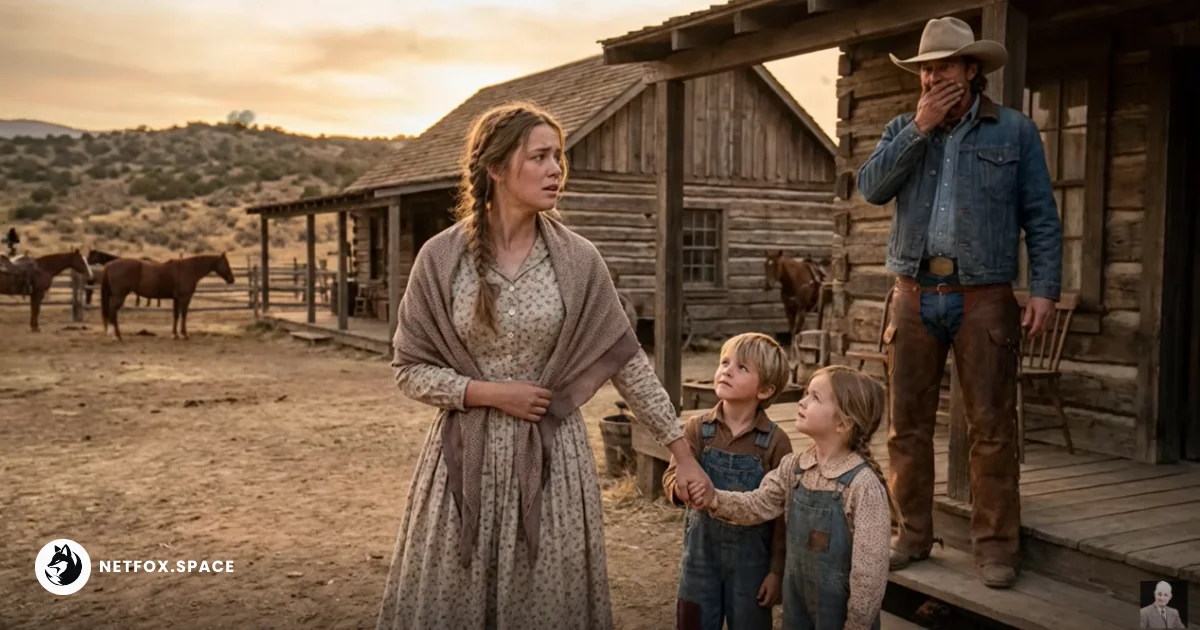
The Calhoun ranch, known as Blackwood, appeared as a silhouette against a blood-orange sunset. It was a sturdy, two-story house of timber and stone, flanked by a massive barn and a network of corrals. It looked like a fortress built against the vacuum of the wilderness.
As the wagon rolled into the yard, the front door didn’t just open; it exploded.
Two small figures flew onto the porch. Even from a distance, Norah could see they were a wild pair. Their hair was a chaotic tangle of sun-bleached blonde, and their clothes were stained with the red earth of the territory.
“You brought another one!” the boy, Sam, shouted. He didn't sound happy; he sounded like a general declaring war.
“She looks like she’ll break if the wind blows,” the girl, Lizzy, added, her arms crossed tightly over her chest.
Silas climbed down, his movements heavy. “This is Miss Norah. She’s stayin’. You’ll treat her with the respect due a guest in this house, or you’ll answer to me. Am I clear?”
The twins didn't answer. They stared at Norah with piercing blue eyes the same flinty gray-blue as their father’s, but filled with a searing, defensive heat.
Norah stepped down from the wagon. Her legs were shaking, but she forced herself to stand tall. She didn’t go to Silas, and she didn’t run for the door. Instead, she walked toward the porch and crouched down until she was at eye level with the children.
“The last one cried,” Sam challenged, stepping to the edge of the boards. “She cried because I put a bullfrog in her washbasin.”
“And the one before that left because I told her she smelled like a wet dog,” Lizzy said with a wicked tilt of her head.
Norah didn't flinch. She looked at their dirt-smudged faces and saw the jagged edges of grief disguised as malice. “Well,” Norah said calmly, “I’ve spent the last three days losing everything I ever loved. I’ve been sold like a heifer in the town square. A bullfrog sounds like pleasant company compared to the men I’ve dealt with lately. And as for the smell I’ve been on a wagon for four hours. I probably do smell like a wet dog.”
The twins blinked. This wasn't the script.
“Are you going to try to kiss our Pa?” Lizzy asked suspiciously.
Norah felt a flush creep up her neck, but she kept her gaze steady. “I am here to cook your supper, mend your socks, and make sure this house doesn't fall down. Your Pa and I have a business arrangement. Nothing more.”
Sam looked at Lizzy. Lizzy looked at Sam.
“We’ll see,” Sam muttered. “We’re still not liking you.”
“That’s fair,” Norah replied, rising to her feet. “I haven't done anything to earn it yet.”
Silas, who had been watching the exchange from the horses, let out a breath he seemed to have been holding for a long time. “Inside,” he barked. “All of you.”
Part IV: The War of Attrition
The first two weeks at Blackwood were a trial by fire.
The twins were relentless. Norah found salt in the coffee, burrs in her bedsheets, and once, a very disgruntled chicken trapped in her wardrobe. Silas was gone before dawn and returned long after dark, leaving Norah alone to navigate the minefield of the Calhoun household.
The house itself was a disaster of masculine neglect. Layers of dust coated every surface, and the kitchen was a graveyard of scorched pots. Norah worked until her fingernails bled. She scrubbed the floors until the grain of the wood shone; she boiled linens until the house smelled of lye and sunshine instead of stale grease.
She didn't complain. Not once.
The turning point came on a Tuesday. Norah was in the garden, trying to reclaim the choked vegetable patch, when she heard a muffled cry from the creek bed.
She dropped her hoe and ran. She found Sam pinned under a fallen cottonwood branch, his leg twisted at an unnatural angle. Lizzy was standing over him, her face white with terror, frozen in place.
“Don't move, Sam!” Norah commanded, her voice ringing with an authority she didn’t know she possessed.
She didn't wait for Silas. She used a fence post as a lever, heaving with every ounce of strength in her slim frame until the branch shifted enough for Lizzy to pull her brother free. Norah then tore her own petticoat into strips, fashioning a splint with the calm efficiency her father had taught her on the trail.
“You’re going to be fine,” she whispered to the sobbing boy. “But you’re going to have to be brave. Can you do that for me?”
Sam gripped her hand, his small fingers digging into her skin. “It hurts, Norah.”
“I know. But the pain is just a sign that you’re still here.”
When Silas rode in an hour later, he found them in the kitchen. Norah had Sam settled on the table, his leg set and bound, while she fed him honey-sweetened tea. Lizzy was sitting at Norah’s feet, leaning her head against Norah’s knee.
Silas stopped in the doorway, his face pale. “What happened?”
“An accident,” Norah said softly. “He’s okay, Silas. He was very brave.”
Silas looked at his son, then at the girl who had saved him. For the first time, the hardness in his eyes cracked. He didn't say thank you not yet but he walked over and placed a heavy, trembling hand on Norah’s shoulder. It was the first time he had touched her by choice.
Part V: The Thaw
Winter descended on the high plains with a roar. The world turned into a monochromatic landscape of white and gray. The ranch became an island in a frozen sea.
Inside the house, however, things were changing.
The twins had stopped the pranks. Instead, they became Norah’s shadows. She taught Lizzy how to knead bread, their hands working the dough in a rhythmic dance. She taught Sam how to read using the few books she had managed to save, his brow furrowed in concentration as he traced the letters.
And then there was Silas.
With the cattle moved to the lower pastures, he was home more often. He began to notice things the way Norah sang low to herself while she mended, the way she managed the twins with a soft word instead of a shout, the way she had turned his cold, hollow house into a sanctuary.
One night, after the children were tucked in, they sat by the hearth. The wind howled outside, rattling the shutters, but the fire was warm.
“I didn't buy you because I wanted a servant, Norah,” Silas said suddenly. He was staring into the flames, his profile sharp and handsome in the glow.
Norah looked up from her sewing. “Then why, Silas? Four hundred dollars is a lot of money for a cook.”
“I saw you on that platform,” he said, his voice dropping to a gravelly whisper. “I saw the way those men were looking at you. Like you were a piece of meat. I knew if I didn't take you, someone like that man with the yellow teeth would. And I couldn't live with that. I thought… if I brought you here, at least you’d be safe. At least you’d have a roof.”
Norah’s heart gave a strange, fluttering leap. “You bought my freedom by buying me.”
“I suppose.” He turned to her then, his gray eyes searching hers. “But now I find myself in a predicament.”
“What predicament?”
“I don’t want a housekeeper anymore, Norah. And the children… they don’t want a Miss Finch.” He paused, reaching out to take her hand. His skin was rough, but his touch was incredibly gentle. “They want a mother. And I… I want a wife. Not because I need one. But because I can’t imagine this house without you in it.”
Norah looked at their joined hands. She thought of the girl on the auction block, and the woman she was now. She thought of the twins' laughter and the way Silas looked at her when he thought she wasn't watching with a reverence that made her feel beautiful.
“I was sold for four hundred dollars,” she whispered, tears pricking her eyes.
“No,” Silas said, leaning in until their foreheads touched. “You are priceless. And if you’ll have me, I’ll spend the rest of my life proving it.”
Part VI: The Frontier Wedding
They were married in the spring, when the wildflowers turned the hills into a riot of purple and gold.
It wasn't a grand affair. Just the circuit rider, the ranch hands, and two very proud six-year-olds. Lizzy wore a dress Norah had made from a bolt of fine silk Silas had brought back from the city, and Sam stood as his father’s best man, standing as tall as his healing leg would allow.
When the preacher asked Norah if she took Silas to be her husband, she didn't hesitate. Her “I do” carried across the prairie, firm and clear.
As they walked out of the house as husband and wife, the twins ran up to them. Lizzy grabbed Norah’s hand, and Sam grabbed Silas’s.
“Does this mean you’re staying forever?” Lizzy asked, her eyes wide.
Norah looked at Silas, who was smiling a real, brilliant smile that reached his eyes. She leaned down and kissed the top of the girl’s head.
“Forever,” Norah promised.
The rancher had bought her, but it was his children who had claimed her first and in the end, it was love that had set them all free. The frontier was still harsh, and the winds would still blow, but for the first time in her life, Norah Finch wasn't just surviving. She was home.
Comments (0)
Please login to comment
Sign in to share your thoughts and connect with the community
Loading...