


Finance Minister François-Philippe Champagne is in Beijing this week to secure new investment and stabilize trade ties, continuing a broader effort to maintain a "realistic and interest-based" relationship with the world’s second-largest economy. The two-day mission, which began on April 1, follows a significant diplomatic opening earlier this year between Prime Minister Mark Carney and Chinese President Xi Jinping.
Diversification serves as a hedge against U.S. trade volatility
The mission comes as Canada navigates a increasingly complex global trade environment, characterized by an assertive protectionist stance from the United States. Under President Donald Trump, U.S. trade policies have created friction with traditional allies, prompting Ottawa to accelerate its pivoting trade strategy amid shifts in U.S. policy.
Champagne characterized the visit as a necessary step for a G7 nation, noting that major global economies have each found distinct ways to maintain a presence in the Chinese market. The ministry’s objective is to "build strategic partnerships and attract new investments," a goal that aligns with Canada’s broader "diversification imperative." By strengthening ties with Beijing, the federal government aims to reduce its overwhelming economic reliance on the American market, which has become less predictable due to recent tariff threats and diplomatic shifts.
 Beijing's iconic CCTV tower is seen in the city's financial district. The total merchandise trade between China and Canada was valued at $124.8 billion in 2025, almost five per cent higher than the previous year. (Lisa Xing/CBC)
The timing of the mission is also significant for the private sector. Organizations like the Canada-China Business Council (CCBC) have advocated for regular ministerial visits to establish a more predictable business environment. For Canadian businesses, especially those in commodity sectors, China represents a market of 1.4 billion people that cannot be easily substituted.
The mission targets a persistent $56 billion trade deficit
While overall trade between Canada and China reached $124.8 billion in 2025—a 5% increase over the previous year—the relationship remains defined by a significant structural imbalance. Canada’s trade deficit with China stood at approximately $56 billion last year, with $90.1 billion in imports dwarfing the $34.1 billion in Canadian exports.
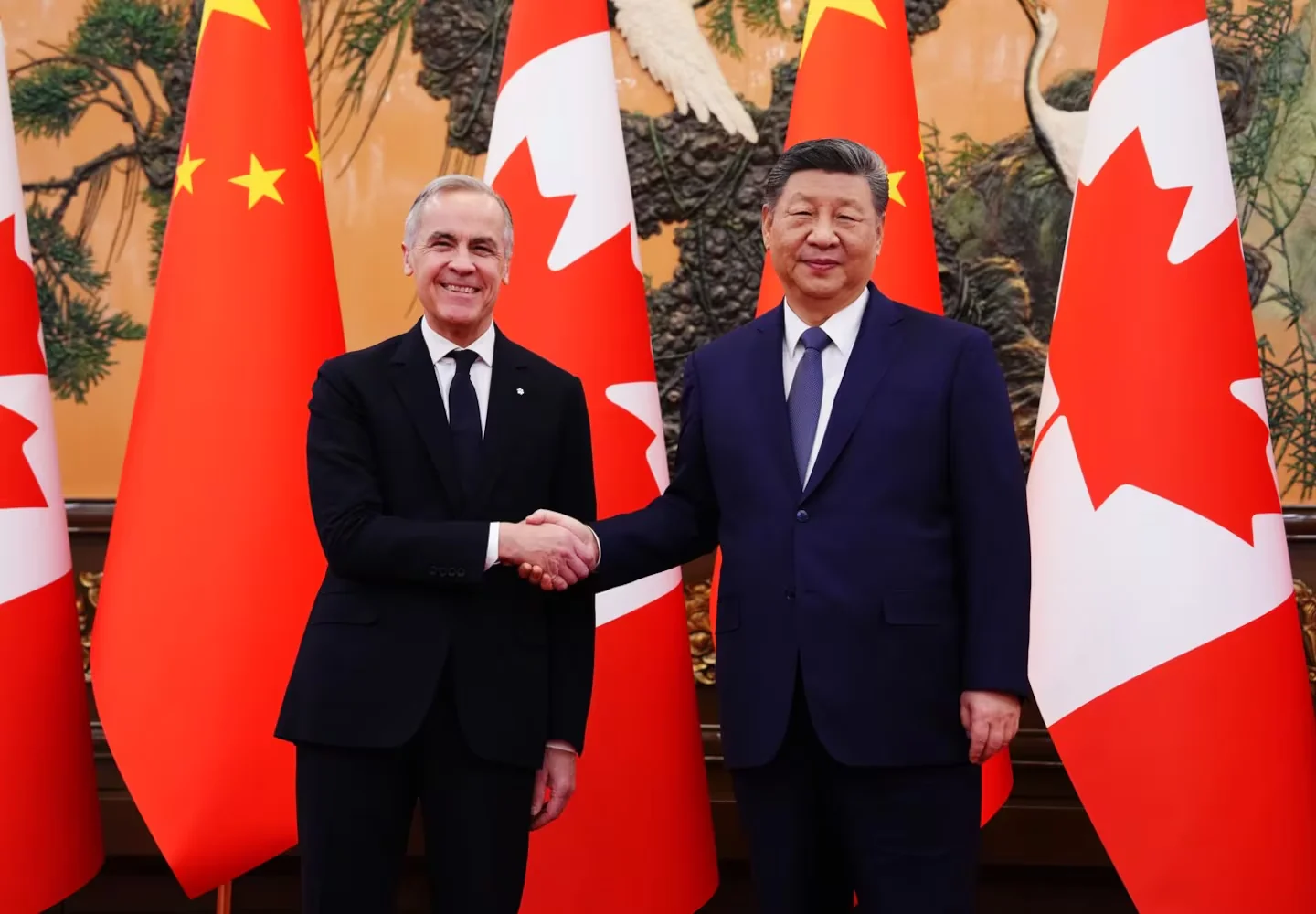 Prime Minister Mark Carney meets with President of China Xi Jinping at the Great Hall of the People in Beijing, China on Friday, Jan. 16, 2026. THE CANADIAN PRESS/Sean Kilpatrick
Prime Minister Carney has set a formal target to increase Canadian exports to China by 50% by the year 2030. Reaching this goal will require more than just maintaining current commodity shipments; it will necessitate deeper penetration into the Chinese domestic market. Economic analysts point to China’s latest five-year plan, which emphasizes boosting domestic consumption, as a potential roadmap for Canadian exporters.
Champagne’s meetings with high-level leaders in the financial sector are intended to identify areas where Canadian firms can capitalize on this shift toward consumer-led growth. However, the path to closing the trade gap is complicated by existing barriers. While the total volume of trade is rising, the deficit grew alongside it in 2025, suggesting that current growth is largely driven by Canadian demand for Chinese manufactured goods rather than a reciprocal surge in demand for Canadian products.
Electric vehicle quotas and agricultural access remain central to the bilateral deal
The current trade mission builds on specific concessions secured during the Prime Minister's visit in January. A cornerstone of that agreement was a quota for Chinese electric vehicles (EVs). Under the deal, Canada allowed 49,000 Chinese EVs into the country at a significantly reduced tariff rate of 6.1%, a sharp drop from the previous 100% rate.
In exchange for this market access, China agreed to reduce or remove tariffs on certain Canadian agricultural products, such as canola meal, through the end of 2026. This "interest-based" trade-off highlights the pragmatic nature of the current administration's approach. By facilitating lower-cost EVs, the government is attempting to meet domestic environmental targets while simultaneously securing relief for a critical agricultural sector that has historically been a target of Chinese retaliatory measures.
However, the arrangement is not all-encompassing. A 25% retaliatory tariff remains in place on Canadian pork, serving as a reminder of the friction that persists. One of Champagne’s tasks in Beijing is to manage these ongoing disputes while ensuring that the temporary relief for agricultural products can be extended or made permanent.
Diplomatic friction over forced labour persists despite economic alignment
Despite the focus on investment and supply chain integration, the visit takes place against a backdrop of domestic political pressure regarding human rights. Prime Minister Carney recently defended Canada’s rigorous engagements on the issue of forced labour, following controversy involving Liberal MP Michael Ma, who faced criticism for comments regarding labour practices in China.
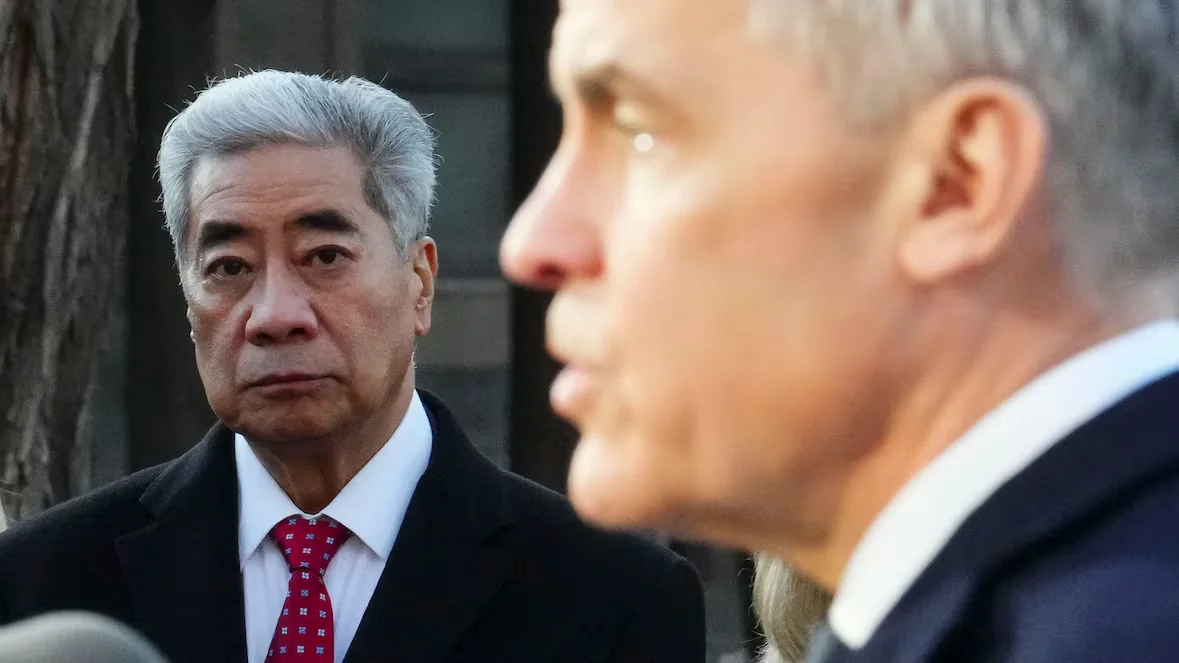 Liberal member of Parliament Michael Ma looks on as Prime Minister Mark Carney holds a news conference earlier this year. Ma joined the government side of the House in December. (Sean Kilpatrick/The Canadian Press)
Carney indicated that supply chain integrity would be a component of the discussions in Beijing. While Champagne has not explicitly detailed how he will raise these issues in his meetings, he reiterated the government’s position of condemning forced labour "in all its forms."
This tension reflects a broader challenge cited by international relations experts: the need to manage a relationship between two countries with fundamentally different political systems and values. As Canada seeks to stabilize its economic footing through Chinese engagement, it must simultaneously navigate the ethical constraints of its own supply chain regulations. The success of the mission will likely be measured by Champagne's ability to advance Canadian financial interests without appearing to sideline these persistent human rights concerns.
Comments (0)
Please login to comment
Sign in to share your thoughts and connect with the community
Loading...