

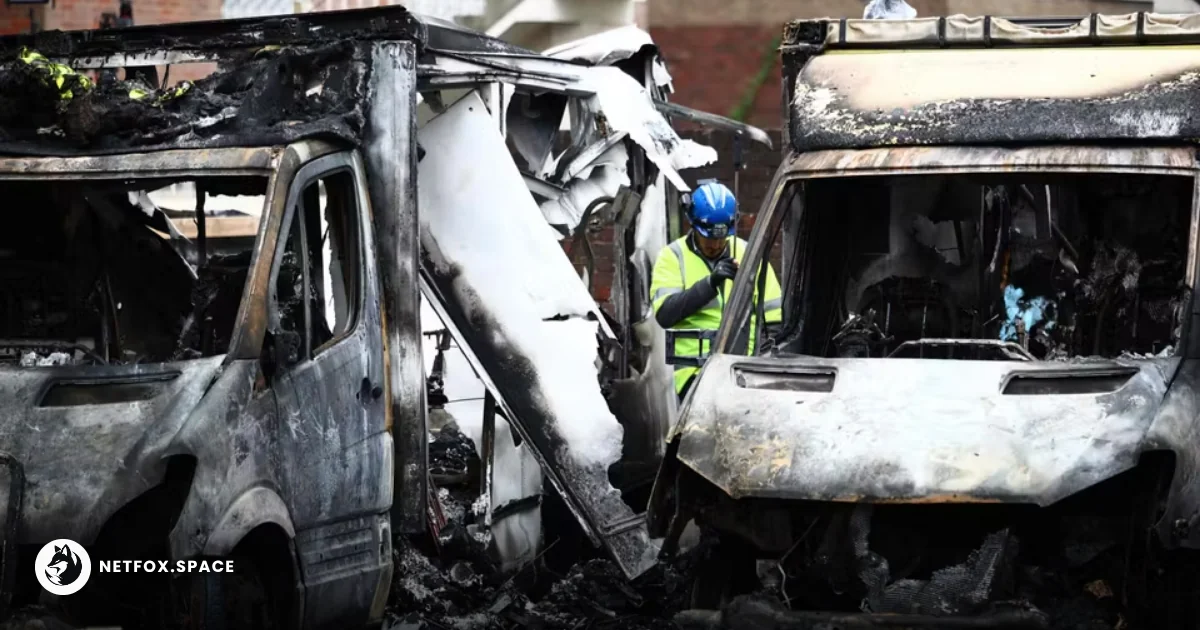
The deliberate torching of ambulances belonging to a Jewish charity in Golders Green has shifted from a local arson case to a high-priority national security matter. Specialist officers are now examining the possibility that the attack was orchestrated or encouraged by interests tied to the Iranian state.
Metropolitan Police Scrutiny of the Golders Green Incident
Early on March 24, 2026, multiple vehicles used by a Jewish medical organization were set ablaze in North London. While the initial response focused on criminal damage, the Metropolitan Police confirmed a probe into a possible Iran link following intelligence suggesting the targeting of community infrastructure. This investigation operates under the shadow of the National Security Act 2023, which provides expanded powers to counter foreign interference on British soil.
Past security assessments have noted a recurring pattern where state actors utilize local criminal elements as proxies to conduct low-level but high-impact intimidation. In this instance, the choice of a medical charity indicates a move toward "soft" targets that require minimal logistics but generate significant community fear.
Assessing the Hybrid Threat Signal
Security analysts are framing the arson within a broader surge of unconventional operations across Western Europe. An ICCT assessment of recent attacks suggests that these incidents often lack the direct signature of professional intelligence officers, instead relying on "deniable" arson or vandalism. This method complicates the diplomatic response, as attributing the act to a sovereign state requires a high threshold of forensic and digital evidence.
The current investigation is tracing a tangled web of communications and finance that reportedly connects the London perpetrators to intermediaries in third-party countries before terminating in Tehran. Institutional memory within the UK’s counter-terrorism command (SO15) points to the 2024 warnings regarding threats against Iranian dissidents in London as a precedent for this type of external targeting.
Regulatory and Diplomatic Friction
The use of proxies provides what officials describe as a layer of insulation for the Iranian Islamic Revolutionary Guard Corps (IRGC). This creates a specific tension within the UK’s Integrated Review of security and foreign policy. If the link to the Golders Green attack is proven, it would force a reassessment of the IRGC's status under UK proscription laws—a move that has been debated in Parliament for several years without a final resolution.
Financial metrics associated with these operations often involve small, fragmented transfers through informal value transfer systems (IVTS) like Hawala, making them difficult for standard banking regulations to flag. Investigators are currently reviewing CCTV and localized cell tower data to identify the specific individuals who executed the arson, while the Foreign, Commonwealth & Development Office (FCDO) monitors the diplomatic fallout.
A key tension point remains the upcoming briefing of the Intelligence and Security Committee of Parliament, where the Home Office is expected to present its findings on whether this arson constitutes a breach of the "red lines" established during the 2025 diplomatic de-escalation talks.
Comments (0)
Please login to comment
Sign in to share your thoughts and connect with the community
Loading...