


The Florida Legislature has moved to approve a new congressional map that could expand Republican representation by up to five seats, a strategy bolstered by strong public support from House Speaker Paul Renner. This mid-decade redistricting effort hinges on a legal argument that rapid population growth has rendered current boundaries unconstitutional.
Legislative and Executive Unity on a New Map Defense
The recent approval of a revised congressional map by the Florida Legislature marks a significant escalation in Governor Ron DeSantis' long-term redistricting strategy. Central to this development is the public endorsement from Florida House Speaker Paul Renner, who has characterized the effort as "doing the right thing" for the state's residents. Renner, a prominent candidate for the 2026 gubernatorial race, has increasingly aligned himself with the Governor’s office on matters of constitutional interpretation, suggesting a coordinated front between the executive and legislative branches.
This alignment is more than a standard party-line vote; it represents a shared legal defense of the legislature's role in map-drawing against what both leaders describe as judicial overreach. By backing the new maps, Renner is signaling to the Republican base that he intends to maintain the DeSantis administration's aggressive posture toward redistricting, which has already successfully dismantled several historically Democratic-leaning districts in previous cycles.
 Rep. Byron Donalds of Naples speaks during CPAC Latino 2025 at Seminole Hard Rock Hotel & Casino in Hollywood, Fla., on June 28, 2025. He is running for Florida governor in the 2026 election. (Al Diaz/Miami Herald/Tribune News Service)
The Malapportionment Argument as a Legal Mechanism
The technical justification for redrawing maps in 2026 only four years after the 2022 cycle relies on the concept of malapportionment. Proponents of the shift, including Renner, argue that the influx of millions of new residents since the 2020 Census has created a "one person, one vote" imbalance. Under this theory, the state's 28 congressional seats are no longer "roughly equal" in population, necessitating an immediate correction rather than waiting for the 2030 Census.
Critics, however, point out that Florida’s Fair Districts amendments, passed by voters in 2010, were intended to prevent such mid-decade changes and partisan advantage-seeking. The administration’s counsel has countered this by suggesting that federal constitutional standards regarding equal protection and malapportionment supercede state-level restrictions. This represents a significant shift in legal interpretation, moving away from the "non-diminishment" standards that previously protected minority-access districts in North Florida.
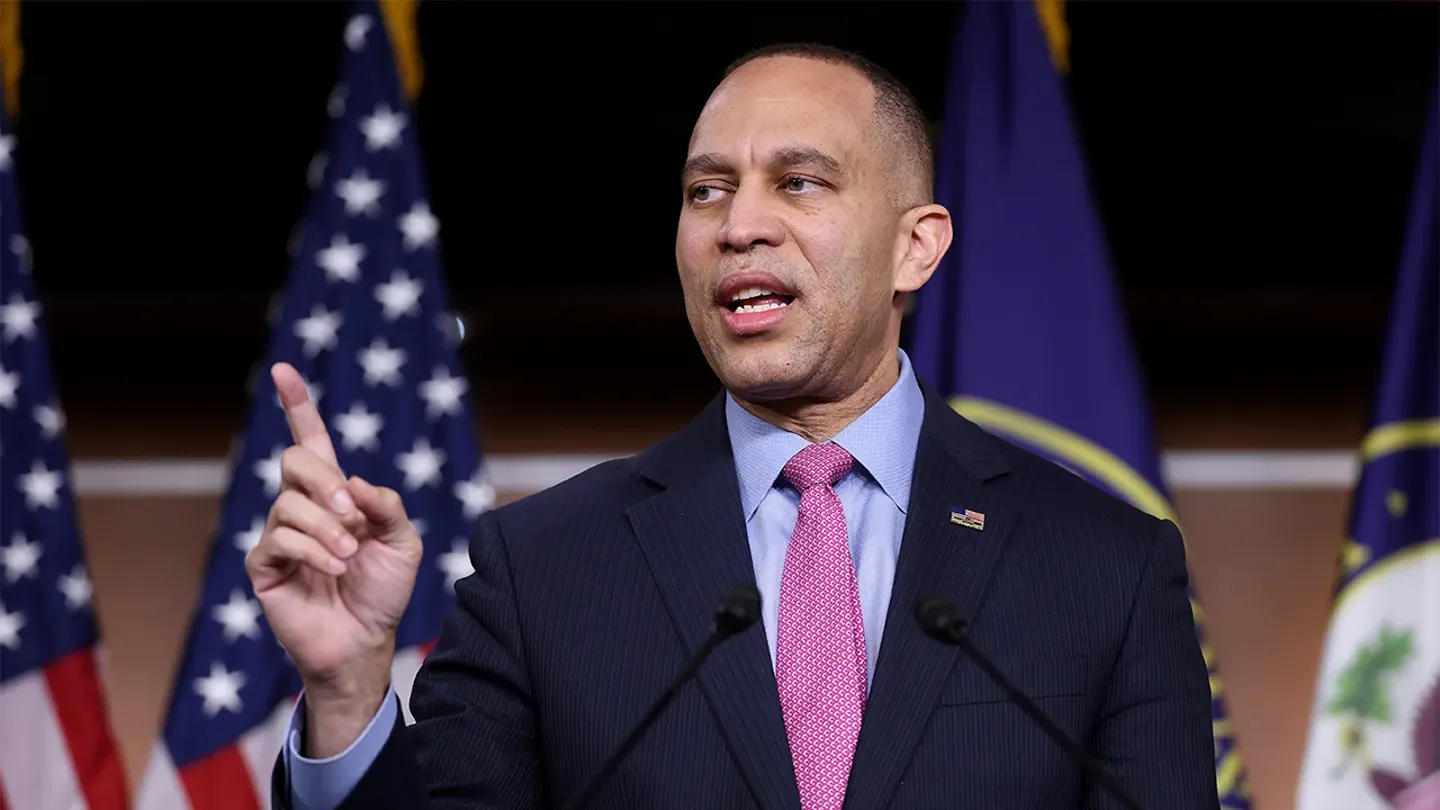 House Minority Leader Hakeem Jeffries speaks at a press conference on Department of Homeland Security funding at the U.S. Capitol in Washington, D.C., on Feb. 4, 2026. (Kevin Dietsch/Getty Images)
Political Implications for the 2026 Gubernatorial Cycle
For Paul Renner, the decision to champion these maps carries substantial political weight. As he prepares to potentially succeed DeSantis, his support for the redistricting fight serves to solidify his credentials as a defender of the GOP's structural power in the state. The new map is projected to net the Republican party up to four or five additional seats in the U.S. House, a shift that would have national implications for the balance of power in Washington.
This move also serves to insulate Renner from primary challenges that might paint him as less confrontational than the current governor. By adopting the Governor's rhetoric regarding "gypped" representation and the need for "normal" maps, Renner is positioning himself as the ideological heir to the DeSantis era. However, this strategy is not without risk, as it ties his political future to the outcome of inevitable court challenges that will test the validity of ignoring state constitutional amendments in favor of federal theories.
 Gov. Gavin Newsom speaks on stage during "Networth And Chill With Guest Governor Gavin Newsom" at the 2026 SXSW Conference and Festival at the Hilton Austin in Austin, Texas, on March 15, 2026. (Gary Miller/FilmMagic)
Conflict Between State Protections and Federal Precedent
The core of the upcoming legal battle lies in the tension between the Fair Districts amendments and recent U.S. Supreme Court rulings. The DeSantis administration argues that maintaining specific minority-access districts, such as the former configuration of District 5, constitutes "race-predominant" gerrymandering that violates the 14th Amendment’s Equal Protection Clause.
The Florida Supreme Court, which is currently dominated by DeSantis appointees, has already shown a willingness to uphold the elimination of majority-Black districts based on this logic. By introducing a new map now, the GOP-led legislature is forcing a new round of litigation that could eventually reach the U.S. Supreme Court, potentially setting a national precedent that weakens state-level "fair map" protections in favor of a narrower interpretation of federal voting rights.
Unresolved Legal and Procedural Questions
Despite the rapid passage of the maps, several operational uncertainties remain. Legislators were reportedly "in the dark" regarding the specific details of the Governor's proposal until shortly before the special session began. This lack of transparency has been a focal point for voting rights groups, who argue that the process denies voters a meaningful choice and violates the spirit of a transparent redistricting process.
Furthermore, the timing of the map's implementation just before the 2026 primary qualifying deadlines creates a compressed schedule for the judiciary to review the changes. If the courts do not issue a stay, the 2026 midterm elections will proceed under these new boundaries, potentially locking in a GOP advantage regardless of the final legal outcome. This "facts on the ground" approach has been a hallmark of Florida's redistricting battles over the last four years, often leaving opponents to litigate districts that have already been used to seat representatives.
What remains to be seen is how the Florida Supreme Court will handle the specific challenge to mid-decade redistricting. While they have upheld the content of the 2022 maps, they have not yet issued a definitive ruling on the authority of the legislature to redraw lines outside of the decennial window. The outcome of that specific procedural question will determine whether Florida's redistricting process becomes a permanent, rolling exercise in political realignment.
Comments (0)
Please login to comment
Sign in to share your thoughts and connect with the community
Loading...