


The International Energy Agency (IEA) has warned that Europe maintains only "six weeks or so" of jet fuel supplies, with widespread flight cancellations anticipated by late May if the Strait of Hormuz remains obstructed. IEA Executive Director Fatih Birol describes the current situation as the most severe energy crisis in history, characterized by a fundamental breakdown in the global distribution of petroleum and liquid natural gas.
European aviation faces a hard supply ceiling by late May
The timeline for European fuel exhaustion is governed by a combination of current reserve levels and the total cessation of inbound shipments from Persian Gulf refineries. Birol indicated that without a permanent reopening of the waterway, the cessation of commercial flights between major European cities is a near-term certainty.
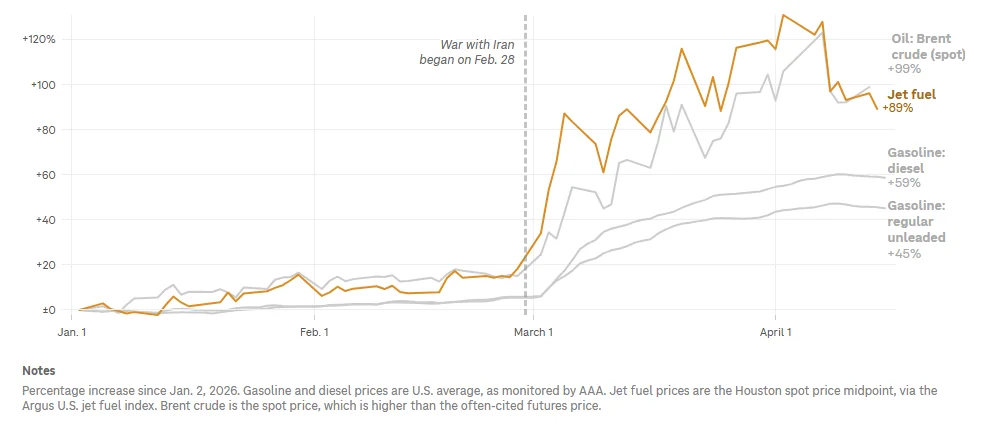 Source: Gasoline and diesel prices: AAA; Jet fuel: Argus Media group; Brent crude: U.S. Energy Information Administration. Credit: Brent Jones/NPR
While many nations maintain Strategic Petroleum Reserves (SPR) of crude oil, jet fuel is a refined product with a significantly more fragile supply chain. European airports and airlines typically operate on "just-in-time" delivery schedules for kerosene-type fuel. The current blockade does not merely raise prices; it removes the physical molecule from the European market. Government leaders have privately communicated to the IEA that a failure to restore transit by the end of May will trigger "huge challenges," ranging from hyper-inflation to localized economic recessions.
Infrastructure damage necessitates a two-year recovery window
A critical finding from the IEA’s assessment is that a diplomatic resolution to the Iran war will not provide immediate relief to energy markets. Birol reported that over 80 key energy assets in the Persian Gulf region have sustained damage during the conflict. Of these, more than one-third are categorized as "severely or very severely damaged."
This destruction affects the midstream infrastructure—pumping stations, refineries, and loading terminals—required to process and export fuel. Consequently, the IEA estimates it will take up to two years to restore production to pre-war levels. This long-term impairment suggests that even if the Strait is cleared of military threats, the scarcity of refined products will persist due to the physical destruction of processing capacity. For aviation, this implies a period of sustained high costs and limited capacity that extends well beyond the current geopolitical flashpoint.
The 'toll booth' precedent threatens global trade norms
The IEA head expressed specific concern regarding Iran's implementation of a fee-based transit system for the Strait. Birol warned that allowing a "toll booth" model to persist creates a dangerous precedent for international maritime law. If a fee-for-passage system is normalized in the Persian Gulf, it could be applied to other vital maritime chokepoints, such as the Malacca Strait in Southeast Asia.
 International Energy Agency Executive Director Fatih Birol speaks at the National Press Club in Canberra, Australia, Monday, March 23, 2026. (Lukas Coch/AAP Image via AP)
The prospect of a permanent shift in how international waterways are governed coincides with a warning of a potential blockade response from U.S. political figures. Birol argued that oil must flow unconditionally between trading partners to maintain economic stability. The current disruption has already shifted the global energy map, forcing nations to reconsider nuclear power and alternative technologies as domestic domestic fuel price surges continue to pressure Western governments.
Developing nations face the highest economic risk
While European flight cancellations are the most visible symptom of the crisis, Birol emphasized that the deepest economic suffering will occur in developing nations. Poorer countries in Africa, Asia, and Latin America lack the capital to compete for dwindling energy supplies on the spot market. These regions are facing a "dark shadow" of geopolitics that impacts basic electricity and heating costs.
Nearly 20% of the world's traded oil passes through the Strait of Hormuz. The current bottleneck has trapped over 110 oil-laden tankers and 15 liquefied natural gas (LNG) carriers within the Persian Gulf. Even if these vessels are eventually released, they represent a one-time relief valve rather than a sustainable solution to the underlying supply deficit. The IEA’s warning serves as a pragmatic acknowledgement that the global economy is currently held hostage by a localized military presence, with no immediate alternative for the volume of energy lost.
Comments (0)
Please login to comment
Sign in to share your thoughts and connect with the community
Loading...