

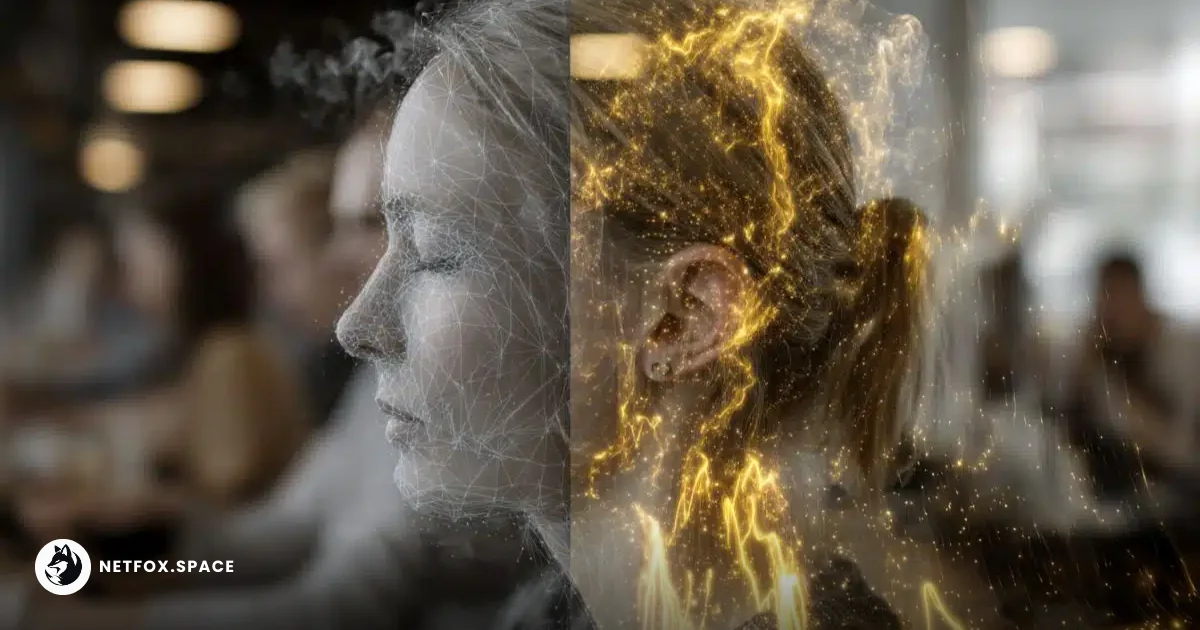
The Mechanism of Cross-Modal Sensory Suppression
Recent experimental data from the Max Planck Institute for Human Cognitive and Brain Sciences has upended the long-held "sensory compensation" theory. While it was previously assumed that shutting off one sense vision would sharpen another hearing researchers discovered that eye closure actually decreases the sensitivity of the auditory system.
The study involved participants detecting faint sounds in a controlled environment. Results indicated that when eyes were closed, the neural threshold for sound detection rose, meaning sounds had to be louder to be consciously perceived. This suggests that the brain’s sensory systems are not a zero-sum game of energy redirection, but rather a complex, integrated network where activity in one area supports the "alertness" of another.
Disruption of Alpha Oscillations and Auditory Gating
The biological root of this phenomenon lies in brain wave activity, specifically Alpha oscillations. When a person closes their eyes, Alpha power increases in the visual cortex, signaling a "resting" or "idling" state. However, this study demonstrates that these waves don't remain isolated; they bleed into the auditory processing regions.
This neural "noise" effectively acts as a filter, muffle-detecting incoming acoustic signals. The Max Planck researchers used electroencephalography (EEG) to track these shifts, noting that the brain's internal state during eye closure creates a barrier for external stimuli. Instead of focusing more on the ears, the brain enters a state of internal reflection that deprioritizes external inputs across the board.

The "Ocular-Acoustic Bridge": What Competitors Are Not Discussing
While most coverage focuses on the simple fact of "hearing less," the deeper implication involves the evolutionary purpose of the Ocular-Acoustic Bridge. This study implies that the human brain is optimized for "multi-modal" alertness; essentially, the brain is most sensitive to environmental threats when all sensory gates are open.
By closing the eyes, the organism signals to the central nervous system that it is withdrawing from the environment. This isn't just a visual choice; it is a systemic shift into a "low-power" or "protected" state. This contradicts the popular "superhero" trope where a blind or eye-closed individual develops heightened hearing. In reality, the absence of visual stimulation may lead to a specialized form of sensory "brownout" that protects the brain from overstimulation during rest.
Implications for the Global Health Sector and Audiology
These findings have immediate consequences for the Clinical Audiology and Environmental Health sectors. Standard hearing tests are often conducted in soundproof booths where patients might instinctively close their eyes to "concentrate." This research suggests such a practice could lead to inaccurate diagnostic data, as the patient's hearing threshold is artificially raised by the act of eye closure itself.
Furthermore, in the field of Occupational Health, this reveals a hidden risk for workers in high-noise environments. If fatigue leads to frequent blinking or prolonged eye closure, their ability to detect auditory warning signals (sirens, verbal commands, or equipment failure noises) may be significantly compromised, even if their ears are physically healthy.
| Condition | Visual State | Neural Response | Auditory Sensitivity |
|---|---|---|---|
| Active Monitoring | Eyes Open | Low Alpha Power | Peak Sensitivity |
| Sensory Withdrawal | Eyes Closed | High Alpha Power | Muffled/Reduced |
| Environmental Noise | Eyes Open | High Selective Attention | Targeted Sensitivity |
| Internal Reflection | Eyes Closed | Global Alpha Synchronization | Generalized Suppression |
The Shift Toward Integrated Sensory Diagnostics
The next phase of this research will likely move into the Neuromorphic Engineering and Virtual Reality (VR) industries. As developers create immersive environments, understanding that "turning off" the visual feed might inadvertently dampen the effectiveness of spatial audio is crucial for maintaining realism and user safety.
We are moving toward a period where sensory health is no longer viewed through isolated silos optometry vs. audiology but as a unified cognitive load. Future diagnostic tools will likely require "eyes-open" protocols to ensure that the brain's processing power is measured at its true functional capacity rather than its resting state.
The volatility of neural thresholds suggests that our "hearing" is not a fixed physical attribute but a fluid state regulated by the orientation of our gaze and the state of our eyelids.
Comments (0)
Please login to comment
Sign in to share your thoughts and connect with the community
Loading...