
US Private Sector Hiring Slumps to 22,000 in January 2026

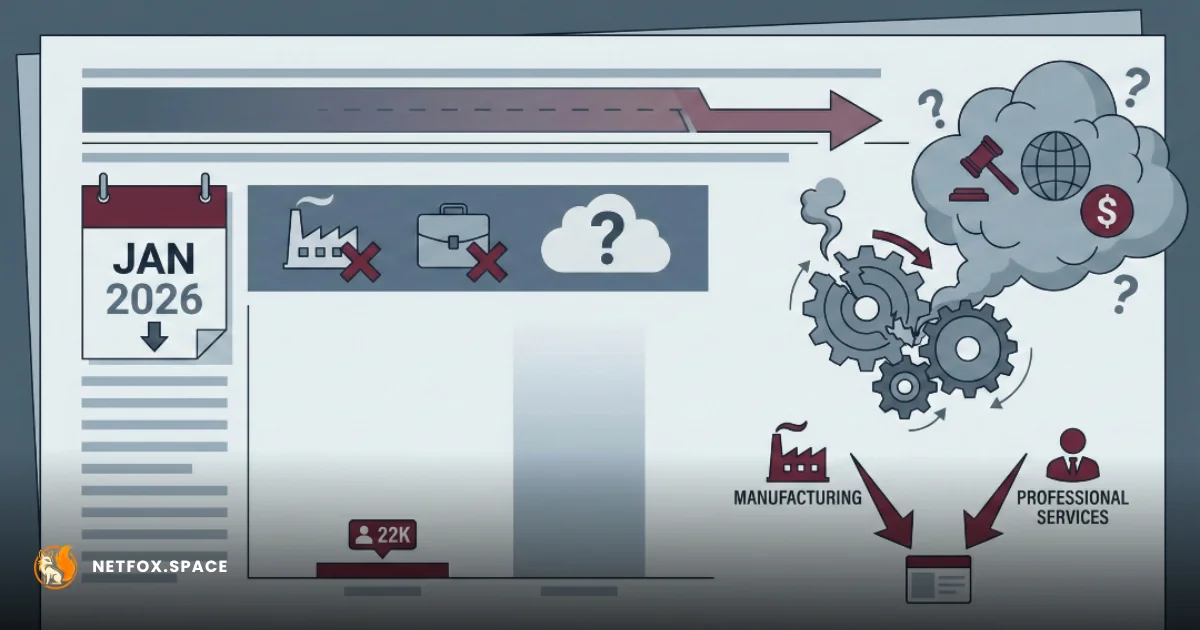
The American labor market ground to a near-standstill in January, as private-sector employers added a mere 22,000 jobs—falling significantly short of the 45,000 roles analysts had forecast. Data released by payroll giant ADP on February 4, 2026, paints a picture of a "lackluster" economy where heavy losses in manufacturing and professional services nearly offset gains in healthcare, leaving the national workforce in a state of fragile equilibrium.
The figures represent a sharp deceleration from December’s downwardly revised 37,000 jobs, signaling that the "no hire, no fire" environment that defined late 2025 has followed the U.S. into the new year.
Healthcare Standout Fails to Mask Industrial Bleeding
The headline figure of 22,000 masks a deeply fragmented economy. If not for a robust 74,000-job gain in the Education and Health Services sector, the U.S. private sector would have recorded a net loss for the month.
Behind the scenes, the "goods-producing" side of the economy is in a sustained retreat. Manufacturing shed another 8,000 positions in January, continuing a grim streak of monthly job losses that began in March 2024. Simultaneously, the Professional and Business Services sector—a traditional engine of white-collar employment—plummeted by 57,000 jobs, its worst performance in over 18 months.
The Tariffs and Automation Squeeze
The "So-What" factor driving this stagnation appears to be a toxic mix of trade uncertainty and rapid technological shifts. Business leaders have increasingly pulled back on expansion plans as the "Liberation Day" tariffs continue to complicate global supply chains and inflate input costs.
Critics argue that the hiring freeze is also a symptom of the AI revolution finally reaching a tipping point. As companies integrate autonomous systems to handle administrative and support functions, the need for human "replacement" hiring has evaporated. ADP Chief Economist Nela Richardson noted that with turnover at historic lows, many firms are simply choosing not to backfill roles, leading to a "continuous and dramatic slowdown" that has now lasted three years.
 No jobs in market today
A Growing Transatlantic Stagnation
The American slump is part of a broader, more worrying international trend of workforce detachment. While the U.S. struggles with a "low-hire" corporate culture, other major economies are facing structural collapses in their future talent pools. This mirrors the UK youth inactivity crisis, where a "lost generation" of over one million young people has exited the workforce entirely.
In both regions, the data suggests that the post-pandemic labor market has become disconnected. While U.S. wage growth for those who stayed in their jobs remained stable at 4.5%, the lack of entry-level opportunities and the rising bar for "AI-immune" skills are creating a permanent class of the underemployed.
Wage Stability Amidst the Hiring Freeze
Despite the hiring slump, those already in the workforce are seeing steady paychecks. Annual pay growth for "job-stayers" held firm at 4.5%, while those who managed to switch roles saw an annualized pay increase of 6.4%.
The move toward higher pay for existing staff—often described as "spreading raises like peanut butter"—suggests that companies are prioritizing retention over growth. Mid-sized firms (50–499 employees) were the only group to show net gains, while large employers (500+ employees) slashed 18,000 positions, further reflecting a "leaner" corporate strategy in the face of 2026's economic headwinds.
The focus now shifts to the Federal Reserve, which is expected to weigh this lackluster data during its next policy meeting. With the labor market cooling faster than anticipated, the possibility of a March interest rate cut has moved firmly back into the spotlight as policymakers attempt to prevent a slow-motion hiring freeze from turning into a broader recession.
Comments (0)
Please login to comment
Sign in to share your thoughts and connect with the community
Loading...