

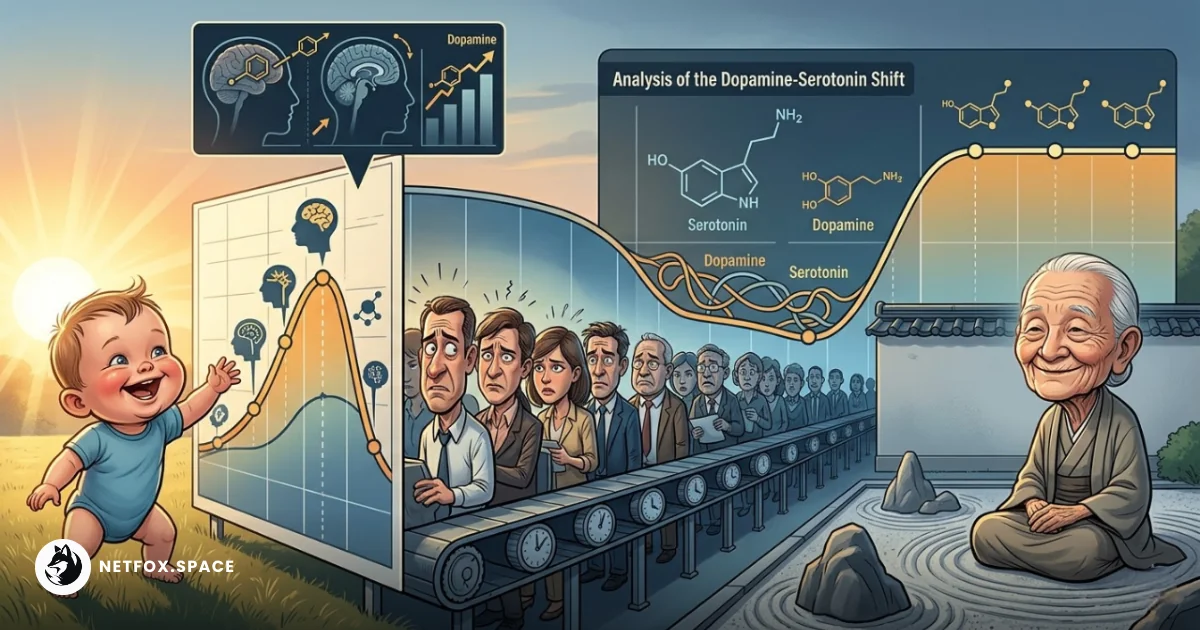
The First Peak: The Dopaminergic Explosion of Childhood
From the "first cry" in the delivery room to the explorative play of the toddler years, childhood represents the most intensive period of synaptic plasticity in the human lifecycle. In the neuroscience sector, 2026 research has pinpointed that the "wonder" associated with childhood isn't just a sentiment; it is a physiological flood of dopamine triggered by a high frequency of "novelty events."
During this phase, the brain is optimized for absorption, creating a "happiness baseline" that is high but fragile. The primary driver of fulfillment here is the external feedback loop—the immediate safety and validation provided by caregivers. This period sets the emotional blueprint for what the individual will perceive as "safety" for the next eight decades.
The Mid-Life Trough: The Paradox of Productivity
As individuals transition into the labor market and family-building years (ages 30–50), global data consistently reveals a "U-curve" dip in reported life satisfaction. This systemic shift is often attributed to the "high-stakes responsibilities" of the middle years, where the brain transitions from a state of discovery to a state of maintenance and risk mitigation.
In this stage, the cortisol-to-dopamine ratio often skews toward stress. The "happiness" of this period is often redefined as "achievement" or "stability," but internal fulfillment frequently lags. It is the phase where the wellness industry sees its highest engagement, as individuals attempt to replicate the chemical ease of their younger years through external interventions.
The Serotonin Pivot: Why Late-Life Happiness Outpaces Youth
The mandatory differentiation in the modern study of aging is the "Positivity Effect"—a cognitive shift where the aging brain begins to prioritize emotionally gratifying information over negative stimuli. Contrary to the "decline" narrative, the gerontology sector now recognizes that the elderly often report higher levels of "stable happiness" than twenty-year-olds.
What competitors and traditional media often miss is the Amigdala-Frontal Cortex decoupling. As we age, the brain's "threat detector" (the amygdala) becomes less reactive to social stressors. This creates a biological foundation for the "smile of old age"—a state of serotonergic calm where happiness is derived from internal synthesis rather than external acquisition. This is the structural explanation for the "contentment of the elder," which is chemically distinct from the "excitement of the child."
The Final Smile: The Neuro-Chemistry of Passing
The phrase "the smile after death" has moved from the realm of poetry into the biomedical research space. Recent studies on end-of-life neuro-discharges suggest that in the moments surrounding death, the brain may experience a surge of endogenous opioids and DMT-like compounds.
This "neuro-surge" is theorized to be an evolutionary mechanism to ease the transition, often resulting in a relaxed facial expression known colloquially as the "final peace." This is not merely a muscular collapse but a systemic shutdown that prioritizes a final state of internal equilibrium. For the general public, understanding this as a biological certainty provides a significant "fear-reduction" benefit, reframing the end of life as a final, integrated peak of the happiness arc.
Systemic Shifts in 2026 Longevity Planning
The realization that happiness peaks at the ends of life is currently reshaping the financial planning and urban development sectors. We are seeing a move toward "intergenerational living modules" designed to pair the "high-novelty" energy of children with the "serotonergic stability" of the elderly.
As we move toward 2027, the focus of the lifestyle sector is shifting away from "anti-aging" (which views the end of the arc as a failure) toward "arc-optimization." The goal is no longer to stay young forever, but to accelerate the transition from the "stress-heavy middle" to the "wisdom-heavy end," ensuring that the "smile of old age" is a prolonged reality rather than a final moment.
Comments (0)
Please login to comment
Sign in to share your thoughts and connect with the community
Loading...