
Skywatcher’s Guide to the April 2026 Planet Parade and Lyrid Meteors

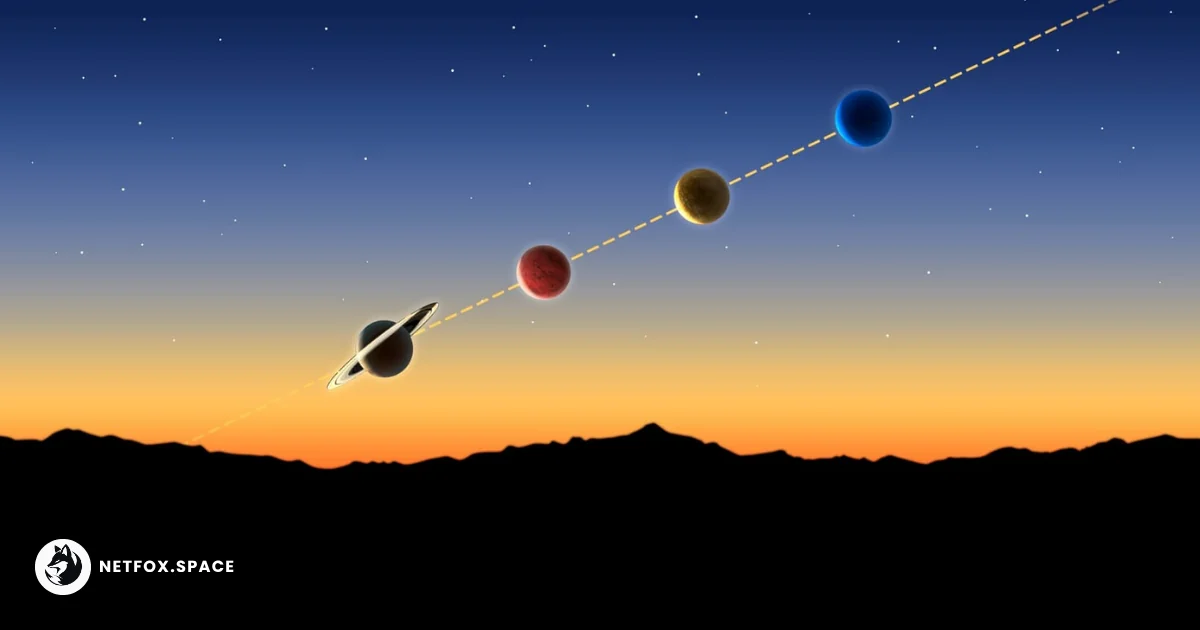
April 2026 offers two major highlights for amateur astronomers: a multi-planet alignment in the pre-dawn sky and the annual Lyrid meteor shower. While the planetary grouping is technically rare, visibility will vary significantly depending on your latitude and the quality of your eastern horizon.
Rare pre-dawn alignment of four planets peaks April 18
Between April 16 and April 23, Mercury, Mars, Saturn, and Neptune will cluster within a 10-degree sector of the sky. This grouping, often called a "planet parade," reaches the four-planet alignment peak around the morning of April 18. During this window, the planets will appear to form a rough line in the eastern sky shortly before sunrise.
Observing this event requires specific timing. While Mercury reaches Mercury’s greatest western elongation earlier in the month on April 3, it remains visible as it joins the other three bodies. Three of these—Mercury, Mars, and Saturn—are visible to the naked eye under clear conditions. Neptune, however, is far too faint for the naked eye and will require a telescope and a detailed sky chart to locate amidst the morning twilight.
Southern Hemisphere provides superior visibility for the alignment
The "parade" is not equally visible across the globe. For observers in the Northern Hemisphere, the alignment is a challenge because the planets sit very low on the horizon, rising only shortly before the Sun. The glare of the approaching dawn will likely wash out the fainter planets, particularly Saturn and the distant Neptune, for those at high northern latitudes.
In contrast, observers in the Southern Hemisphere will have a significantly better view. From locations like Australia, South Africa, or South America, the ecliptic—the path the planets follow—rises at a much steeper angle. This allows the planets to climb higher into a darker sky before sunrise, making the tight grouping much easier to distinguish. To see the alignment, find a location with an unobstructed view of the east-southeast horizon, such as a beach or a high clearing.
Lyrids meteor shower peaks under moonless pre-dawn skies April 22
Following the planetary alignment, the annual Lyrid meteor shower is scheduled to reach its Lyrid meteor shower peak during the late night of April 21 and the early morning of April 22. This shower occurs as Earth passes through the debris trail of the parent comet of the Lyrids, Comet C/1861 G1 (Thatcher).
The 2026 peak is particularly favorable for skywatchers because of the lunar cycle. The Moon will be a waxing crescent, roughly 44% illuminated, and is set to sink below the horizon after midnight. This leaves the prime viewing hours—from 2:00 AM local time until the first light of dawn—in total darkness. Under these conditions, rural observers can expect to see approximately 15 to 20 meteors per hour. The meteors appear to radiate from a point near the bright star Vega in the constellation Lyra, though they can flash across any part of the sky.
Comments (0)
Please login to comment
Sign in to share your thoughts and connect with the community
Loading...