

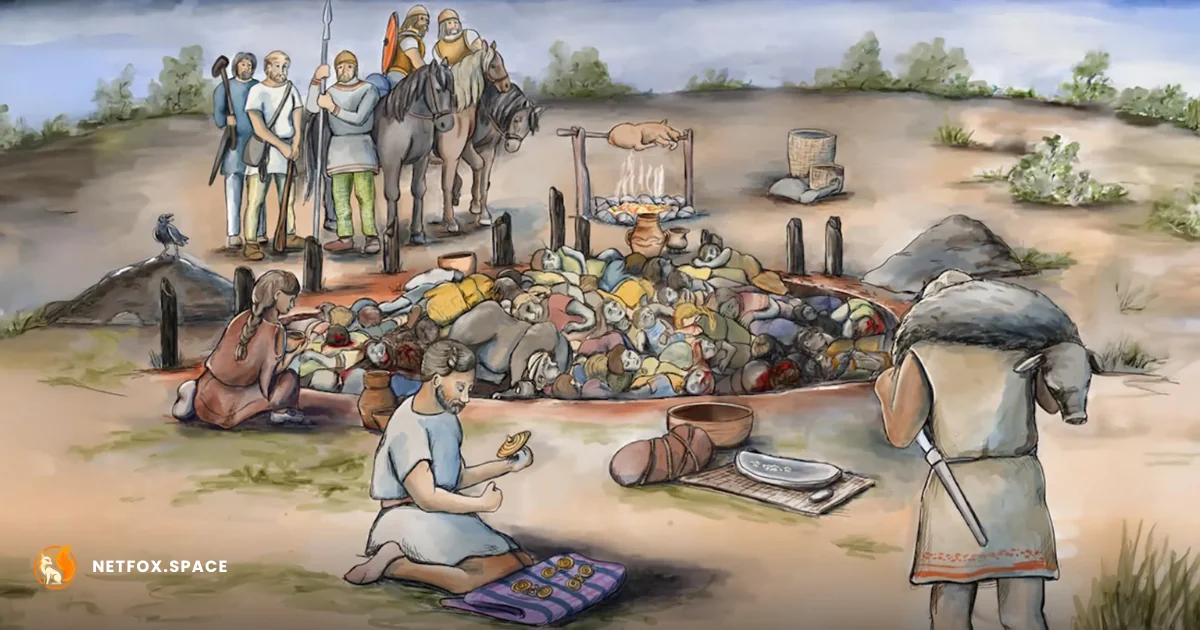
Discovery of the Mediana Prehistoric Mass Burial
Archaeologists have uncovered a significant prehistoric mass grave at the Mediana site near modern-day Niš, Serbia, dating back approximately 2,800 years. The site contains the remains of at least 77 individuals who were victims of a singular, high-intensity act of violence during the Early Iron Age.
The biological profile of the victims is highly specific, consisting primarily of women and children. Skeletal analysis reveals blunt-force trauma and perimortem injuries consistent with a deliberate execution-style event rather than a standard battlefield engagement. This find challenges previous assumptions about the scale and nature of tribal friction in the Balkan Peninsula during the first millennium BCE.
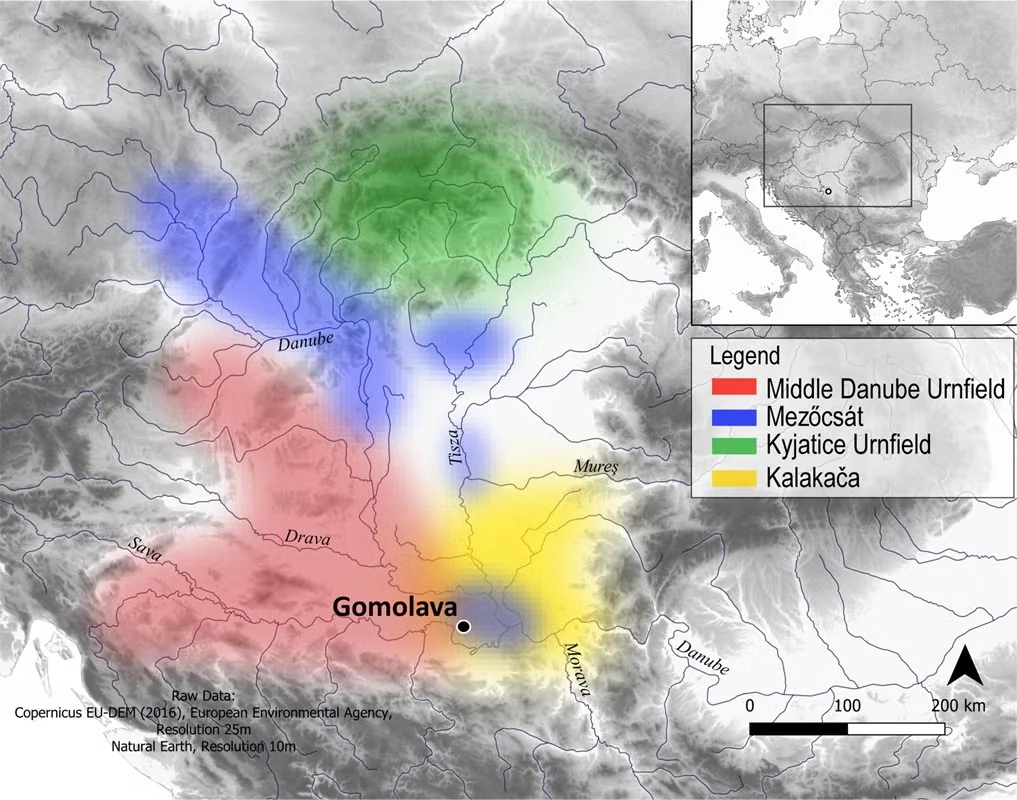 Map showing the location of Gomolava and the early first-millennium BC archaeological ceramic typo-chronology groups in the Southwest Carpathian Basin. (CREDIT: Caroline Bruyère and Hannes Schroeder)
Genetic Divergence Among the Victims
Recent ancient DNA (aDNA) analysis conducted on the remains suggests that the victims were not members of a single, isolated family unit. Instead, the genetic data indicates that the individuals belonged to multiple distinct communities across the region. This lack of biological relatedness between all victims suggests they were gathered from various settlements before their deaths.
The presence of diverse genetic markers within a single mass burial points toward a coordinated round-up. This indicates that the perpetrators specifically targeted certain demographics—women and children—across a wider geographic area to achieve a specific psychological or political outcome.
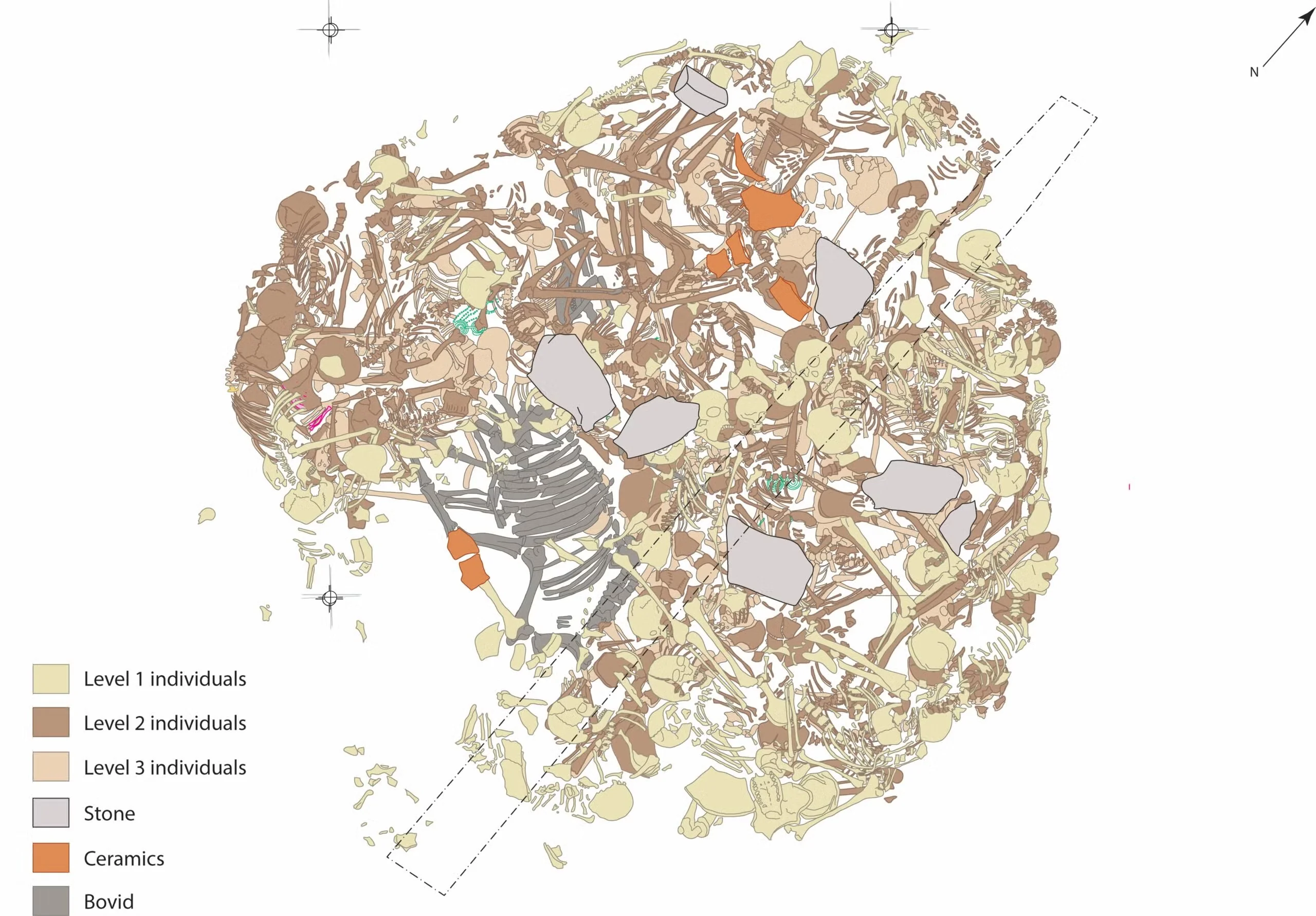 Burial plan of the human remains and finds from Gomolava mass burial 2. (CREDIT: Sara Nylund after Tasic 1972)
The Calculus of Symbolic Violence in Prehistoric Europe
While mass killings in the Neolithic or Bronze Age were often the result of resource desperation or sudden raids, the Mediana massacre represents a "calculated message" strategy. By deliberately sparing adult males and executing the vulnerable members of multiple rival groups, the attackers likely aimed to break the long-term demographic viability of their opponents.
This event marks a transition from "simple" warfare—fighting for immediate resources—to "symbolic" warfare, where the goal was the psychological subjugation or total erasure of a cultural identity. In the European Iron Age, as social hierarchies became more rigid and territorial boundaries more defined, such massacres served as a brutal deterrent to neighboring tribes attempting to encroach on fertile land or trade routes.
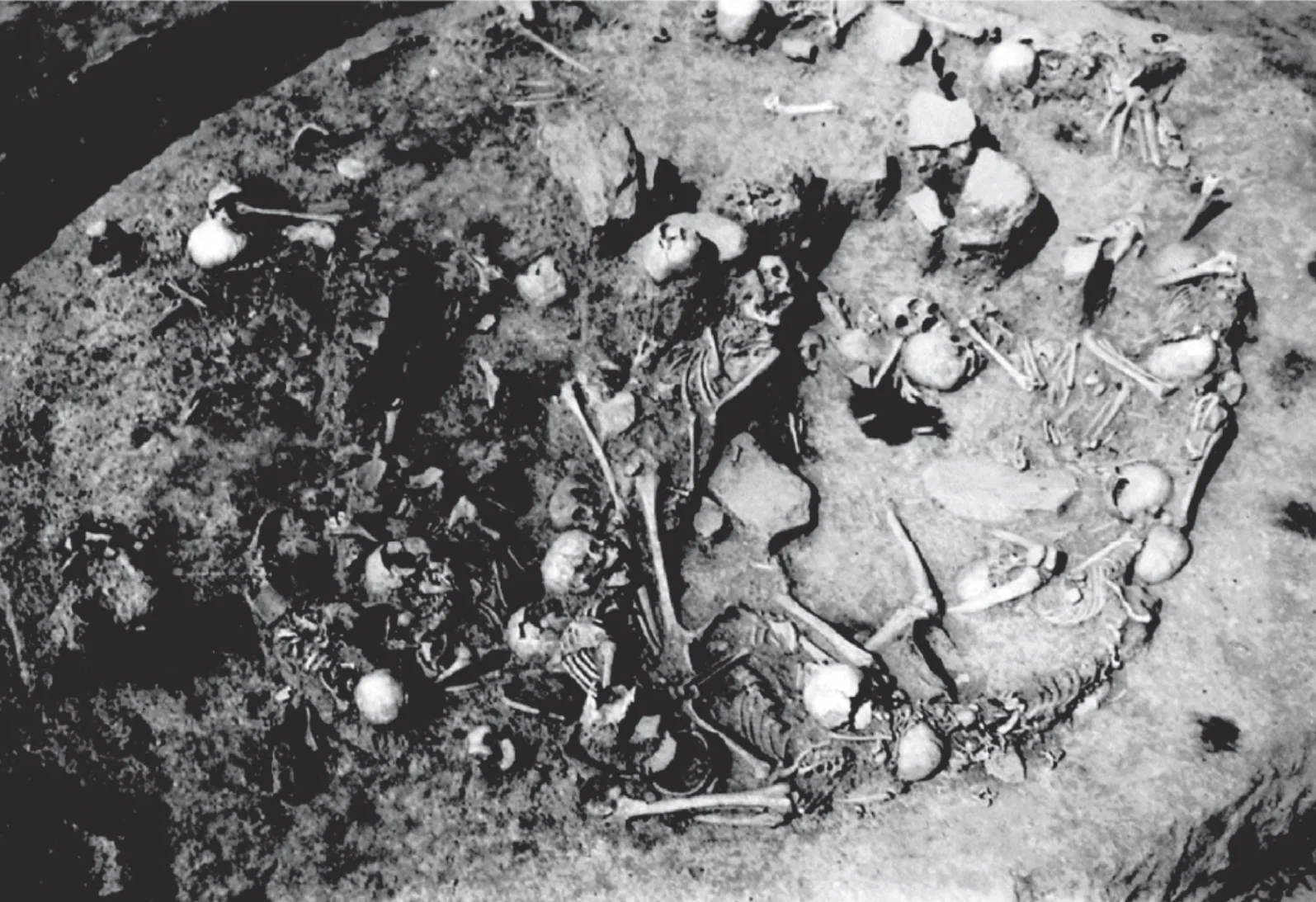 Photograph of the Gomolava mass burial (reproduced courtesy of the Museum of Vojvodina). Note that no scale was included in the original photograph. (CREDIT: Sara Nylund after Tasic 1972)
Escalation of Territorial Conflict in the Balkan Sector
The Balkan Iron Age was characterized by the rise of complex chiefdoms and increased competition for control over mineral-rich regions and trans-European transit corridors. The location of the grave in the Morava River valley—a primary north-south artery—suggests the massacre was tied to the control of this vital logistical path.
The systematic nature of the killings suggests a level of military organization previously underestimated for this period. To successfully capture and execute 77 people from various locations requires a disciplined force and a centralized command structure, signaling that the "warrior class" in early Central European societies had already evolved into a highly professionalized and lethal apparatus.
| Feature | Details of the Mediana Massacre |
|---|---|
| Estimated Date | ~800 BCE (Early Iron Age) |
| Body Count | Minimum 77 individuals |
| Primary Demographic | Women, infants, and adolescents |
| Cause of Death | Massive perimortem blunt force trauma |
| Geographic Significance | Morava River Valley, Central Serbia |
| Primary Implication | Transition to organized, symbolic tribal warfare |
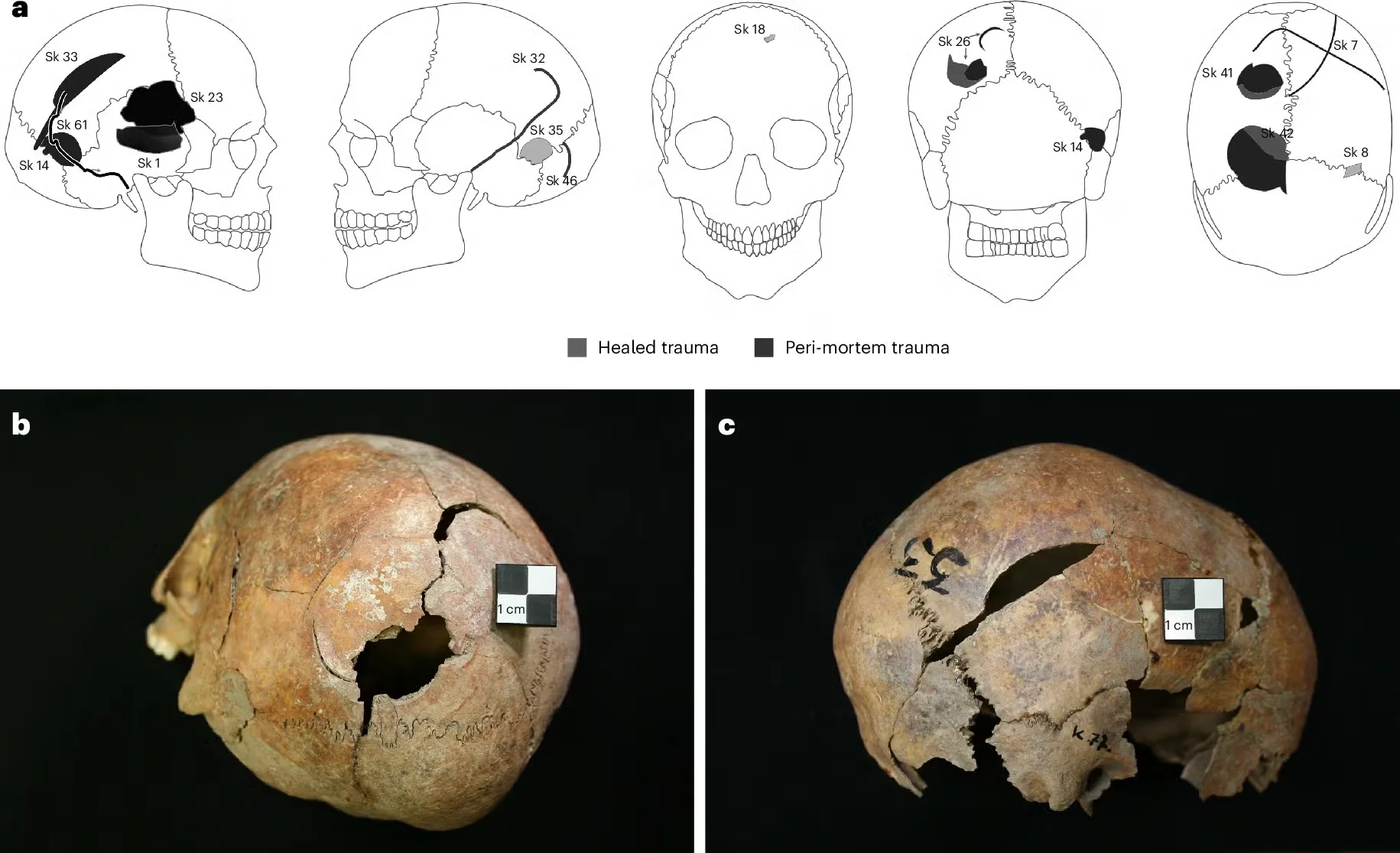 a–c, Distribution and examples of cranial injuries recorded at Gomolava (a), including Sk26 in posterior-lateral view (b) and Sk33 in right-lateral view (c); both individuals had sustained extensive peri-mortem injuries. (CREDIT: Nature Human Behaviour)
Structural Shifts in Iron Age Societal Security
The discovery forces a reassessment of the "pax" or relative stability often attributed to the early phases of the Iron Age in the Balkans. It highlights a period of extreme social volatility where the traditional protections of kinship were superseded by the requirements of territorial expansion and tribal dominance.
As archaeological teams expand their survey of the surrounding region, the focus shifts to finding the settlements these victims originated from. The absence of defensive fortifications at contemporary sites in the immediate area suggests that these communities were caught in a moment of transition—unable to protect themselves against a new, more aggressive form of organized violence that would eventually define the rise of the great European tribal confederations.
Comments (0)
Please login to comment
Sign in to share your thoughts and connect with the community
Loading...