
2026 Eta Aquarid Meteor Shower: Peak Times and Viewing Guide


The 2026 Eta Aquarid meteor shower will reach its peak on the night of May 5 and the early morning of May 6, offering a chance to see debris from the famous 1P/Halley comet. While the shower is known for its high speed and persistent glowing "trains," observers this year must contend with significant interference from a bright waning gibbous moon.
The 2026 peak coincides with a waning gibbous moon
The primary challenge for the 2026 Eta Aquarids is the timing of the lunar cycle. Because the moon reached its full phase on May 1 the first of two full moons this month it will still be roughly 84% illuminated during the shower’s peak. This bright light will drown out the fainter meteors that constitute the bulk of the display.
Practitioners suggest that the best strategy for 2026 is to position oneself in a "lunar shadow." By placing a physical obstruction, such as a building, a thick group of trees, or a hill, between your line of sight and the moon, you can reduce the direct glare. This helps maintain dark adaptation in your eyes, allowing you to catch the brighter meteors that would otherwise be lost to the sky's overall brightness.
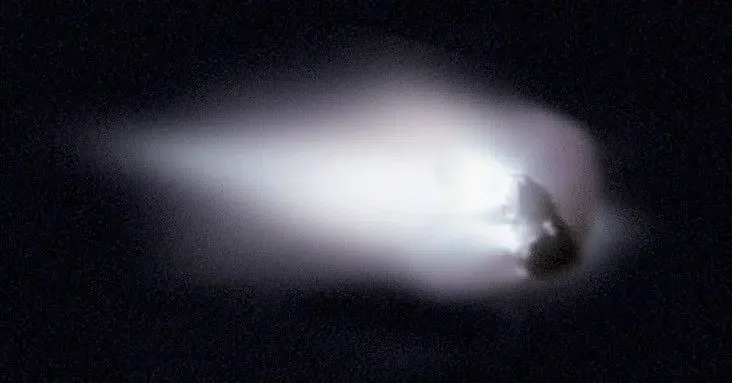 In 1986, the European spacecraft Giotto became one of the first spacecraft to encounter and photograph the nucleus of a comet, passing and imaging Halley’s nucleus as it receded from the Sun. Halley Multicolor Camera Team, Giotto Project, ESA
Debris from Halley’s Comet creates the annual May display
The Eta Aquarids are not composed of new material but are the result of Earth passing through a stream of ice and dust left behind by Halley’s Comet centuries ago. Halley’s Comet follows an elliptical orbit that intersects Earth’s path at two distinct points. The May passage creates the Eta Aquarids, while a second passage in October results in the Orionid meteor shower.
These particles enter the atmosphere at approximately 66 kilometers per second. This extreme velocity is responsible for the shower's signature "trains" incandescent bits of debris that remain visible for several seconds after the meteor itself has vanished. In 2026, these persistent trains may be the most visible feature for observers, as they often remain bright enough to be seen even through moderate light pollution or moonlight.
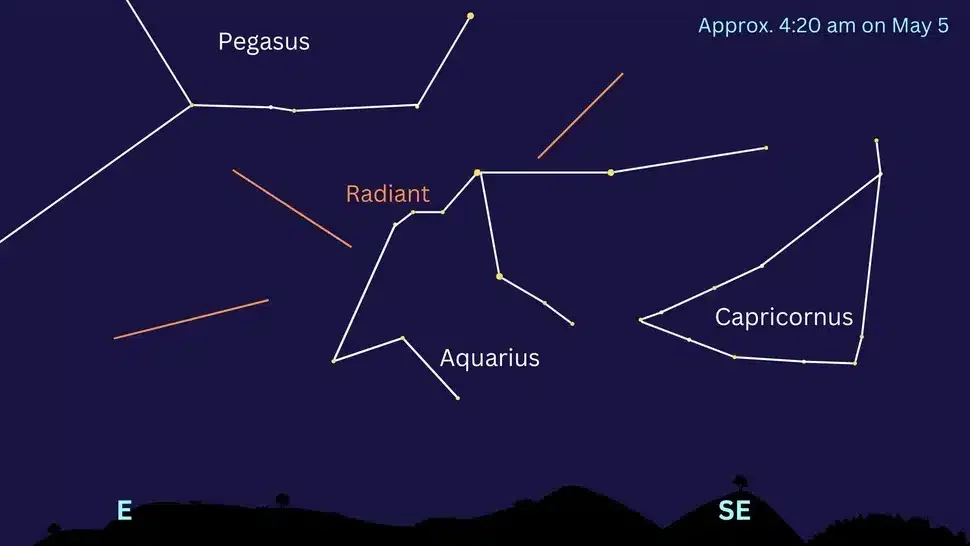 Graphic showing the Eta Aquarid meteor shower radiant in the predawn hours on May 6. (Image credit: Future/Daisy Dobrijevic)
Southern Hemisphere observers retain the best vantage point
The viewing experience for the Eta Aquarids is heavily dependent on latitude. The radiant point the area of the sky where the meteors appear to originate is located near the star Eta Aquarii in the constellation Aquarius. For those in the Southern Hemisphere, this radiant climbs high into the sky before dawn, allowing for a higher volume of visible meteors.
Under ideal, moonless conditions, the Southern Hemisphere can see a Zenithal Hourly Rate (ZHR) of up to 50 or 60 meteors. However, the presence of the 84% illuminated moon in 2026 is expected to slash these numbers by more than half, likely resulting in 15 to 25 visible meteors per hour in dark-sky locations.
Optimal viewing requires timing the pre-dawn hours
For observers in the Northern Hemisphere, the radiant sits much lower on the southern horizon. This lower angle significantly reduces the hourly rate, often down to 10 to 30 meteors under perfect conditions. In 2026, northern skywatchers might see fewer than 10 per hour due to the lunar glare.
Despite the lower count, Northern Hemisphere viewers have the unique opportunity to spot "Earthgrazers." These are meteors that enter the atmosphere at a shallow angle, appearing to skim across the horizon with long, slow-moving tails. To maximize your chances, experts recommend beginning your observation roughly two hours before local dawn. This is the period when the radiant is at its highest point before the sky begins to brighten with the morning sun. Avoid looking directly at the moon or your phone screen, as the 20-minute window required for your eyes to adjust to the dark is critical for spotting these elusive streaks.
Comments (0)
Please login to comment
Sign in to share your thoughts and connect with the community
Loading...