
Detecting Gravitational Waves via Atomic Spontaneous Emission

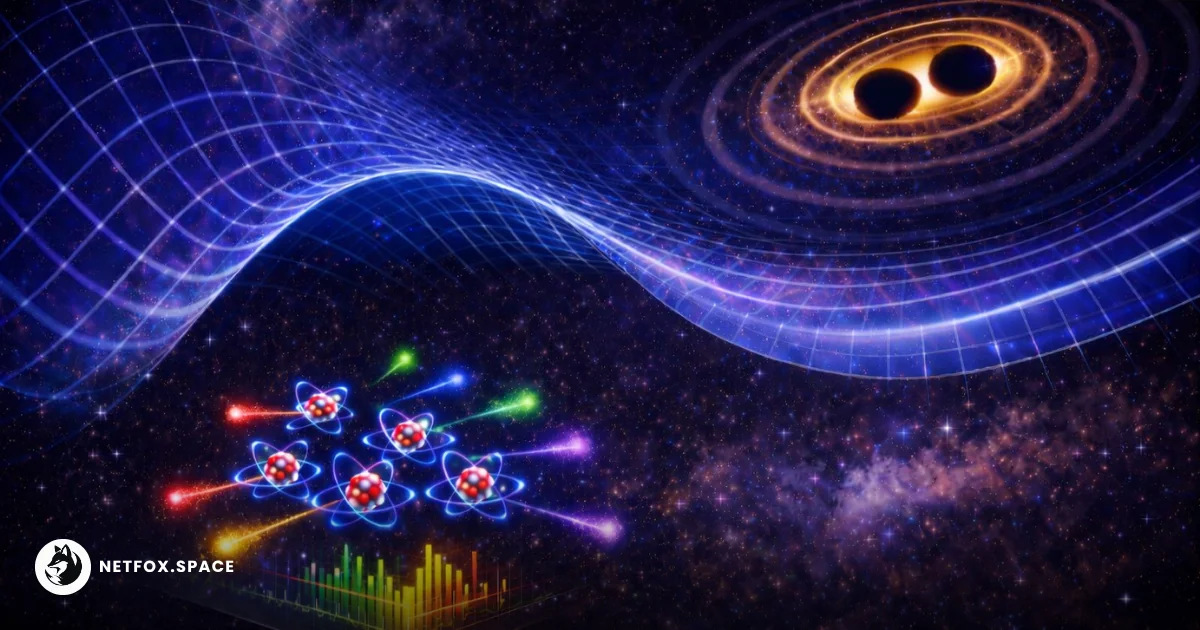
Scientists have detailed a theoretical framework for detecting gravitational waves by measuring subtle frequency shifts in the light emitted by atoms. This approach moves beyond the traditional method of tracking physical mirrors, suggesting that the "ripples" in spacetime can be identified by how they modulate the quantum field during spontaneous emission.
Shifting focus from test masses to the quantum vacuum
Since their first direct detection in 2015, gravitational waves (GWs) have primarily been observed through their classical influence on "test masses." Ground-based detectors like LIGO use laser interferometry to measure the infinitesimal change in distance between mirrors as a wave passes by. These methods rely on geodesic deviation—the way gravity moves physical objects relative to one another.
However, the research published in Physical Review Letters proposes a different mechanism. Instead of watching how a wave moves a macroscopic object, the researchers investigated how a plane gravitational wave interacts with a pointlike two-level atom and the quantum field surrounding it.
This conceptual shift suggests that the vacuum itself is modulated by the passing wave. This modulation does not just move the atom; it alters the fundamental interaction between the atom and the electromagnetic field, leaving a signature in the photons the atom releases.
Why the internal state of the atom remains unchanged
A critical nuance in this proposal is that the passing gravitational wave does not change the total decay rate of the atom. In practical terms, this means that if a scientist only monitors whether or not an atom has transitioned from an excited state to a ground state, they will find no evidence of the gravitational wave. The "information" about the wave is not stored in the atom's internal energy levels.
Instead, the information is encoded in the "composite atom-field system." When an atom undergoes spontaneous emission, it releases a photon. The researchers found that the gravitational wave induces a periodic modulation of the quantum field, which creates a direction-dependent change in the frequency of that emitted photon.
From a practitioner's perspective, this means the detector cannot simply be a counter of atomic decays; it must be a spectroscopic tool capable of measuring the specific energy and angle of the outgoing light. The vacuum field acts as an extended sensor that records the spacetime distortion and transfers that data to the photon.
The quadrupolar signature and frequency sidebands
The proposed method identifies a specific visual and mathematical signature that would allow scientists to distinguish gravitational wave signals from background noise. This signature is quadrupolar—it forms a specific four-lobed shape in the plane perpendicular to the direction the gravitational wave is traveling.
The researchers described two distinct regimes for detection based on the frequency of the gravitational wave:
-
Low-frequency waves: These cause a simple, angle-dependent frequency shift (a slight reddening or bluing of the light) depending on where the detector is positioned relative to the wave.
-
High-frequency waves: These produce "sidebands" in the emission spectrum. These sidebands are additional peaks of light at specific frequencies, a hallmark of a system being "driven" by an external periodic force—in this case, the ripple of spacetime itself.
By looking for this characteristic quadrupolar pattern, researchers could potentially filter out other environmental factors that might shift an atom's emission spectrum, such as local electromagnetic interference or thermal fluctuations.
Path to implementation in cold-atom experiments
While currently theoretical, the paper suggests that the requirements for a physical experiment are "not daunting." To reach the sensitivity required to detect gravitational waves in the (sub)millihertz range—a target for next-generation observatories—an experiment would need between and atoms.
This volume of atoms is already routinely achieved in modern "cold-atom" experiments, where clouds of atoms are trapped and cooled to near absolute zero using lasers. The researchers analyzed the "Fisher information"—a mathematical measure of how much information about a variable (like a gravitational wave's amplitude) can be extracted from a set of measurements.
Their analysis suggests that by using photon number measurements in these cold-atom clouds, it is possible to reach the "quantum Cramér-Rao bound," which represents the maximum possible sensitivity allowed by the laws of quantum mechanics. This makes spontaneous emission a viable, ultra-compact alternative to the multi-kilometer-long arms of traditional laser interferometers.
Comments (0)
Please login to comment
Sign in to share your thoughts and connect with the community
Loading...