

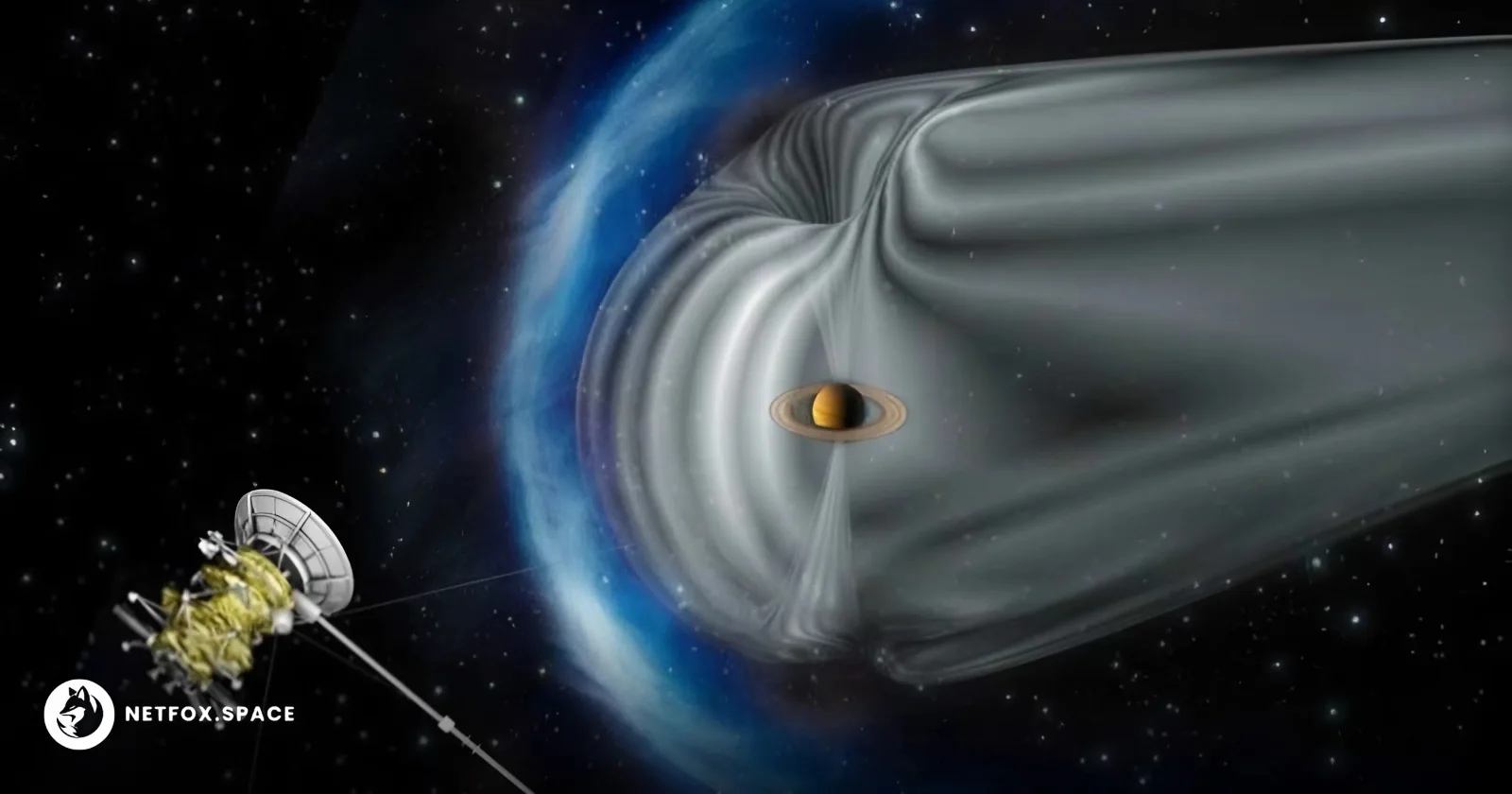
Saturn’s magnetic environment is not the symmetrical protective bubble seen around Earth; instead, it is noticeably lopsided, with the regions where solar particles enter the atmosphere shifted toward the planet's "afternoon" side. New research published in early 2026 identifies the planet’s rapid rotation and a persistent cloud of particles from the moon Enceladus as the primary drivers of this magnetic distortion.
A departure from the Earth-centric magnetic model
At Earth, the magnetosphere—the "shield" that deflects solar wind—is relatively symmetrical. The magnetic cusps, which are funnel-like regions at the poles that allow solar particles to leak into the atmosphere, generally stay centered near "local noon," directly facing the sun. This symmetry is a hallmark of a system dominated primarily by the external force of the solar wind.
However, the study on Saturn's cusp reveals a fundamentally different configuration. By analyzing 67 distinct "cusp events" captured by the Cassini spacecraft between 2004 and 2010, researchers found that Saturn’s cusps are skewed toward the dusk side. While Earth’s cusps center around 12:00 local time, Saturn’s peak occurrence was found between 13:00 and 15:00, with some signatures extending as far as 20:00 (post-dusk).
This finding suggests that the internal dynamics of a gas giant can overpower the shaping influence of the solar wind, creating a magnetospheric structure that behaves more like Jupiter’s than Earth's.
How rapid rotation and Enceladus warp the field
Two factors distinguish Saturn from Earth in this context: its rotation speed and its internal plasma sources. Saturn completes a rotation in about 10.7 hours, a speed that forces its magnetic field lines to drag a massive amount of plasma along with them. Much of this plasma originates from the icy moon Enceladus, which continuously vents water vapor and charged particles into the magnetosphere.
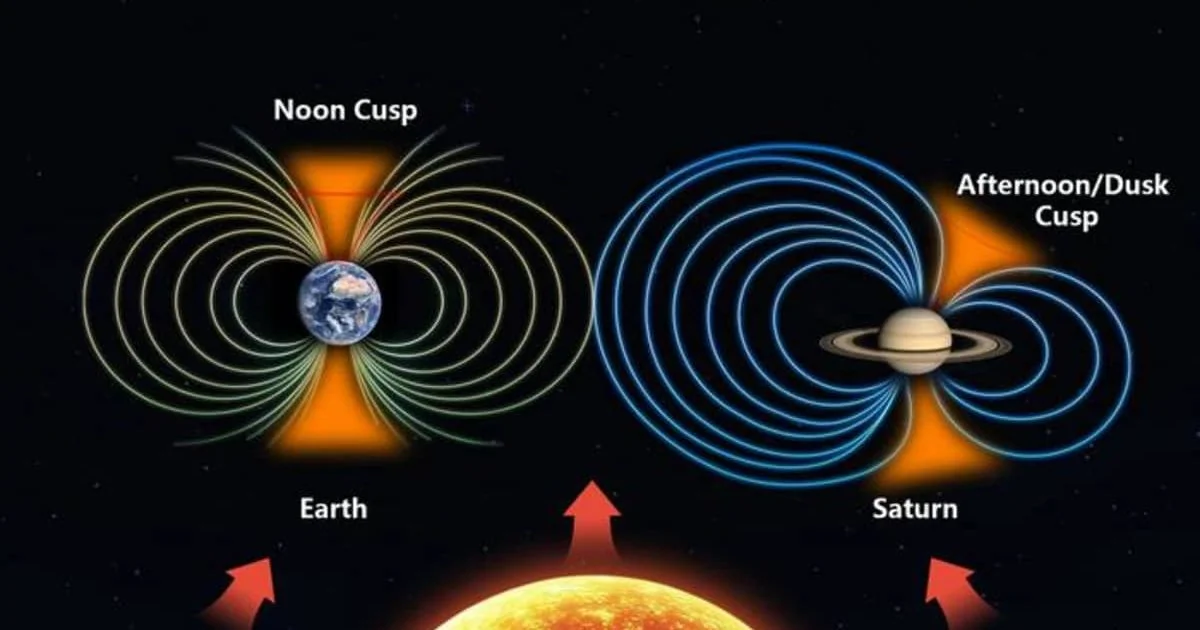 Schematic showing the position of Saturn's cusp compared to Earth's. (Representative Cover Image Source: Southern University of Science and Technology (SUSTech), Shenzhen, China)
The researchers used magnetohydrodynamic simulations to visualize how these forces interact. The rapid rotation drives a "rotation-dominated transport" of closed magnetic flux toward the dayside. On the "dawn" side of the planet, this internal flow actually opposes the incoming solar wind. Because the magnetic reconnection rate—the process that "opens" the field lines to the sun—is low in this area, magnetic flux piles up on the morning side.
This pile-up increases magnetic pressure, causing the dawn-side magnetosphere to expand outward. Conversely, the afternoon or "dusk" side remains more compressed. Because the cusps are anchored to this lopsided topology, they naturally shift toward the dusk side, explaining why Cassini detected more solar particle entries in the post-noon sector.
Correcting for the "Cassini Bias" in planetary data
One of the major hurdles in interpreting data from long-term space missions is ensuring that the findings reflect the planet’s nature rather than just the spacecraft's path. Cassini’s orbits were not uniform; the ship spent more time in certain regions than others. To claim a "global" asymmetry, the researchers had to implement dwell-time normalization.
This practitioner-level adjustment involves dividing the number of observed cusp events by the total time the spacecraft spent in a specific sector. Without this correction, the data might simply show where Cassini happened to be, rather than where the cusps actually existed. The fact that the dusk-side skew remained prominent after normalization provides the strongest evidence yet that the asymmetry is a physical property of Saturn, not a statistical artifact.
Furthermore, the analysis of ion dispersion suggests that once magnetic field lines are "opened" by the solar wind, they continue to migrate toward the dusk side for up to 10 hours before the plasma is detected. This "lagging field" configuration is a direct result of Saturn’s sub-corotating plasma, which moves slower than the planet’s core but still fast enough to shift the magnetic entry points.
Unresolved questions and solar wind limitations
Despite the clarity of the duskward shift, significant uncertainties remain regarding the "type" of magnetic reconnection occurring at Saturn. At Earth, we can measure the interplanetary magnetic field (IMF) in real-time to see how it triggers magnetic "breaks" in our shield. At Saturn, however, there was no dedicated solar wind monitor upstream of the planet during the Cassini mission.
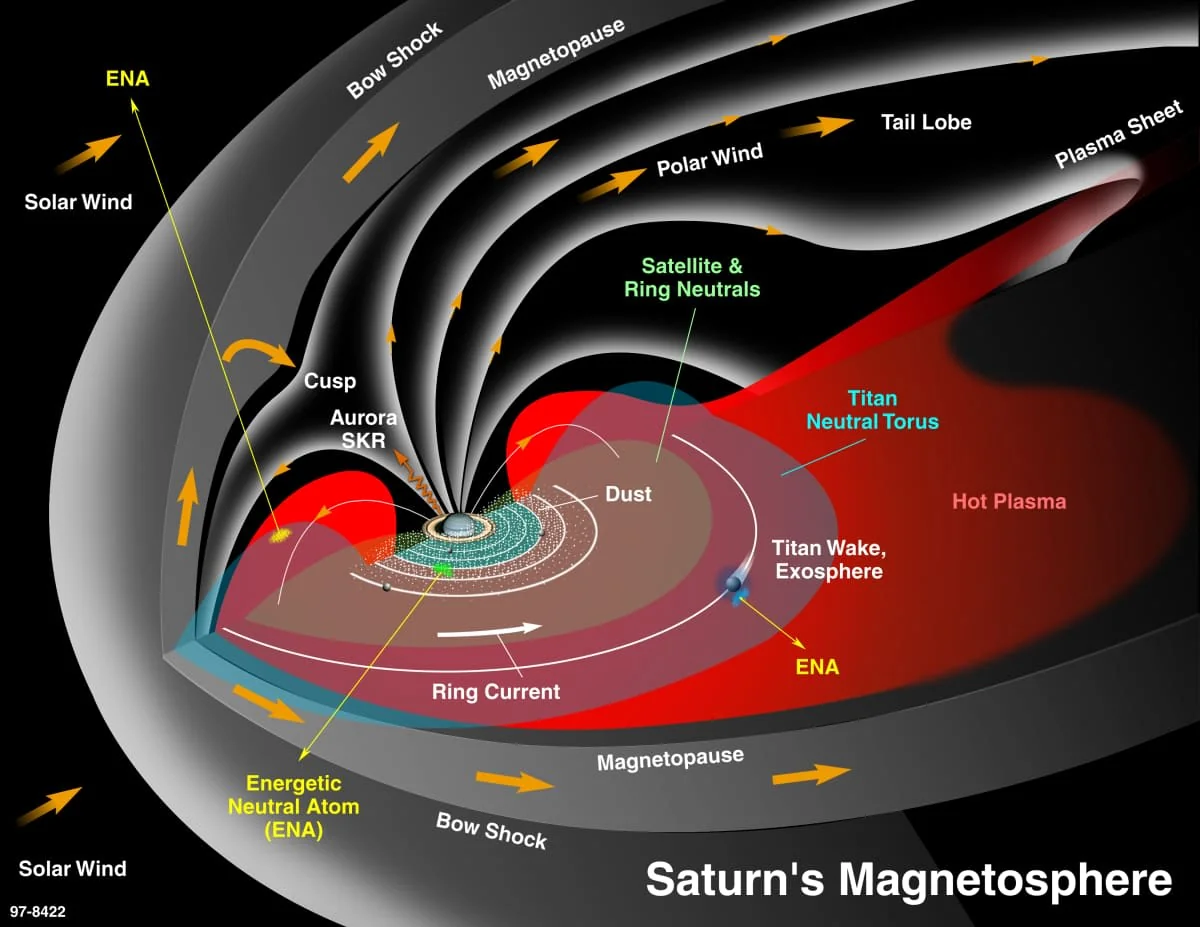 Cassini studied Saturn's magnetosphere by mapping the magnetic field, studying the flow of excited gases under its influence and observing how it affects Saturn's auroras. (Representative Image Source: NASA)
The scientific report notes that without real-time solar wind data, it is difficult to determine exactly how the north-south or east-west components of the IMF influence these events day-to-day. The researchers had to rely on models to estimate solar wind conditions, which can be imprecise at a distance of nearly a billion miles from the sun.
This research does more than just map a single planet; it provides a template for understanding "rotation-dominated" systems. As we discover more giant planets around other stars, the interplay between rapid spin and internal plasma sources—as demonstrated at Saturn—will likely be the primary lens through which we interpret their invisible magnetic boundaries.
Comments (0)
Please login to comment
Sign in to share your thoughts and connect with the community
Loading...