

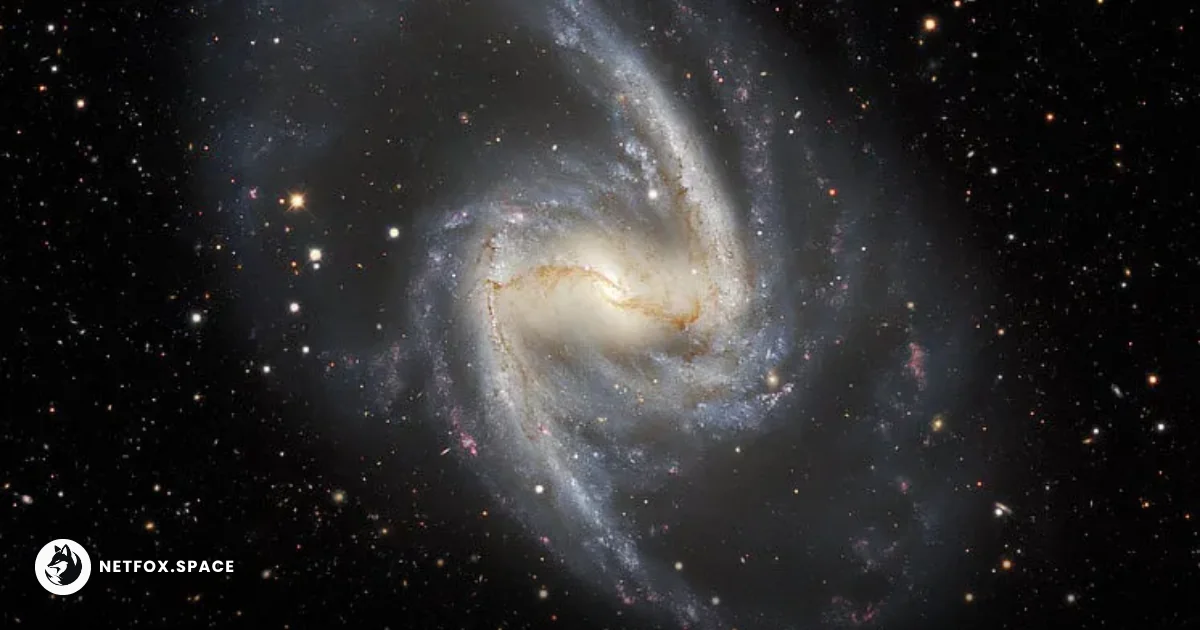
Mapping the Life Cycle of NGC 1365
A team of international astronomers has successfully reconstructed the chronological development of NGC 1365, known as the Great Barred Spiral Galaxy, spanning approximately 12 billion years. Situated 56 million light-years away in the constellation Fornax, this galaxy serves as a structural mirror for understanding our own Milky Way.
By utilizing data from the Very Large Telescope (VLT) and the Atacama Large Millimeter/submillimeter Array (ALMA), researchers identified distinct "stellar populations" that act as temporal markers. This mapping confirms that the galaxy's complex spiral structure was not a singular event but a multi-stage accumulation of matter and energy.
 Credit: ESO/M. Kornmesser
The Spectroscopic Fingerprints of Stellar Birth
The breakthrough centers on "chemical tagging," a process where the elemental composition of stars reveals their birth era. Stars formed in the early universe lack heavy metals, while younger generations are enriched by the remnants of previous supernovae.
Researchers analyzed over 1,000 star-forming clusters within NGC 1365 to determine the velocity and distribution of gas. This data allows scientists to see the "fossil record" of the galaxy, distinguishing between the ancient central bulge and the more recent, gas-rich spiral arms.
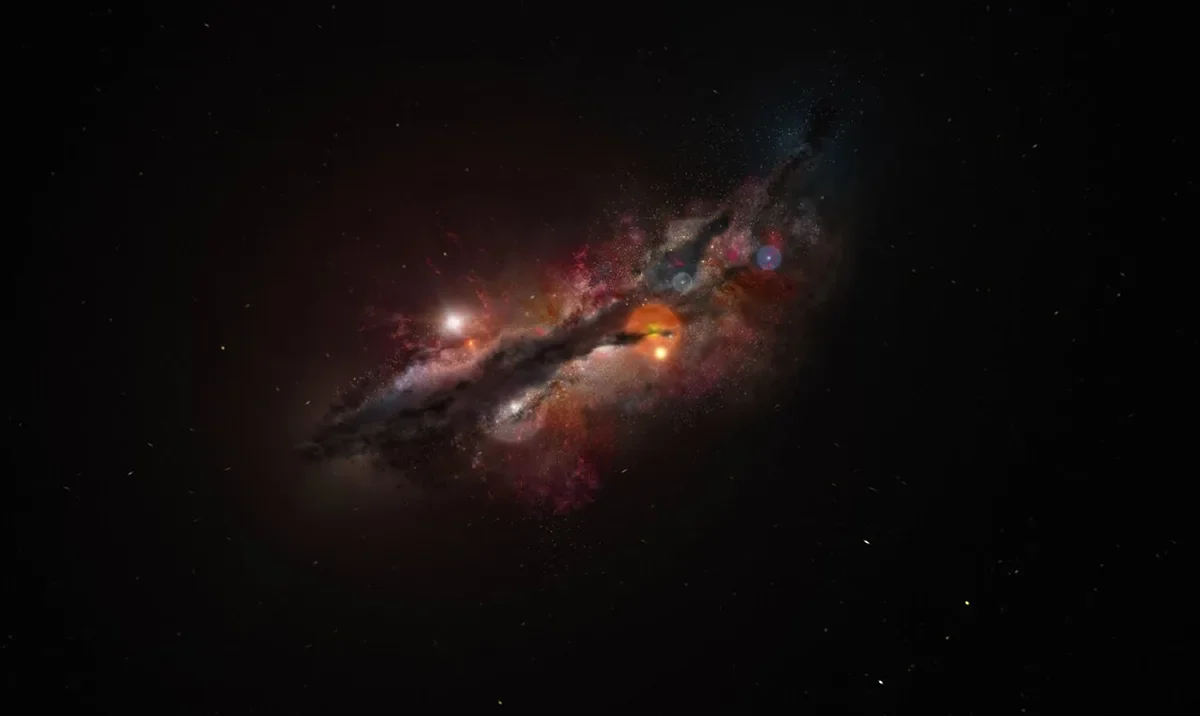
 Artist’s impression of spiral galaxy NGC 1365 colliding with a smaller galaxy. Credit: Melissa Weiss/CfA
The "Barred" Engine: A Structural Catalyst for Growth
While many reports focus on the visual beauty of NGC 1365, the critical differentiation lies in the Barred Spiral Mechanism as a driver of galactic metabolism. Unlike non-barred galaxies, the central bar of NGC 1365 acts as a massive gravitational funnel.
This structure creates a "highway" for interstellar gas, forcing it toward the center at high speeds. This creates a feedback loop: the bar triggers intense starburst activity in the nucleus while simultaneously feeding the supermassive black hole at the core. This structural analysis suggests that the "bar" is not just a shape, but a late-stage evolutionary phase that accelerates a galaxy's maturity by efficiently redistributing its mass.
Cross-Sector Impact on Extragalactic Research
The findings bridge a gap between the European Southern Observatory (ESO)’s local observations and the deep-field infrared data provided by the James Webb Space Telescope (JWST). By establishing a 12-billion-year baseline for a single entity, the biotech and data science sectors are seeing increased crossover in "pattern recognition" algorithms used to sort these massive astronomical datasets.
| Evolutionary Phase | Approximate Age | Primary Structural Development |
|---|---|---|
| Primordial Core | 10–12 Billion Years | Formation of the central dense bulge. |
| Disk Expansion | 5–8 Billion Years | Accumulation of cold gas; early disk stability. |
| Bar Emergence | 1–3 Billion Years | Gravitational instability creates the central bar. |
| Modern Era | Present | Active star formation in spiral arms; AGN activity. |
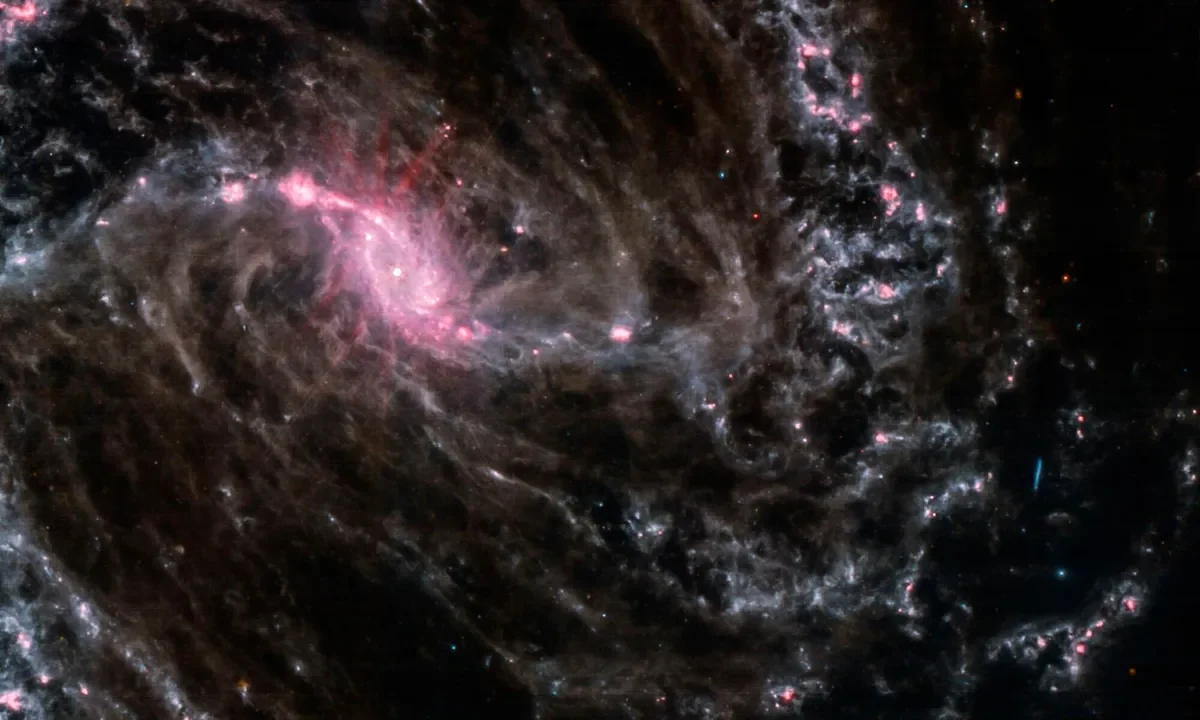 NGC 1365, as seen by the James Webb Space Telescope. Credit: NASA/JPL-Caltech/Judy Schmidt
The Future of Galactic Forensics
The ability to trace a galaxy's lineage with this level of precision shifts the astrophysics sector from observation to "forensic reconstruction." As telescopes become more sensitive, the goal is to apply this "space archaeology" template to more distant, faint objects.
This methodology will eventually challenge current models of Dark Matter distribution. If the growth of NGC 1365 does not align with predicted gravitational pulls from invisible matter, it may force a fundamental recalibration of the Lambda-CDM model, the current standard for how we believe the universe is structured.
Comments (0)
Please login to comment
Sign in to share your thoughts and connect with the community
Loading...