

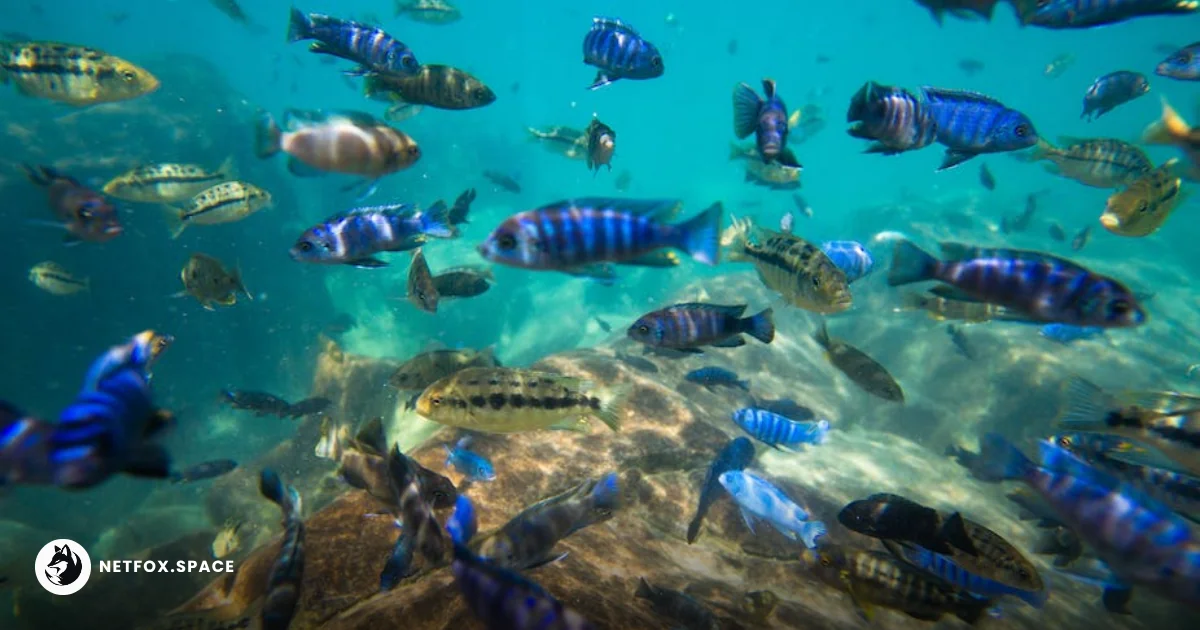
The emergence of more than 800 cichlid species in Lake Malawi within a geologically brief period has long challenged evolutionary models. New genomic research reveals that "supergenes"—large, flipped segments of DNA—allow these fish to lock in beneficial trait combinations and adapt to new ecological niches with unprecedented speed.
Chromosomal inversions solve the conflict between recombination and speciation
The central mystery of Lake Malawi’s biodiversity is the speed of its "adaptive radiation." While humans and chimpanzees have diverged over millions of years, hundreds of distinct cichlid species evolved in this single East African lake in a fraction of that time. A study published in the journal Science by researchers from the Universities of Cambridge and Antwerp suggests that the primary driver of this speed is the presence of chromosomal inversions.
In typical reproduction, meiotic recombination mixes DNA from both parents, creating new genetic combinations. While this provides variety, it can also be counterproductive to speciation because it breaks apart "co-adapted" sets of genes that work well together. Chromosomal inversions—stretches of DNA where the orientation is flipped—effectively solve this problem. Because these flipped regions cannot easily pair with non-flipped chromosomes during cell division, recombination is suppressed. This creates a "supergene" where multiple traits, such as vision adapted for deep water and specific feeding behaviors, are inherited as a single, unbreakable package.
Genomic data reveals five inversions that segregate by habitat depth
To identify these mechanisms, the research team sequenced 1,375 genomes from 240 different cichlid species. The analysis focused on the benthic subradiation—the species that live and feed near the lake bottom. The researchers discovered five large chromosomal inversions, each suppressing recombination across more than half of a single chromosome.
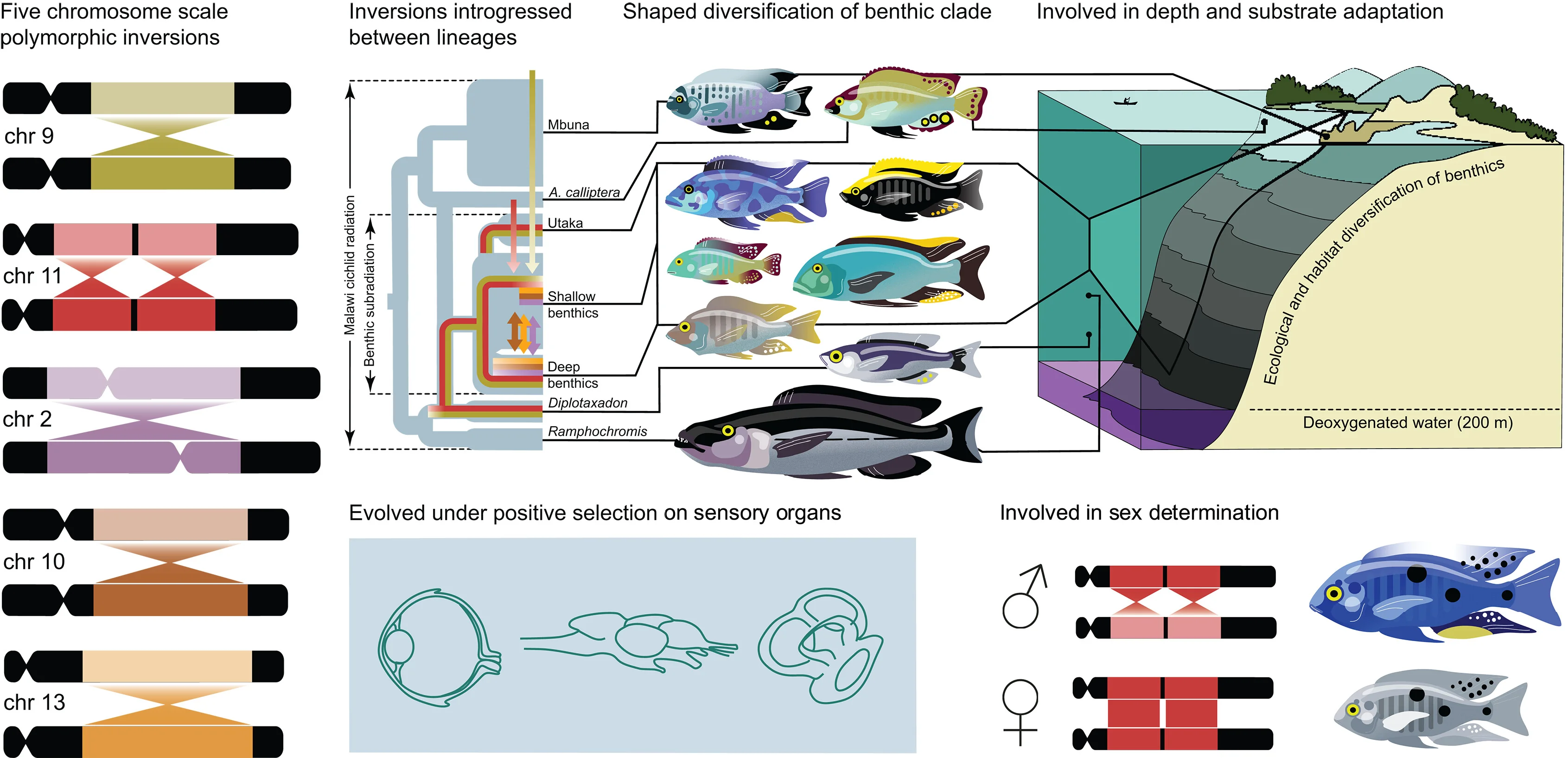 Five large chromosomal inversions contribute to the diversification of Malawi cichlids. Inversions established in the diverse benthic subradiation. Inversion-region haplotypes were exchanged through hybridization of lineages within and outside of the Malawi radiation and contribute to ecological and habitat divergence, sensory adaptation, and sex determination.
The distribution of these inversions was not random. The findings in the study show a strong correlation between the specific version of an inversion a fish carries and the depth of its habitat. Fish living in the "benthic" zone (down to 200 meters) possessed specific genetic haplotypes that differentiate them from their shallow-water relatives. This suggests that the inversions acted as evolutionary anchors, allowing species to remain distinct even when they live in close proximity without physical barriers.
Hybridization with deepwater species introduced the adaptive supergenes
The study also provides evidence for how these supergenes originated. Rather than evolving entirely within the Lake Malawi radiation, at least two of the five major inversions were introduced through admixture with the deepwater pelagic genus Diplotaxodon.
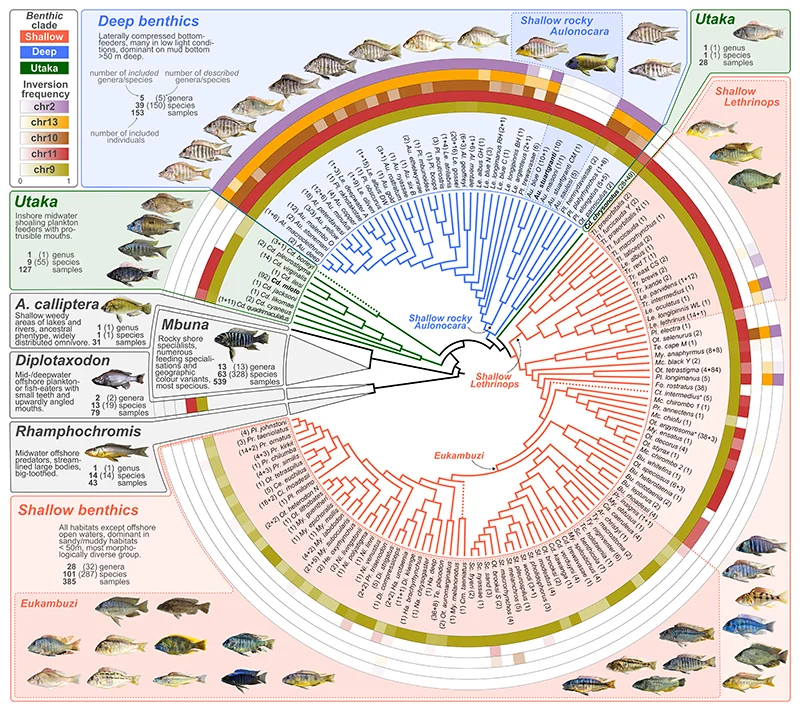 Study system and prevalence of five large inversions.
This process, known as introgression, allowed the benthic cichlids to "borrow" pre-existing adaptations for deep-water survival. By hybridizing with lineages from both inside and outside the Malawi radiation, the fish gained access to a wider "toolbox" of genetic material. The presence of the inversions ensured that once these useful traits arrived, they were not diluted or lost through subsequent breeding with other species. This explains why bursts of species diversification in the lake coincide with specific historical introgression events.
The supergenes show a dual role in sensory adaptation and sex determination
Beyond environmental adaptation, the researchers found that these supergenes are enriched with genes related to neurosensory functions, physiology, and reproduction. For example, genes influencing how fish perceive light in the dim, high-pressure environment of the deep lake are locked within these inversions.
An unexpected finding of the research was the role these inversions play in sex determination. On three specific chromosomes, the re-introduction of ancestral DNA segments coincided with a "Y chromosome-like" role in some benthic species. This transient sex linkage suggests an interplay between natural selection (survival in deep water) and sex-specific selection (mate choice and reproduction).
While the study focused on cichlids, the researchers noted that chromosomal inversions are common across many taxa, including humans. This suggests that the "supergene" mechanism may be a universal driver of biodiversity, allowing life to pivot and adapt rapidly when new ecological niches become available.
What this means for the field:
-
Speciation Mechanism: Confirms that structural variants, not just individual point mutations, are critical for rapid evolution.
-
The Hybridization Factor: Highlights that interbreeding between different species can be a constructive force for adaptation rather than a barrier.
-
Unresolved Questions: It remains unclear how often these inversions occur spontaneously versus being maintained through long-term evolutionary history.
Comments (0)
Please login to comment
Sign in to share your thoughts and connect with the community
Loading...