
10-Billion-Year-Old Supernova May Unlock Dark Energy Secret


The Discovery of SN 2025wny: A Window Into the Deep Past
On March 16, 2026, an international team of researchers announced the detection of SN 2025wny, an extraordinarily rare superluminous supernova whose light has traveled for over 10 billion years to reach Earth. First identified by the Zwicky Transient Facility in California, the event is significant not just for its age, but for its unique positioning. The explosion occurred during a period of cosmic history when the universe was in its most active phase of star formation.
This specific event was captured as a "gravitationally lensed" supernova, a phenomenon where the light from a distant object is bent by the gravity of a massive foreground galaxy. This cosmic alignment acts as a natural magnifying glass, amplifying the supernova's brightness by a factor of up to 50 times. Without this gravitational boost, the explosion would have remained invisible to even the most powerful ground-based observatories.
Five Images, One Explosion: A Rare Astrophysical Alignment
The supernova, nicknamed "SN Winny," appeared in the sky not as a single flash, but as five distinct images arranged in a pattern resembling cosmic fireworks. This rare configuration was confirmed through follow-up observations by the Liverpool Telescope in La Palma and the James Webb Space Telescope. By observing the same explosion five separate times, scientists can effectively "replay" the stellar death in slow motion.
Each of the five images represents light that followed a slightly different path through space. Because these paths vary in length, the light from each version of the supernova arrived at Earth at different times. This "time-delay" effect allows astronomers to watch different stages of the same explosion simultaneously, providing a multi-perspective data set that is nearly impossible to obtain through traditional observation.
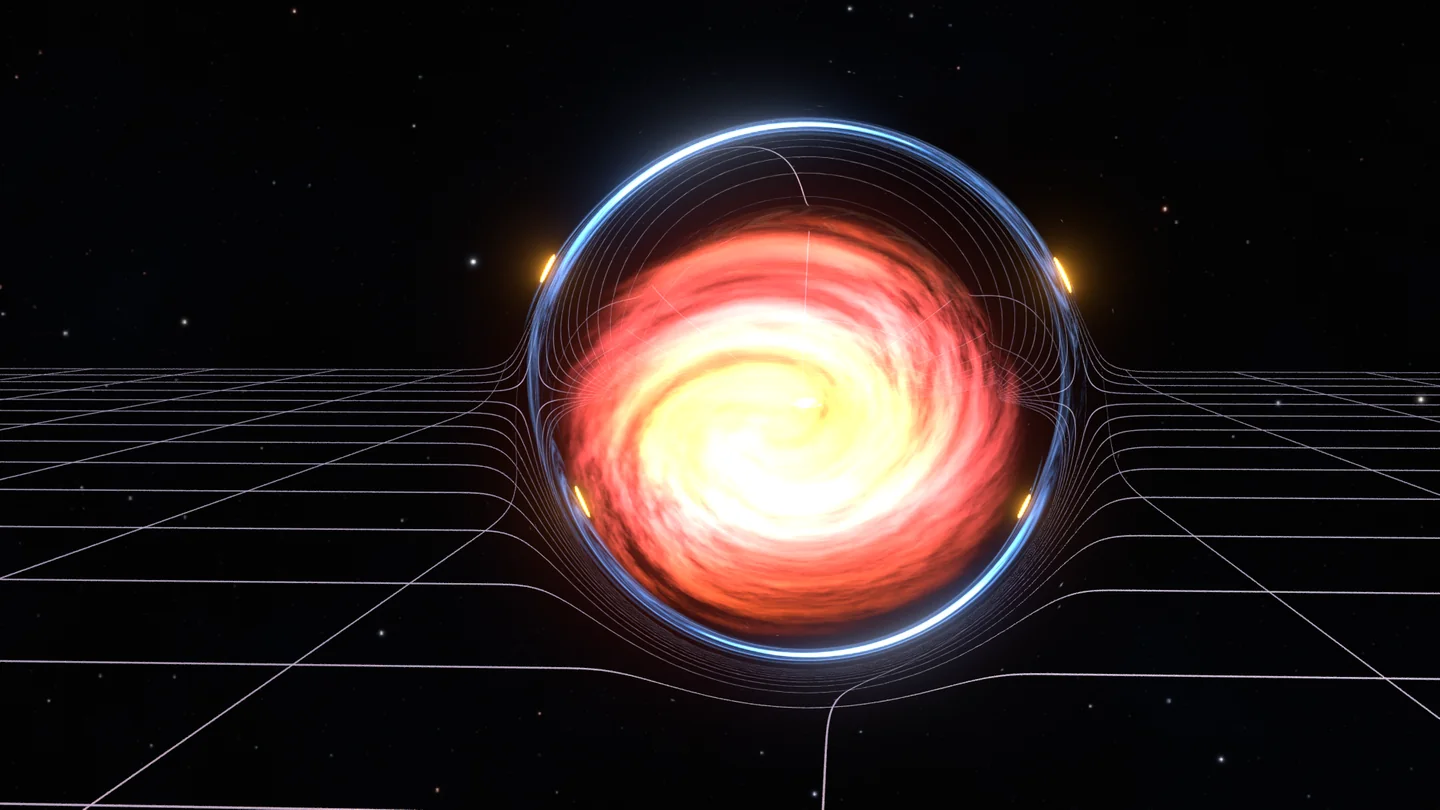 An artist’s interpretation of light from a supernova passing through a gravitational lens, reaching Earth at different times. Credit: Oskar Klein Center, University of Stockholm / Samuel Avraham & Joel Johansson.
The Time-Delay Mechanism: Measuring the "Hubble Tension"
The mandatory differentiation in this discovery lies in its potential to resolve the Hubble Tension, a fundamental conflict in modern physics regarding how fast the universe is expanding. Currently, measurements from the early universe (the Big Bang's afterglow) and the local universe (nearby galaxies) produce two different values for the expansion rate, known as the Hubble constant. SN 2025wny provides a third, independent way to calculate this number.
By measuring the precise time delays between the five images, astronomers can calculate the absolute distance to the supernova with extreme precision. Dr. Daniel Perley, a reader in astrophysics at Liverpool John Moores University, noted that the nature of this system allows scientists to bypass traditional measurement errors. If the resulting expansion rate aligns with one of the two conflicting values, it could finally settle a decade-long debate in the astrophysics sector.
| Feature | Data Point | Scientific Value |
|---|---|---|
| Supernova Age | > 10 Billion Years | Samples the universe during its peak growth era. |
| Redshift () | 2.01 | Quantifies the extreme distance and light stretching. |
| Magnification Factor | 20x to 50x | Enables medium-sized telescopes to see deep space. |
| Image Count | 5 | Multiplies the data points for time-delay math. |
Systemic Implications for Dark Energy Theory
The ultimate prize of this observation is a deeper understanding of Dark Energy, the mysterious force that makes up approximately 68% of the universe and drives its accelerating expansion. If the expansion rate derived from SN 2025wny reveals that the speed of expansion has changed in unexpected ways over the last 10 billion years, it would suggest that dark energy is not a constant force.
Such a finding would necessitate a complete rewrite of the Standard Model of Cosmology. This would move dark energy from being a "cosmological constant" to a dynamic field that evolves over time. For the General Public, this isn't just a change in math; it alters our understanding of the ultimate fate of the universe—whether it will continue to expand forever or eventually undergo a "Big Rip."
What Happens Next: The Multi-Observatory Watch
The global scientific community is now racing to analyze data from the Hubble Space Telescope and the Keck Telescopes in Hawaii to map the exact mass of the lensing galaxies. Jacob Wise, the PhD student who first recognized the lensed nature of the images, emphasized that the next few months of monitoring are critical. As the supernova fades, the underlying light of the host galaxy will become visible, providing the final clues needed for a high-precision calculation.
The resolution of the Hubble Tension is no longer a theoretical exercise; it is an impending data-driven collision. As the time-delay measurements from SN 2025wny are finalized, the results will either solidify our current understanding of the cosmos or force the scientific community to accept that our most fundamental laws of physics are incomplete.
References:
-
Liverpool John Moores University
-
ScienceDaily
-
Mirage News
-
The Astrophysical Journal Letters
Comments (0)
Please login to comment
Sign in to share your thoughts and connect with the community
Loading...