

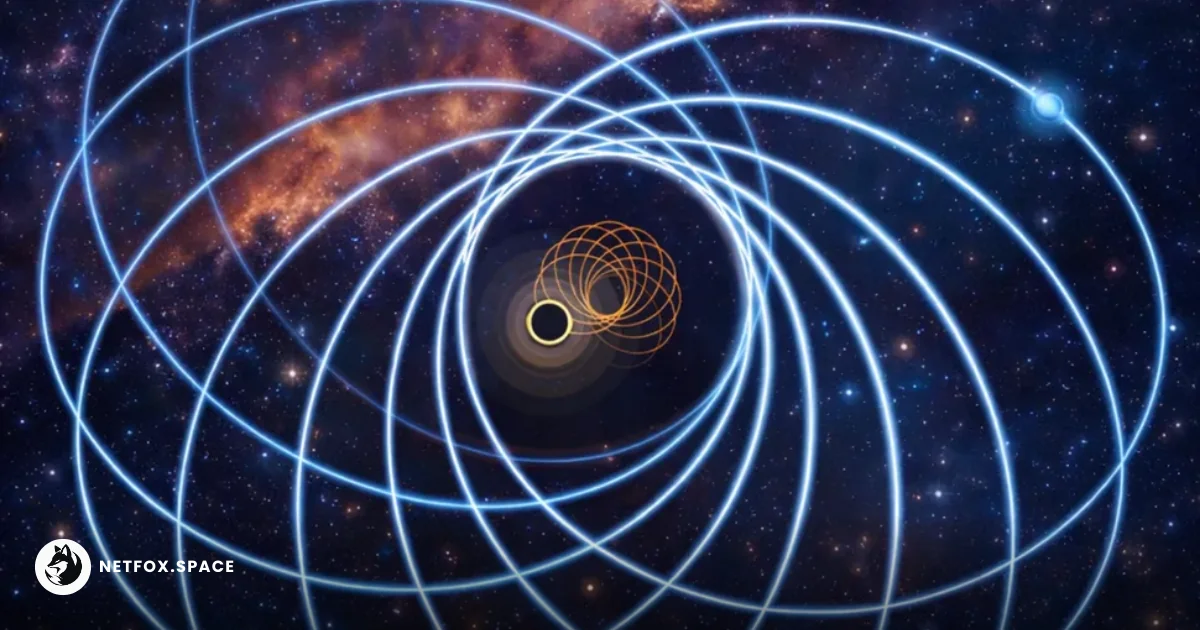
The Mechanics of Asymmetric Compact Binary Coalescence
Recent astrophysical observations and simulations have identified a subset of Black Hole-Neutron Star (BHNS) mergers that defy the standard "circularized" model of orbital decay. Traditionally, scientists believed that as these massive entities spiraled toward each other, gravitational radiation would smooth their paths into perfect circles before the final impact.
However, data now suggests that many of these pairs maintain "eccentric" or oval-shaped orbits until the moment of collision. This phenomenon occurs when a Neutron Star is captured by a Black Hole in a dense stellar environment, such as a globular cluster, where gravitational interactions are chaotic and frequent.
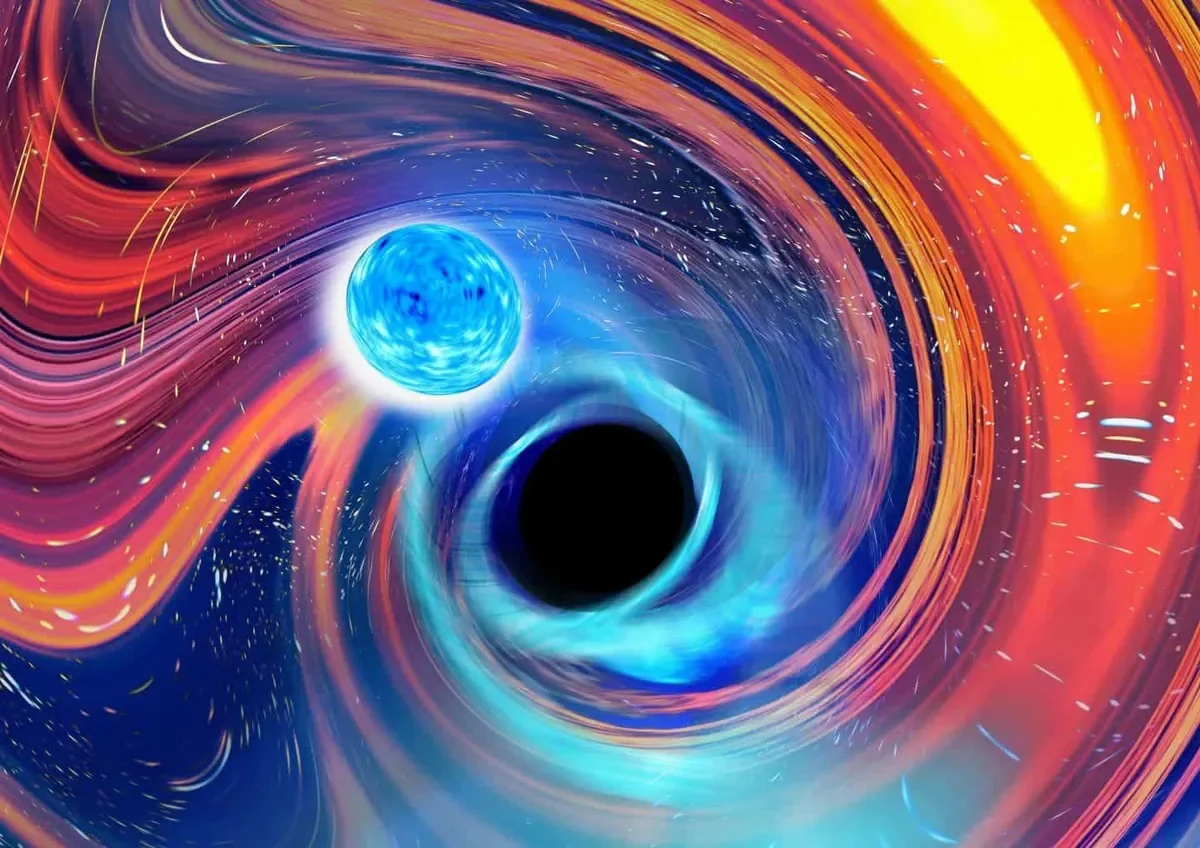 An illustration of a neutron star-black hole mixed merger (Image credit: Carl Knox, OzGrav – Swinburne University)
Disruption of the Standard Cosmological Model
The presence of extreme eccentricity in these mergers acts as a laboratory for testing Albert Einstein’s General Relativity under "strong-field" conditions. In a standard merger, the gravitational wave signal is a predictable "chirp" that rises in frequency and amplitude.
When orbits are eccentric, the signal becomes a complex series of bursts, creating a "glitch" in current detection algorithms used by the Laser Interferometer Gravitational-Wave Observatory (LIGO). This indicates that our current census of the universe may be missing a significant population of mergers simply because our software is tuned to look for circular patterns.
The "Kick" Mechanism: Why Orbits Refuse to Circularize
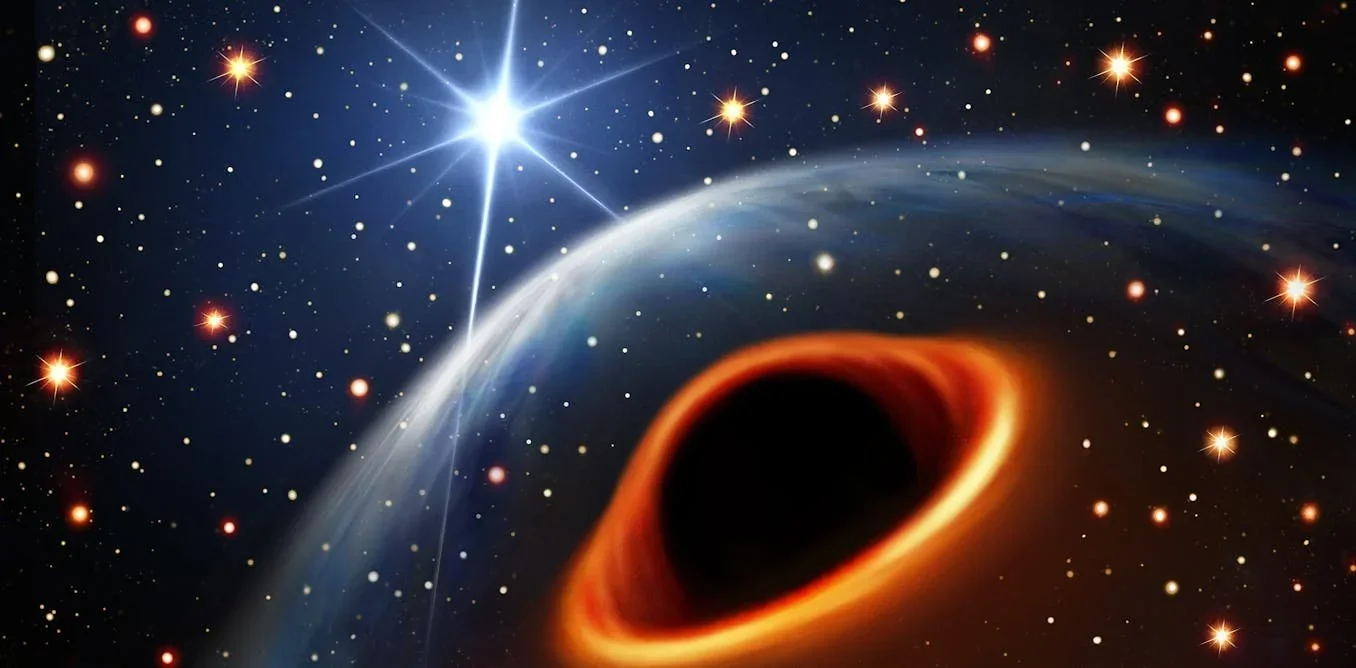
While most competitors focus on the visual spectacle of the merger, the technical differentiator lies in the Natal Kick hypothesis. When a massive star undergoes a supernova to become a neutron star, the explosion is often asymmetrical, firing the remnant across space like a celestial cannonball.
If this kick happens within a binary system, it can force the new neutron star into an extreme, elongated orbit around its black hole companion. If the system is "tight" enough, the objects collide before gravitational waves have time to circularize the path. This implies that the internal fluid dynamics of a dying star—the nuclear physics of the supernova itself—directly dictates the gravitational wave signature millions of years later.
Comparison of Orbital Dynamics in BHNS Mergers
| Feature | Circularized Merger (Standard) | Eccentric Merger (Observed) |
|---|---|---|
| Origin | Isolated binary evolution | Dynamic capture in dense clusters |
| Wave Signal | Continuous, rhythmic "chirp" | Discrete, modulated "bursts" |
| Tidal Disruption | Predictable stretching of Neutron Star | Violent, erratic shredding |
| Physics Test | Linear General Relativity | Non-linear, strong-field gravity |
| Detection Rate | High (current templates) | Low (requires new algorithms) |
Systemic Implications for Heavy Element Nucleosynthesis
These "odd" orbits change the mathematical probability of R-process nucleosynthesis, the method by which the universe creates heavy metals like gold and platinum. In a circular merger, the neutron star is often swallowed whole by the black hole, leaving no debris.
In an eccentric merger, the high-velocity, "slingshot" nature of the approach can lead to a violent tidal disruption. This flings neutron-rich matter into space at relativistic speeds, where it undergoes radioactive decay. Consequently, the eccentricities of these orbits are a primary variable in determining the chemical enrichment of entire galaxies.
Emerging Frontiers in Gravitational Wave Astronomy
The discovery of high-eccentricity mergers necessitates a total overhaul of the Numerical Relativity templates used by international research teams. As the KAGRA detector in Japan and Virgo in Italy increase sensitivity, the focus shifts from merely finding mergers to analyzing the "orbital memory" of these systems.
The upcoming launch of the Laser Interferometer Space Antenna (LISA) will likely reveal that the universe is far more "jittery" than our smooth, circular models have suggested, forcing a reconciliation between chaotic stellar dynamics and the rigid predictions of gravitational theory.
Comments (0)
Please login to comment
Sign in to share your thoughts and connect with the community
Loading...