
DNA in Space: How Asteroid Samples Rewrote Life's Origin

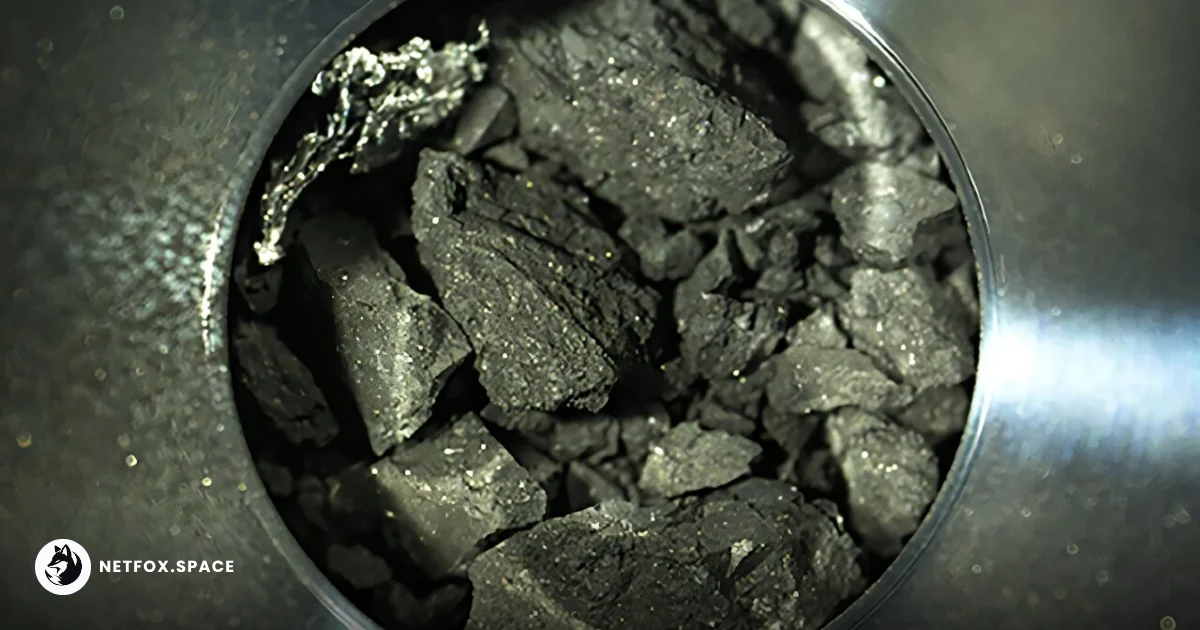
The OSIRIS-REx Legacy: Deciphering the Pristine Record of Bennu
As of early 2026, laboratories at the NASA Goddard Space Flight Center have released the most detailed chemical inventory to date of the samples returned from the asteroid Bennu. These carbon-rich fragments, older than Earth itself, contain a surprising abundance of water-bearing minerals and organic compounds. Unlike meteorites that fall to Earth and suffer atmospheric contamination, these "pristine" samples provide an uncorrupted snapshot of the astrobiology conditions present during the solar system’s infancy.
The discovery of high concentrations of carbon and nitrogen in these samples confirms that asteroids acted as "chemical couriers" during the Late Heavy Bombardment era. By delivering these materials to a cooling Earth 4 billion years ago, these celestial bodies provided the raw "hardware" required for the first self-replicating systems to emerge.
Uracil and the Vitamin B3 Connection: The Building Blocks are Universal
The Japan Aerospace Exploration Agency (JAXA) recently concluded its primary analysis of the Ryugu samples, identifying uracil—one of the four nucleobases in RNA—and nicotinic acid (Vitamin B3). This follows a 2025 breakthrough where a joint international team confirmed the presence of all five "canonical" nucleobases (Adenine, Guanine, Cytosine, Thymine, and Uracil) within carbonaceous chondrites.
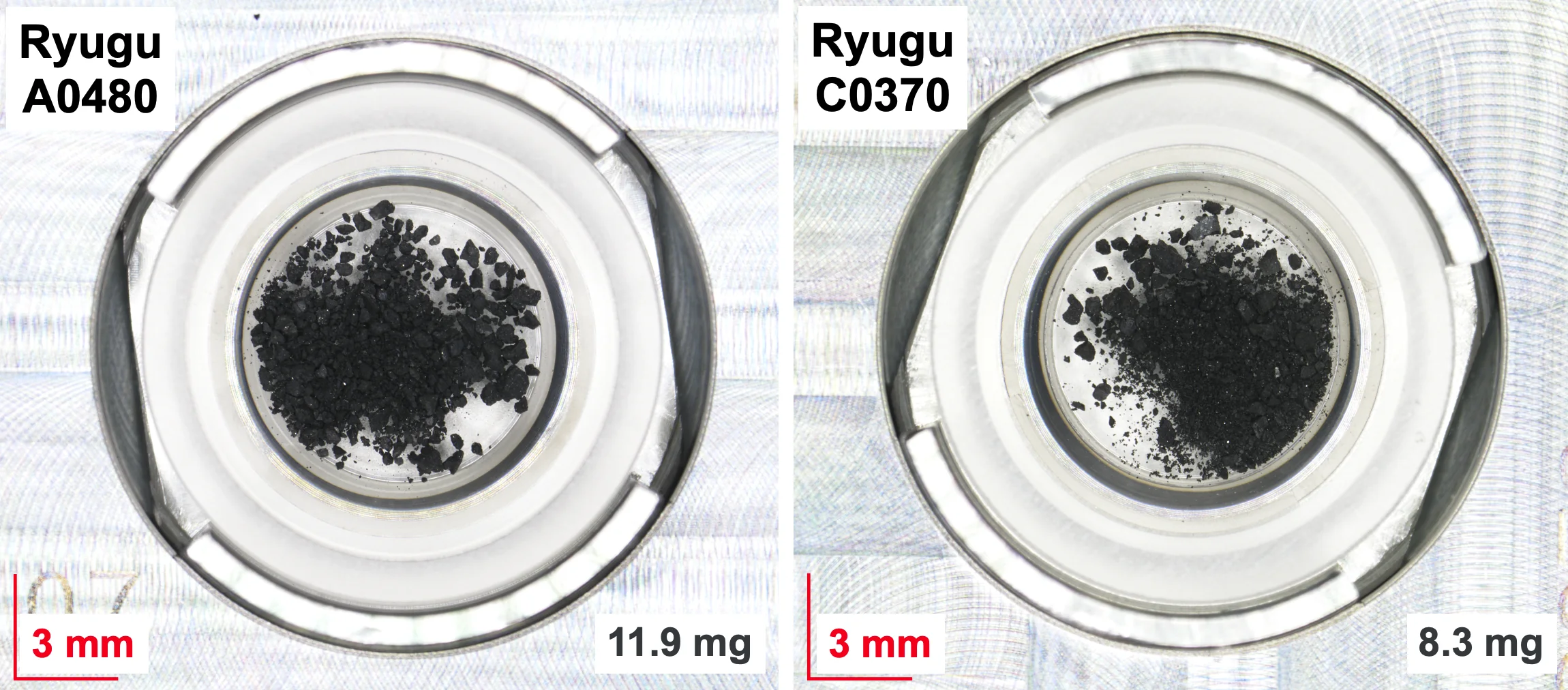 This week’s result is just the latest in a growing collection of discoveries.
These molecules are not "life" themselves, but they are the specific, complex instructions required to build it. The presence of Nicotinic Acid ($C_6H_5NO_2$) is particularly significant, as it acts as a precursor for NAD, a coenzyme essential for metabolism in all living cells. The fact that these specific molecules are found in cold, irradiated space suggests that the chemistry of life is a fundamental property of the universe’s physics, not a terrestrial fluke.
The Abiotic Engine: Why ‘Space Chemistry’ Mimics Biology
What mainstream reporting often overlooks is the "photochemical mechanism" that allows these complex molecules to form in a vacuum without biological intervention. In the frozen reaches of the asteroid belt, simple ices containing water, ammonia, and carbon monoxide are blasted by ultraviolet radiation and cosmic rays. This energy triggers a series of complex reactions known as "abiotic synthesis," effectively turning an asteroid into a natural chemical reactor.
The Differentiation Block: The Contamination Proof
The primary hurdle in this research has always been proving that these DNA components didn't just "seep in" after the asteroid hit Earth. The mandatory differentiation in 2026 research comes from Isotopic Ratio Analysis. Researchers found that the Carbon-13 ($^{13}C$) levels in the uracil found on Ryugu are significantly higher than anything found in Earth’s biosphere. This "isotopic fingerprint" proves beyond a doubt that these building blocks were forged in the interstellar medium, long before the Earth had an atmosphere or a single strand of DNA.
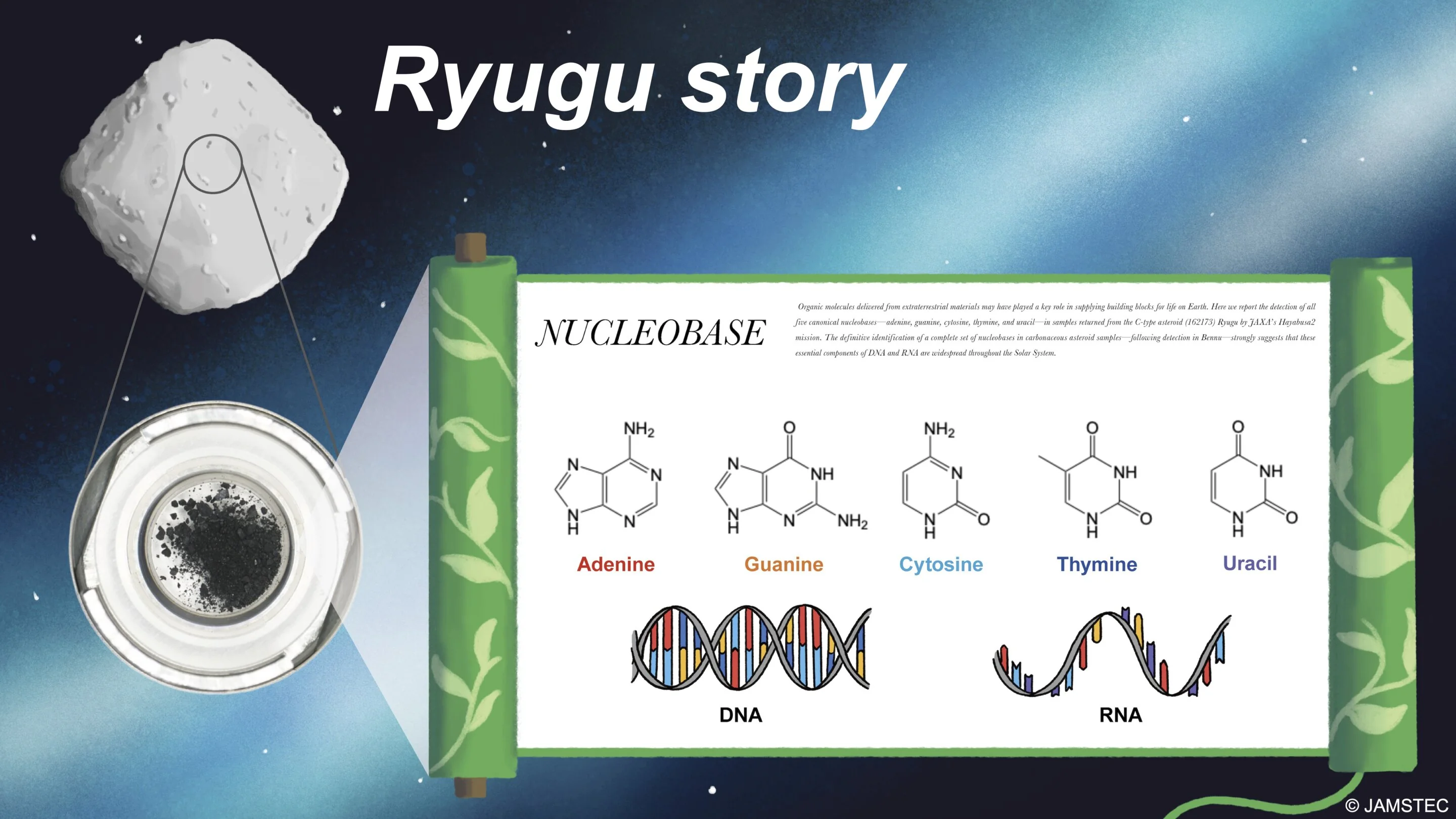 The “Ryugu Story” illustration depicting the detection of all five canonical nucleobases in samples returned from asteroid Ryugu by the Hayabusa2 mission. Credit: JAMSTEC
Galactic Implications: From Rare Earth to Biological Inevitability
The systemic implication of finding a "complete toolkit" in asteroids is a pivot from the "Rare Earth" hypothesis toward a model of "Biological Inevitability." If the ingredients for DNA are distributed ubiquitously across the Milky Way Galaxy, then every solar system with a "water-rich" asteroid belt is essentially being seeded with the potential for life.
This shift impacts how the European Space Agency (ESA) and NASA prioritize future exoplanet searches. We are no longer looking for planets that might have "lucked into" the right chemistry; we are looking for planets that had the right "delivery service" from their local debris disks.
| Molecule Detected | Asteroid Source | Biological Function |
|---|---|---|
| Uracil | Ryugu / Bennu | RNA sequence coding |
| Nicotinic Acid | Ryugu | Metabolic coenzyme (Vitamin B3) |
| Adenine | Murchison / Bennu | DNA/RNA & ATP energy transfer |
| Amino Acids | Multiple | Protein synthesis building blocks |
| Hexamethylenetetramine | Ryugu | Precursor to complex organic sugars |
The Next Frontier: Searching for Pre-Biotic Persistence on Psyche
While Bennu and Ryugu have provided the "organic" map, the upcoming data from the Psyche Mission—currently en route to a metal-rich asteroid—aims to investigate the role of metallic catalysts in origin-of-life chemistry. Scientists suspect that iron and nickel surfaces on early asteroids may have acted as "assembly lines," aligning simple organic molecules into the more complex chains required for the first membranes.
As the Planetary Science community prepares for the next generation of sample returns, the focus is shifting from what is out there to how these molecules survived the transition from space to a planetary surface. The tension now lies in the "survival window": how much of this cosmic DNA survived the heat of atmospheric entry, and whether we might find even more complex, "proto-biological" structures deep within the ice moons of the outer solar system.
References:
-
arstechnica.com (We keep finding the raw material of DNA in asteroids—what’s it telling us?)
-
kobe-np.co.jp (All five types of bases found on Ryugu: Key to unlocking the origins of life, the building blocks of life)
Comments (0)
Please login to comment
Sign in to share your thoughts and connect with the community
Loading...