

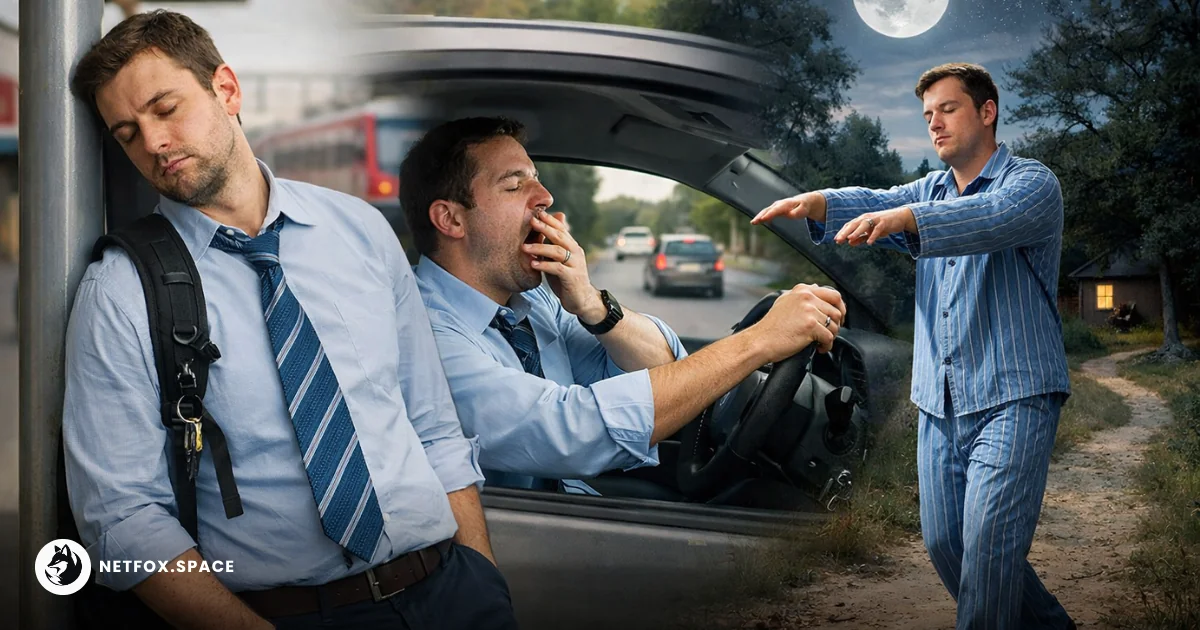
The 25-Kilometer Gauntlet: Living with Automatic Behavior
For years, my morning routine was a high-stakes gamble involving a 25-kilometer stretch of highway. Diagnosed with Type 1 Narcolepsy and REM sleep behavior disorder, my brain frequently bypasses the transition between wakefulness and sleep. This creates a state known as Automatic Behavior, where the body continues a complex task—like steering a vehicle at 100 km/h—while the conscious mind is effectively offline.
The commute from my suburban home to the city center was not just a drive; it was a battle against the "sleep attack." Unlike simple tiredness, these neurological events are sudden and irresistible. On multiple occasions, I would "wake up" three kilometers past my intended exit with no memory of the preceding five minutes, my hands still gripped white-knuckled on the steering wheel.
The Physics of a Near-Miss: When Sleepwalking Meets Traffic
The turning point occurred during a rainy Tuesday evening on the M1 Motorway. While merging into high-speed traffic, a sudden wave of cataplexy—a sudden loss of muscle tone triggered by the stress of a near-cut-off—rendered my knees weak and my eyelids heavy. I drifted across two lanes of traffic, narrowly missing a concrete barrier.
These terrifying lapses are not merely "dozing off." They represent a systemic failure of the Hypothalamus, which fails to produce sufficient orexin to regulate arousal. In a vehicle, this translates to a total lack of situational awareness. The sensory data of the road is processed, but the executive function required to react to a sudden brake light is absent, creating a lethal lag in response time.
The Neurological Blind Spot: Why Traditional Road Safety Fails
Standard road safety advice—such as "pull over and have a coffee"—is fundamentally inadequate for those with chronic sleep-wake instability. Most public safety campaigns target "drowsy driving," which assumes a gradual onset of fatigue. Narcolepsy is a binary switch; you are awake until, neurologically, you are not.
Competitive analysis of sleep disorder management often misses the "Cognitive Loading" factor. The sheer mental energy required for a narcoleptic to stay present during a 25km drive causes a feedback loop of exhaustion. By the time I reached my office, my neurological "battery" was depleted, leading to a higher frequency of sleepwalking episodes later that evening. Understanding that the commute itself was the primary trigger for the worsening of my nocturnal sleepwalking was the key to structural improvement.
Comparative Risk Mitigation Strategies
| Strategy Category | Traditional Approach | My Implemented Protocol |
|---|---|---|
| Medication Timing | Standard morning dose | Split-dose titration 30 mins pre-commute |
| Route Selection | Fastest path (Highways) | High-engagement backroads (Lower speeds) |
| Environmental | Radio or podcasts | Cold-air induction and vocal stimulation |
| Structural | Trying to "power through" | Mandatory 15-minute "prophylactic nap" |
| Technological | Standard Cruise Control | Lane-keep assist and driver-monitoring sensors |
The Infrastructure Gap: How Modern Design Taxes the Sleep-Deprived
Current urban planning and long-distance infrastructure are built for the "neurotypical" driver. Highways are designed to be monotonous to reduce driver agitation, but for someone with narcolepsy, this monotony is a chemical trigger for sleep. The lack of sensory variation on a 25km stretch of smooth asphalt acts as a hypnotic inducer.
To improve my survival rate, I had to deliberately "break" the efficiency of my commute. I transitioned from the high-speed motorway to a route involving more frequent stops and turns. This increased the "Attentional Demand," forcing my brain to remain in an active state. While this added 15 minutes to my journey, the metabolic cost of navigating intersections prevented the transition into a trance-like automatic state.
Strategic Realignment and the Future of the Commute
The long-term resolution required moving beyond physical interventions and into biological management. Adhering to a strict "Sleep Hygiene" regimen—overseen by the American Academy of Sleep Medicine guidelines—was only the baseline. The real shift came from advocating for a hybrid work model to reduce the weekly "mileage of risk."
However, even with optimized medication and route changes, the underlying risk remains. As vehicle automation technology advances, the legal and ethical framework for drivers with neurological conditions remains in flux. The looming question is whether future regulations will mandate biometric monitoring for all high-risk drivers, potentially stripping the autonomy of those who have spent years mastering their own symptoms.
Comments (0)
Please login to comment
Sign in to share your thoughts and connect with the community
Loading...