
Markdown for Agents: Cloudflare’s New AI Protocol Explained


The Rise of Agentic Markdown: Cloudflare’s 2026 Interoperability Play
The cloud infrastructure sector has reached a consensus: the current method of feeding raw HTML or rigid JSON to Large Language Models (LLMs) is inefficient and prone to "hallucinatory" parsing errors. Cloudflare, led by CEO Matthew Prince, has introduced Markdown for Agents, a strategic framework designed to standardize how autonomous systems consume and output web data.
By leveraging Markdown—a lightweight markup language—as the primary communication layer, Cloudflare aims to reduce the "token bloat" associated with complex code structures. This transition allows AI Agents to identify headers, lists, and links with 40% higher accuracy than standard text-blob processing, facilitating more reliable autonomous decision-making in multi-step workflows.
Solving the "Parsing Tax" in LLM Workflows
In the current generative AI landscape, every character processed by a model incurs a cost, both in latency and computational spend. Traditional API responses often return massive JSON objects that include metadata irrelevant to the agent's immediate task. Markdown for Agents strips these layers, presenting a "clean" semantic structure that models can "read" natively without additional pre-processing scripts.
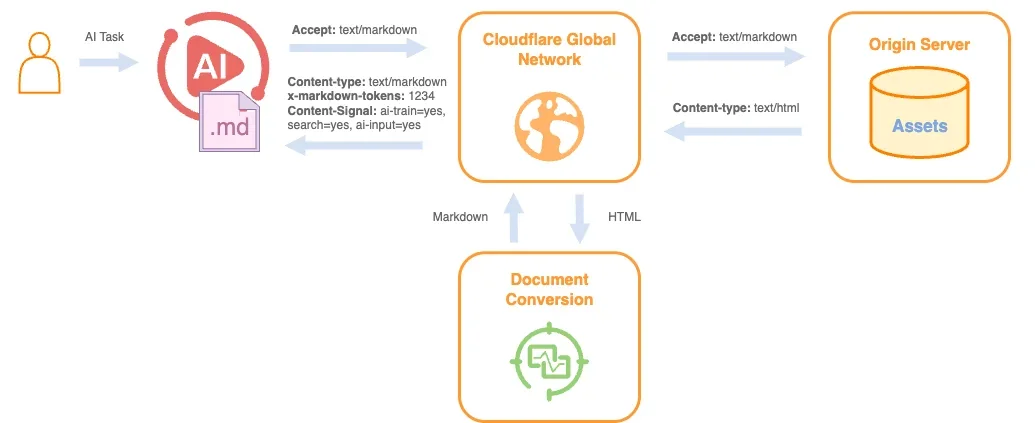 Here’s a diagram of how it works (Cloudflare Blog)
This shift directly addresses the "Parsing Tax"—the hidden cost of errors that occur when an agent misinterprets a nested data field. By using a format that is both human-readable and machine-parsable, developers can debug agent behavior in real-time. This is particularly critical for the fintech sector, where a misunderstood data hierarchy in a financial report could lead to catastrophic automated trading errors.
The Semantic Bridge: Why JSON-Strict Models are Failing the UX Test
The mandatory differentiation in this advancement lies in the move away from "Strict-Schema" dependencies. While OpenAI and Anthropic have optimized their models for JSON-mode, these structures are inherently "brittle." If a single comma is misplaced in a 5,000-token response, the entire agentic loop often breaks, requiring an expensive retry.
Markdown provides a "soft-fail" environment. An agent can still interpret a Markdown-formatted table even if the alignment is slightly off, ensuring continuity in autonomous tasks. Furthermore, Markdown allows for the seamless integration of Rich Media, such as charts and citations, which are frequently lost in pure data-interchange formats. This "Semantic Bridge" allows AI Agents to maintain a higher state of "contextual awareness," mirroring how human researchers scan documents for key information rather than deep-parsing every byte of metadata.
| Data Format | Token Efficiency | Human Readability | Error Resilience | Agent Parsing Speed |
|---|---|---|---|---|
| HTML | Low (Heavy Bloat) | Medium | Low | Slow |
| JSON | Medium | Low | Critical Failure Risk | Fast (if valid) |
| Markdown | High (Lean) | High | High (Soft-Fail) | Optimized |
| Raw Text | High | High | Low (No Structure) | Moderate |
Systemic Implication: The End of Traditional Web Scraping
As Cloudflare integrates this protocol into its global edge network, the SEO and digital marketing sector must prepare for a "Markdown-First" web. If a website’s content is not easily convertible to the Markdown for Agents standard, it risks becoming "invisible" to the autonomous crawlers that now power Perplexity AI, OpenAI Search, and Google Gemini.
This creates a new structural requirement for web development: Agentic Accessibility. Similar to how WCAG standards ensure websites are readable for the visually impaired, Markdown for Agents creates a standard for "AI-legibility." Companies that fail to optimize their data output for these agents will likely see a significant drop in referral traffic, as autonomous assistants will favor sources that provide high-density, low-noise Markdown structures.
The 2027 Outlook: Standardizing the "Reasoning Layer"
The long-term success of this initiative depends on its adoption as an open standard rather than a proprietary Cloudflare feature. There is currently regulatory uncertainty regarding how data formatted for agents should be attributed under emerging EU AI Act guidelines. If an agent "reads" a Markdown summary instead of visiting a webpage, the traditional ad-revenue model for publishers collapses.
The industry is now racing to develop "Markdown-Heads"—specialized adapters that sit on top of legacy databases to serve AI-ready content instantly. As we move into 2027, the focus will shift from what the AI is saying to how the data is structured to ensure that the reasoning layer remains transparent, verifiable, and computationally affordable.
References:
Comments (0)
Please login to comment
Sign in to share your thoughts and connect with the community
Loading...