
Lightpanda: Why the Machine-First Browser Beats Chromium

The Architecture of Inefficiency in Human-Centric Browsing
For two decades, the Chromium Project, spearheaded by Google LLC, has defined the modern web experience. However, Chromium and its commercial counterpart, Google Chrome, were architected for human interaction—prioritizing visual rendering, persistent sessions, and user interface responsiveness. This legacy design includes heavy sub-systems for extensions, sync services, and complex caching mechanisms that facilitate "human" browsing but act as dead weight in cloud environments.
When a machine or an AI agent triggers a Chromium instance in a headless environment, it executes millions of lines of code dedicated to features the machine will never use. This results in significant "cold start" latency, often taking seconds to initialize. In the high-frequency world of data extraction and automated testing, these seconds aggregate into massive computational waste and inflated cloud infrastructure costs.
Engineering Speed with the Zig Programming Language
Lightpanda.io has departed from the industry-standard C++—the foundation of Chromium—to build its engine using the Zig programming language. This choice is strategic; Zig provides the low-level memory control of C but with modern safety features and a focus on optimal binary size. By stripping away the legacy bloat of the Blink rendering engine and the V8 JavaScript engine's human-optimized overhead, Lightpanda achieves near-instantaneous startup times.
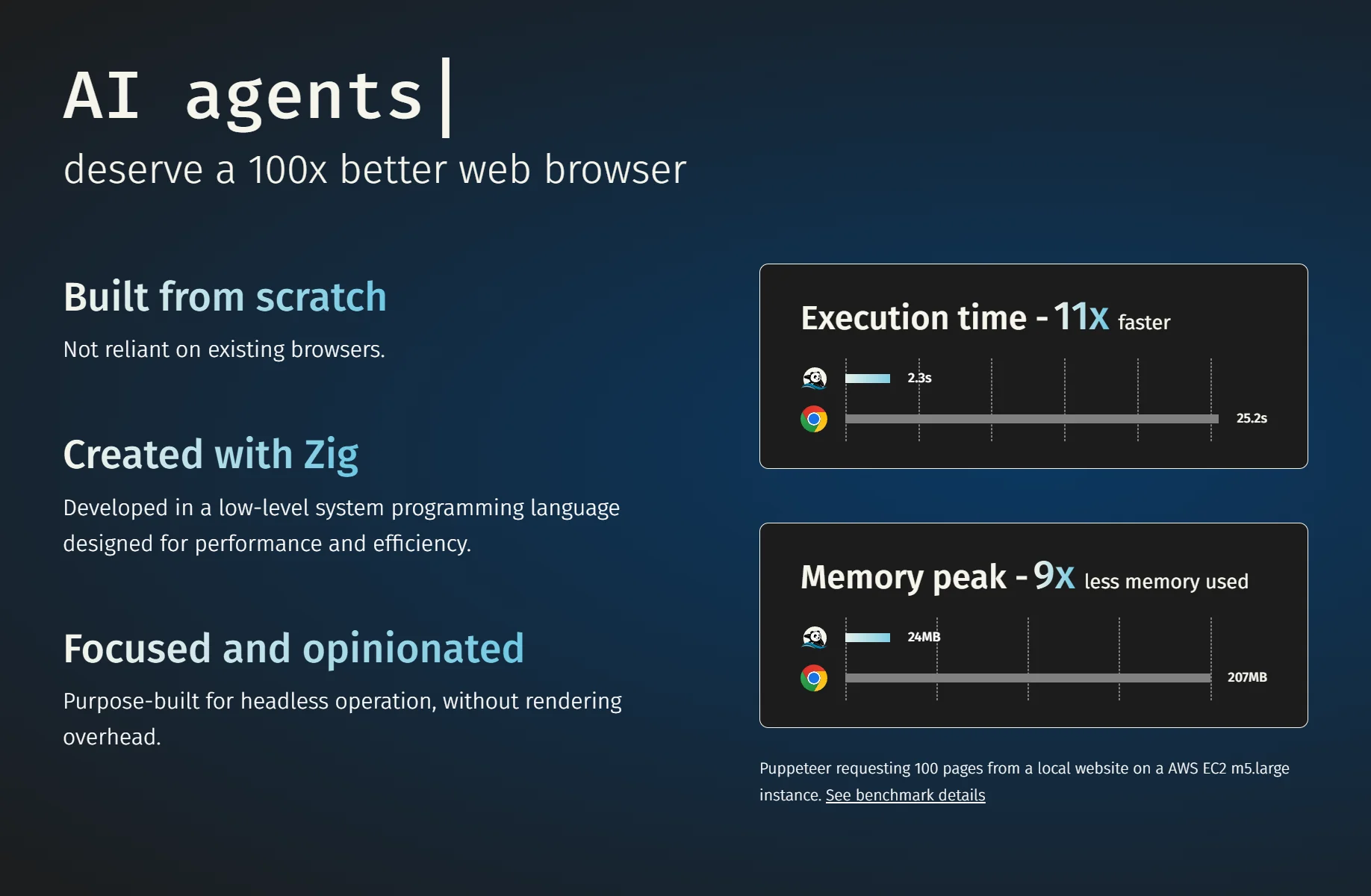 The first browser for machines, not humans. 10x faster. 10x less memory. Instant startup.
The shift to Zig represents a broader movement toward minimalist, high-performance systems. While the industry often debates the merits of memory safety in languages like Rust, Zig’s focus on explicitness and lack of a hidden runtime makes it uniquely suited for "machine browsers" that must operate with surgical precision. For a deeper dive into how this language choice impacts modern development, see the analysis on Rust vs. Zig in 2025.
The Agentic Infrastructure Shift: Browsing as a Compute Resource
Current market analysis suggests we are entering the "Agentic Era," where the primary consumers of web content are no longer humans, but AI agents. Unlike humans, these agents do not need a visual DOM (Document Object Model) to be painted on a screen; they need structured data and execution environments.
The traditional browser is a "stateful" entity, carrying cookies, local storage, and history across sessions. For automation, this state is a liability. Lightpanda introduces a paradigm where the browser is treated as a stateless compute resource. Each request is isolated, preventing the "noisy neighbor" effect and cross-contamination of data. This structural shift moves the browser from being a piece of software you "run" to a high-speed API you "invoke," fundamentally altering the economics of the SaaS and web scraping sectors.
Security Paradigms: Eliminating the Shared State Risk
Standard browsers are inherently "leaky" by design to support user convenience. Persistent cookies and session tokens are stored to keep users logged in, but in the context of automated workflows, this creates a massive attack surface. If a single browser instance in a cloud cluster is compromised, the shared state can potentially expose sensitive credentials from previous tasks.
Lightpanda’s "machine-first" philosophy mandates absolute isolation. By ensuring that every process starts from a clean slate without the overhead of clearing cache or managing profiles, it mitigates common vulnerabilities such as session hijacking and cross-site scripting (XSS) persistence. This makes it an essential tool for Cybersecurity firms and FinTech institutions that require rigorous data provenance and environment purity for their automated compliance checks.
Economic Comparison: Cloud-Native Browser Efficiency
The financial exposure of sticking with Chromium for large-scale automation is becoming untenable for high-growth tech firms. Below is a comparative breakdown of resource allocation between traditional "headless" Chrome and the Lightpanda machine-first approach.
| Metric | Chromium (Headless) | Lightpanda (Zig-based) | Sector Impact |
|---|---|---|---|
| Startup Latency | 800ms – 3,000ms | 10ms – 50ms | Real-time Execution |
| RAM per Instance | 150MB – 400MB | < 20MB | Server Density |
| Binary Size | ~150MB | < 10MB | Deployment Speed |
| State Management | Persistent (Risk) | Ephemeral (Secure) | Compliance/Security |
| Primary Language | C++ | Zig | Performance/Safety |
The Inevitability of Headless Evolution
As the OpenAI and Anthropic ecosystems expand, the demand for "Browser-as-a-Service" (BaaS) will pivot away from visual fidelity toward execution speed. The technical debt of Chromium—while manageable for desktop users—is a terminal bottleneck for the next generation of the autonomous web. The transition to Zig-based, machine-optimized engines signals a future where the "web browser" disappears entirely into the backend stack, functioning more like a standard library than a standalone application.
This shift leaves a significant regulatory uncertainty regarding how websites will distinguish between "legitimate" machine browsers and malicious bots, as the performance gap between the two continues to close.
References:
-
Lightpanda GitHub
-
Zig Software Foundation
-
Chromium Project
Comments (0)
Please login to comment
Sign in to share your thoughts and connect with the community
Loading...