
Anthropic & Mozilla Partner to Secure Firefox with AI

The Silicon Valley Security Compact
On March 6, 2026, Anthropic, the San Francisco-based artificial intelligence safety firm, announced a formal partnership with the Mozilla Foundation to harden the Firefox web browser. This initiative seeks to integrate advanced Large Language Models (LLMs) into the browser’s continuous integration and deployment (CI/CD) pipelines to identify complex security flaws before they reach production. Dario Amodei, CEO of Anthropic, framed the move as a critical step in using "AI for defense" to counteract the rising tide of AI-generated malware.
The collaboration focuses on the browser technology sector, where the stakes for user privacy and data integrity are at an all-time high. By granting Mozilla developers access to specialized versions of the Claude model, the partnership aims to automate the tedious process of code auditing. This allows the non-profit organization to compete with the massive engineering resources of corporate rivals while maintaining its commitment to open-source transparency.
Eliminating the "Memory Safety" Achilles' Heel
Firefox, like most modern browsers, relies on millions of lines of C++ code, a language that is powerful but notoriously susceptible to memory-management errors. These vulnerabilities—such as buffer overflows and use-after-free bugs—account for approximately 70% of high-severity security patches across the industry. Through this partnership, Mozilla engineers are using AI to facilitate the migration of critical components to Rust, a memory-safe language originally sponsored by Mozilla itself.
The immediate impact is a more resilient "sandbox"—the isolated environment where web code executes. By leveraging AI to scan legacy codebases for subtle patterns that traditional "fuzzing" tools often overlook, the team can predict how a malicious actor might attempt to escape the sandbox. This proactive approach is designed to neutralize exploits before they can be weaponized in the wild, providing a significant safety net for the general public.
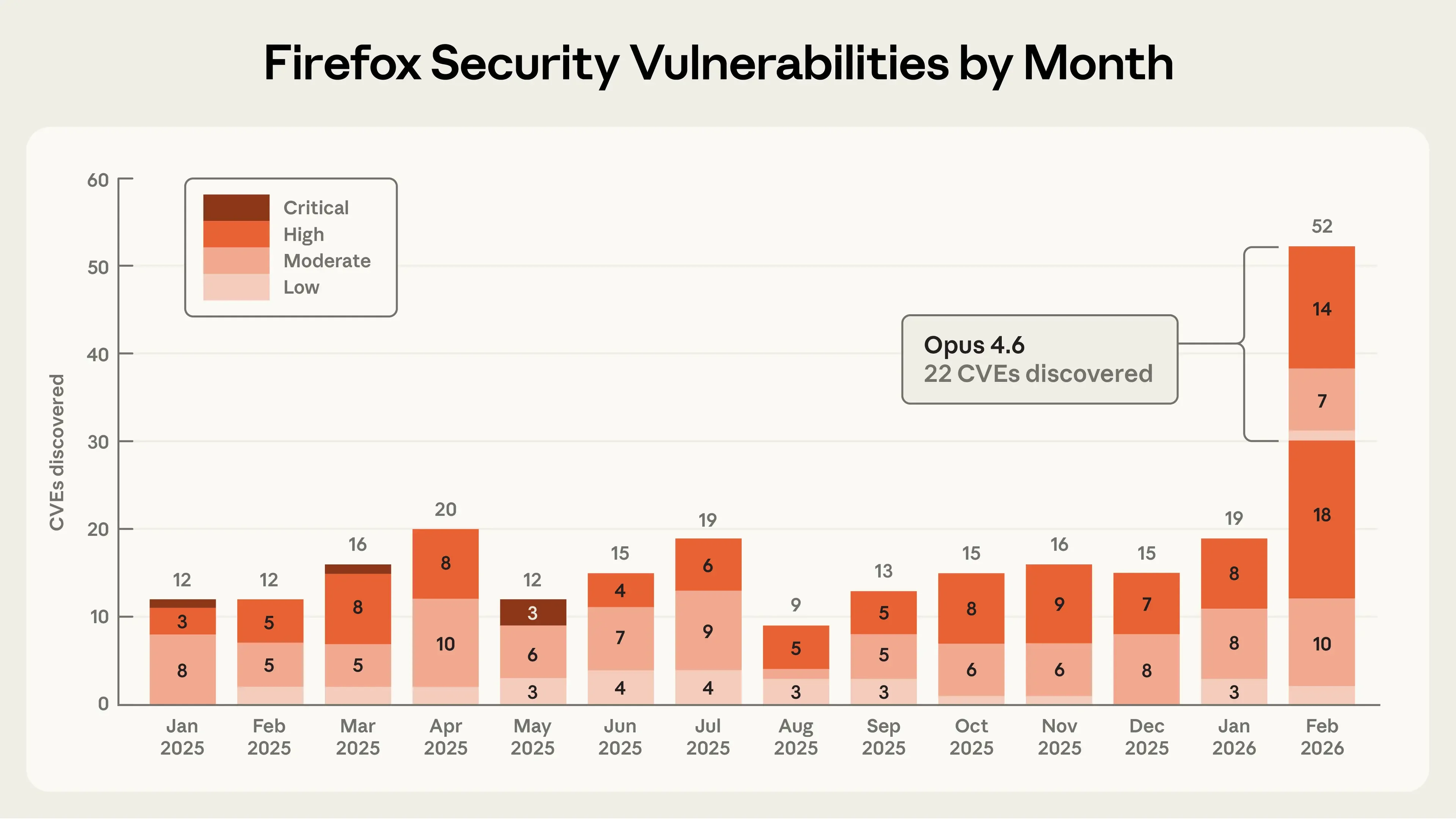 Firefox security vulnerabilities reported from all sources, by month. Claude Opus 4.6 found 22 vulnerabilities in February 2026, more than were reported in any single month in 2025.
Security Methodology Comparison: Legacy vs. AI-Assisted
| Security Metric | Legacy Fuzzing (Manual/Automated) | AI-Assisted (Anthropic/Mozilla) |
|---|---|---|
| Bug Detection Latency | Weeks to Months | Real-time / Hours |
| Code Coverage | Procedural / Surface-level | Contextual / Deep-logic |
| False Positive Rate | High (Requires manual triage) | Low (Refined by LLM reasoning) |
| Primary Focus | Syntax and Crash triggers | Logic flows and Memory safety |
| Remediation | Manual Patching | AI-Suggested Code Refactoring |
Hidden Implications: The AI-vs-AI Arms Race in Browser Sandboxing
While the public discourse focuses on "finding bugs," the hidden implication of this partnership is the shift toward an automated zero-day response. In a landscape where state-sponsored actors use specialized AI to find and execute exploits in minutes, human-only security teams are no longer a viable defense. This collaboration transforms the browser into a dynamic, AI-monitored space that can recognize and neutralize polymorphic threats—malware that changes its own code to avoid detection.
Furthermore, this alliance challenges the "Chromium Monoculture." With Google's engine powering Chrome, Edge, and Brave, a single vulnerability in the Chromium core can expose billions of users. By developing a unique, AI-hardened security architecture for the Gecko engine (which powers Firefox), Mozilla is creating a biological-style "genetic diversity" in the web ecosystem. This ensures that a single AI-driven exploit cannot collapse the entire global internet infrastructure.
Systemic Impact on Digital Sovereignty and the DMA
The partnership carries significant weight within the European Union, where the Digital Markets Act (DMA) is forcing big tech companies to allow more competition. Regulators in Brussels have expressed concern over the concentration of browser technology in the hands of a few advertising-driven firms. A more secure, AI-powered Firefox provides a credible alternative that aligns with the EU’s focus on regional digital sovereignty and user-centric privacy.
As the United States also begins to scrutinize the dominance of the Alphabet Inc. ecosystem, the Anthropic-Mozilla alliance provides a roadmap for how independent players can leverage AI to bridge the resource gap. This isn't just about software; it’s about the financial exposure of the global fintech and e-commerce sectors, which rely on secure browsers to process trillions of dollars in transactions. A breach in a major browser is no longer a tech glitch; it is a systemic economic risk.
The Era of Autonomous Patching
The forward tension of this partnership lies in the move toward "autonomous patching." Engineers are currently testing a "closed-loop" system where Claude identifies a flaw, suggests a Rust-based replacement, and automatically verifies the fix against the browser’s massive test suite. This could theoretically reduce the window of exposure for users from days to seconds, fundamentally altering the economics of cyberattacks by making exploits obsolete almost as soon as they are conceived.
However, this transition introduces a new regulatory uncertainty: if an AI-generated patch introduces an unforeseen structural failure, the liability frameworks within the United Kingdom and the United States remain largely unwritten. As the browser becomes an autonomous defensive agent, the line between software engineering and algorithmic governance continues to blur, creating a high-stakes experiment in the future of trust on the open web.
References:
Comments (0)
Please login to comment
Sign in to share your thoughts and connect with the community
Loading...