
OpenAI Acquires Astral: The Rustification of AI Development


The Speed Moat: Integrating Ruff into the OpenAI Ecosystem
On March 20, 2026, OpenAI officially announced the acquisition of Astral, the high-performance software company responsible for the Ruff linter and uv package manager. This move brings Charlie Marsh, the founder of Astral and a former engineer at Khan Academy, directly into the OpenAI research and infrastructure fold. The acquisition is not merely a talent grab; it is a tactical absorption of the fastest-growing developer toolchain in the Python ecosystem.
Ruff has gained massive adoption by being 10 to 100 times faster than legacy tools like Flake8 or Black. For a company like OpenAI, which manages one of the world's largest and most complex Python codebases to power its GPT-5.2 architecture, reducing linting and formatting times from minutes to milliseconds is a critical operational efficiency. This integration allows for near-instantaneous continuous integration (CI) pipelines, accelerating the deployment of frontier models.
Scaling the AI-Generated Code Loop
The primary driver behind this acquisition is the evolution of AI agents that write and execute code autonomously. As OpenAI moves toward "Agentic Workflows," the bottleneck is no longer how fast a human can write code, but how fast the system can validate and fix it. By embedding Astral’s Rust-based engine directly into its inference API, OpenAI can provide real-time, "correct-by-construction" code generation.
When an AI generates a Python script, it must be checked for syntax errors, security vulnerabilities, and stylistic consistency. Legacy Python tools, written in Python themselves, are too slow for the millisecond-latency requirements of agentic loops. Astral’s tooling, written in Rust, provides the sub-second feedback necessary for an AI to iterate on its own code without human intervention.
Beyond Tooling: The Strategic Pivot to High-Performance Systems
While most analysts view this as a developer-experience play, the hidden implication is the broader Rust Revolution currently sweeping through Silicon Valley. OpenAI is signaling that the future of AI infrastructure is a hybrid model: the flexibility of Python for researchers, backed by the memory safety and speed of Rust for the underlying engine.
This acquisition mirrors a larger industry trend where major players like Microsoft Corporation are moving to replace C/C++ with Rust to eliminate memory-related bugs. By owning Astral, OpenAI secures the expertise needed to "Rustify" the entire Python data science stack. This could eventually lead to a native Rust implementation of core libraries like Pandas or NumPy, further distancing OpenAI’s performance capabilities from open-source competitors.
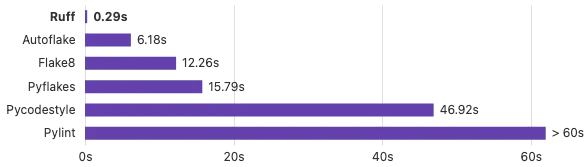 An extremely fast Python linter and code formatter, written in Rust.
The Data Science Performance Gap
The efficiency gains from replacing the legacy Python toolchain are quantifiable. The table below illustrates the performance leap OpenAI gains by moving from traditional Python-based tools to the Astral-native stack.
| Tool Category | Legacy Tool (Python-based) | Astral Tool (Rust-based) | Speed Improvement |
|---|---|---|---|
| Linting | Flake8 | Ruff | 10x – 100x |
| Formatting | Black | Ruff Format | 30x – 50x |
| Package Sync | pip / poetry | uv | 10x – 100x |
| Startup Time | ~200ms | <10ms | ~20x |
Source: Astral Performance Benchmarks 2026
Impact on the Open Source Community and Python Governance
The acquisition raises significant questions for the Python Software Foundation (PSF) regarding the centralization of essential developer tools. Ruff and uv have become foundational to the ecosystem, used by projects like FastAPI, Pandas, and Hugging Face. With Astral now under OpenAI’s control, the community is wary of "vendor lock-in" or a shift in focus toward OpenAI-specific features at the expense of general-purpose utility.
Sam Altman, CEO of OpenAI, has pledged to keep the core Astral tools open source, yet the tension remains. If OpenAI begins prioritizing "AI-friendly" linting rules or exclusive integrations for its own platforms, it could fragment the Python ecosystem. This move forces a confrontation between the traditional, slow-moving community-led development and the high-velocity, corporate-backed "Rustification" of the web's most popular programming language.
The future of Python development is no longer about human readability alone; it is about machine-speed execution. As OpenAI integrates Astral, the industry waits to see if this marks the beginning of a "closed-loop" development environment where AI writes, tests, and optimizes its own infrastructure with a speed that renders human-led development cycles obsolete.
References:
-
Astral Official (GitHub)
-
OpenAI Newsroom
-
Rust Foundation Industry Report 2026
-
Astral to join OpenAI
Comments (0)
Please login to comment
Sign in to share your thoughts and connect with the community
Loading...