
NVIDIA NemoClaw: Securing the OpenClaw Agent Ecosystem


The NemoClaw Stack: Bridging the Gap in Autonomous Agency
At the GTC 2026 conference, NVIDIA announced the launch of NemoClaw, a purpose-built software stack designed to fortify the OpenClaw agent platform. This release marks a transition from passive generative models to "agentic AI"—autonomous entities capable of executing multi-step workflows without constant human intervention.
NemoClaw enables a single-command installation that integrates NVIDIA Nemotron models with the newly introduced NVIDIA OpenShell runtime. By providing a unified deployment method, the stack simplifies the process of creating "claws"—self-evolving assistants that can manage files, write code, and navigate software environments. This infrastructure is designed to run across diverse environments, including the cloud, on-premises servers, and local hardware.
Localized Intelligence: RTX PCs and DGX Spark Deployment
A core component of the NVIDIA strategy is the decentralization of agentic power. NemoClaw is optimized to run locally on NVIDIA GeForce RTX PCs and laptops, as well as high-end NVIDIA RTX PRO workstations. This local execution ensures that sensitive user data remains within the hardware perimeter, bypassing the latency and privacy risks associated with pure cloud-based AI.
For enterprise-scale local deployment, the stack supports the NVIDIA DGX Station and the new NVIDIA DGX Spark AI supercomputer. The DGX Spark, powered by the NVIDIA GB10 Grace Blackwell Superchip, provides the 1 petaFLOP of performance necessary for agents to perform real-time reasoning and "self-correction." This hardware synergy allows agents to develop new skills through a "privacy router" that selectively connects to cloud-based frontier models only when local compute is insufficient.
The "Lethal Trifecta" Filter: Securing the Agentic Frontier
While OpenClaw—created by Peter Steinberger—has become the fastest-growing open-source project in history, it introduced what cybersecurity researchers term a "lethal trifecta" of risks: unrestricted system access, external communication capability, and the potential to execute malicious code. NemoClaw serves as the critical "infrastructure layer" that was previously absent from the open-source ecosystem.
The mandatory differentiation in NVIDIA’s approach lies in the NVIDIA OpenShell runtime. Unlike standard wrappers, OpenShell functions as an isolated sandbox that sits between the agent and the operating system. It enforces policy-based guardrails that strictly define what an agent can see and do. This allows a "claw" to have the agency required for productivity—such as modifying a local database—while preventing it from exfiltrating that data to unauthorized external endpoints.
| Component | Technical Function | Primary Security/Performance Value |
|---|---|---|
| NVIDIA OpenShell | Isolated Sandbox Runtime | Governs execution and prevents unauthorized system access. |
| NVIDIA Nemotron | Open-source LLM | Optimized for local reasoning and low-latency response. |
| Privacy Router | Hybrid Intelligence Gateway | Filters outgoing data before querying cloud frontier models. |
| NVIDIA Agent Toolkit | Orchestration Layer | Coordinates multi-agent workflows and skill development. |
Systemic Shift: Moving from Generative Chat to Agentic Action
The introduction of NemoClaw signals a shift in the semiconductor industry and software development. Jensen Huang, founder and CEO of NVIDIA, described OpenClaw as the "operating system for personal AI," comparing its impact to the rise of Microsoft Windows or macOS. The focus is no longer just on generating text but on executing actions through a "digital employee" model.
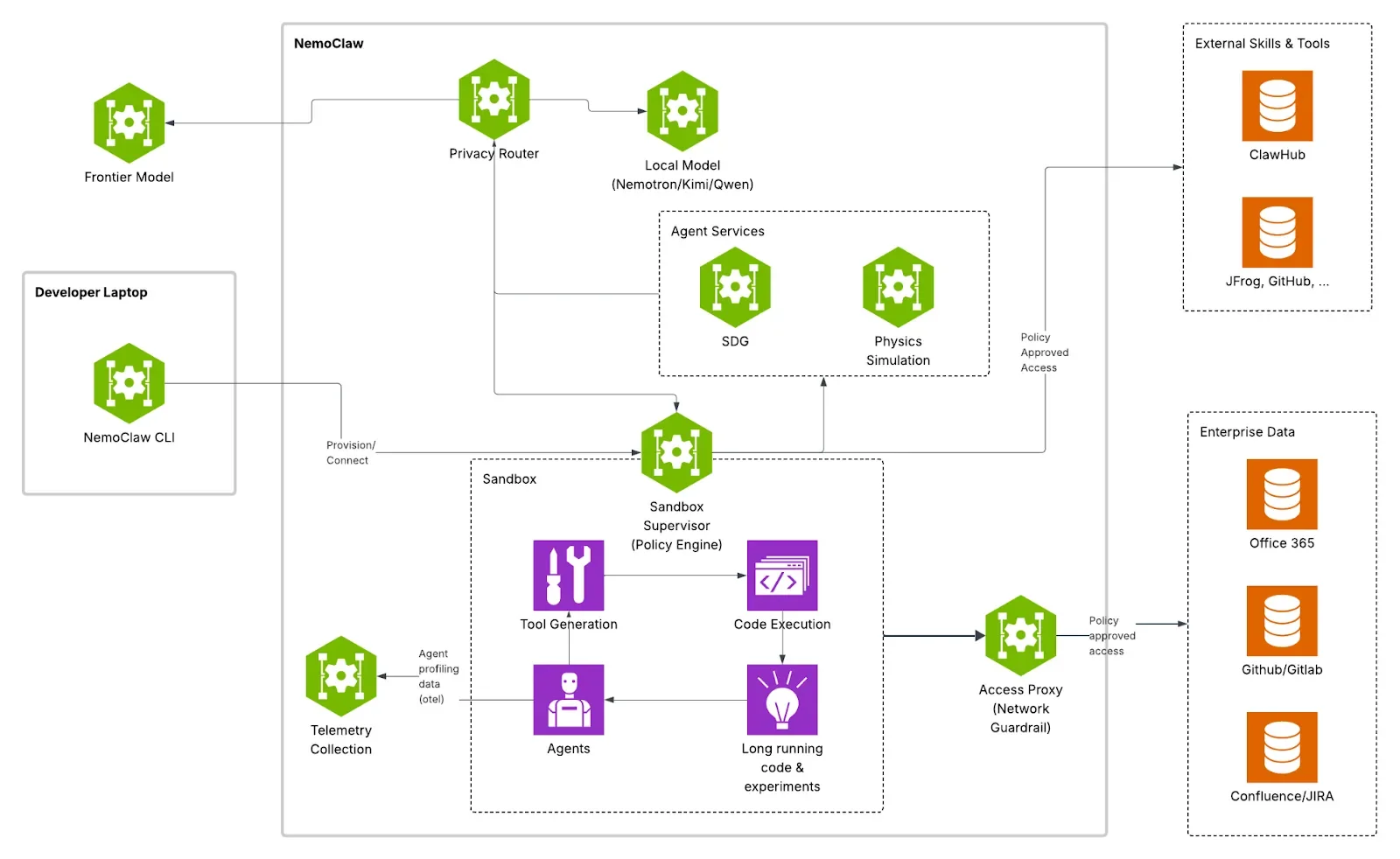 OpenShell’s architecture for safer autonomous agents, illustrating the core components: the sandbox, the policy engine, and the privacy router.
This shift creates a new demand for persistent, always-on compute. Unlike traditional applications that sit idle, autonomous agents require 24/7 background processing to monitor tasks and evolve. This necessity validates NVIDIA's push into the Grace Blackwell architecture, which is specifically tuned for the high-frequency inference cycles required by self-learning agents that must constantly "think" to stay useful.
Institutional Alignment and the Open Source Renaissance
The NemoClaw release is not an isolated product but a strategic contribution to a broader ecosystem that includes OpenAI, Meta, and Zhipu AI. By positioning itself as the provider of the "guardrails and hardware," NVIDIA ensures that regardless of which model a developer chooses, the underlying security and execution remain tethered to NVIDIA's software-hardware stack.
This alignment also addresses the growing regulatory scrutiny surrounding autonomous AI. By implementing hardcoded privacy controls at the runtime level rather than relying on model-level "alignment," NemoClaw provides a verifiable framework for enterprise compliance. As "claws" begin to handle financial transactions and internal corporate data, the ability to audit an isolated sandbox like OpenShell becomes a prerequisite for adoption in regulated sectors like banking and healthcare.
The rapid scaling of the OpenClaw community suggests that the industry is entering a period of "software renaissance." However, the autonomy granted to these agents creates a permanent tension between productivity and security. The success of NemoClaw will likely be measured by its ability to prevent the first high-profile "agentic breach"—a scenario where an autonomous assistant is subverted to act against its owner’s interests.
References:
Comments (0)
Please login to comment
Sign in to share your thoughts and connect with the community
Loading...