

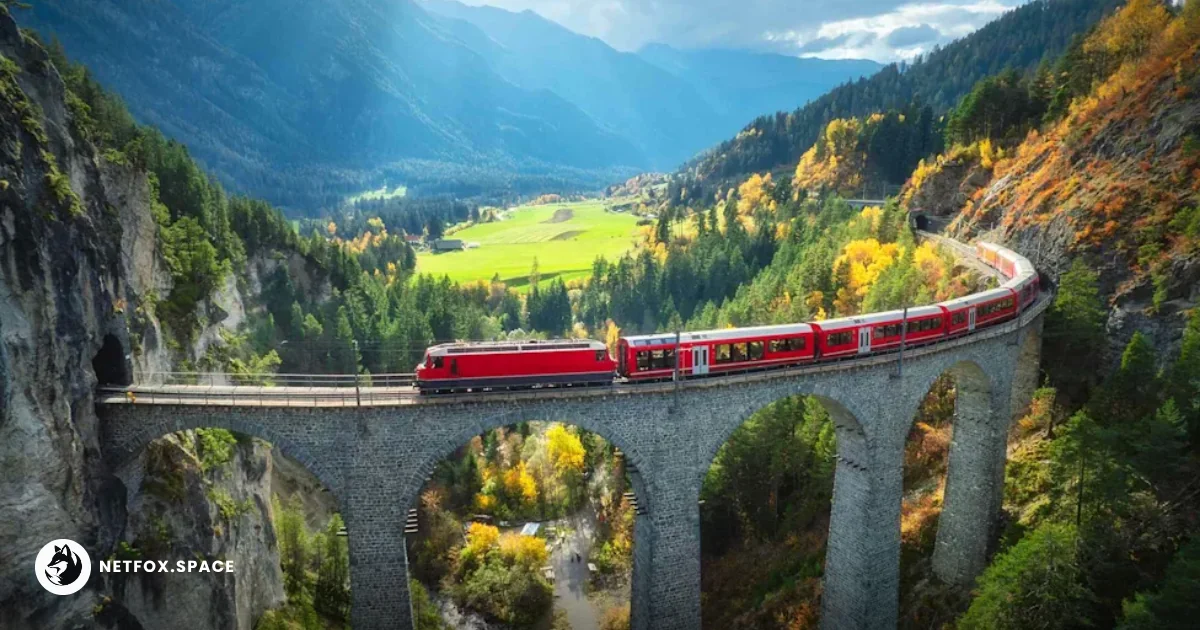
The Bernina Express, a 76-mile rail journey connecting Switzerland and Italy, has been named the most beautiful train route in Europe. The designation highlights a route that functions as both a vital piece of Alpine infrastructure and a UNESCO World Heritage site known for extreme elevation changes.
Navigating a 7,000-foot vertical ascent without rack-and-pinion
The most distinct technical feature of the Bernina Express is its ability to manage a massive shift in altitude without the use of a cog or rack-and-pinion system. Starting in Chur, the oldest city in Switzerland, the train climbs to its highest point at Ospizio Bernina, situated at 7,391 feet above sea level.
This ascent requires the train to handle gradients as steep as 7%, a feat achieved through a series of loops and tunnels designed to lengthen the track and reduce the steepness of the climb. For travelers, this means the environment shifts rapidly from the high-Alpine glaciers of the Bernina Pass to the Mediterranean-influenced palm trees of Tirano, Italy, in roughly four hours.
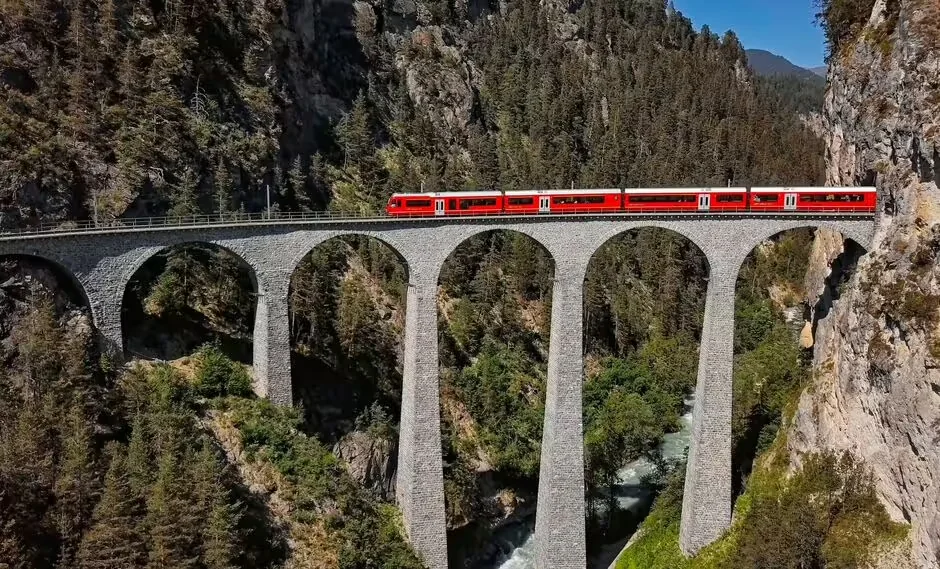 Travelling by train is a great way to see Europe. (Image: Getty)
Architectural milestones across 196 bridges and 55 tunnels
The "most beautiful" ranking is supported by the route's dense concentration of engineering landmarks. The journey passes over 196 bridges and through 55 tunnels, many of which are considered masterpieces of early 20th-century construction.
Two specific structures define the route's identity. The Landwasser Viaduct, a 213-foot-high limestone bridge, leads the train directly into a tunnel carved into a vertical rock face. Further south, near the Italian border, the Brusio Spiral Viaduct serves a purely functional purpose: it allows the train to change elevation within a very tight valley floor by traveling in a 360-degree circle. These structures are a primary reason the Rhaetian Railway in the Albula / Bernina Landscapes was granted UNESCO World Heritage status in 2008.
 RuslanKphoto / Shutterstock
Practical logistics for seasonal Alpine travel
While the route is operational year-round, the experience changes significantly based on the season. In winter, the focus is on the "Bernina Glaciers" and the frozen White Lake (Lago Bianco), while summer trips emphasize the lush green valleys of the Engadin region.
The train features panoramic carriages with floor-to-ceiling windows specifically designed to accommodate the steep angles of the surrounding peaks. However, travelers should note that the Bernina Express is a dedicated tourist train that requires seat reservations; those seeking more flexibility can travel the same tracks on local regional trains, which use the same infrastructure but lack the specialized panoramic windows and direct routing.
Comments (0)
Please login to comment
Sign in to share your thoughts and connect with the community
Loading...