
Lynx Framework: TikTok’s Native Rendering Powerhouse


ByteDance, the parent company of TikTok, has officially open-sourced Lynx, its high-performance cross-platform framework designed to deliver native user interfaces using standard web technologies. The release marks a significant shift in the mobile development landscape, directly challenging established players like React Native and Flutter by promising "native-first" performance without the steep learning curve of non-web languages.
The Dual-Threaded Performance Breakthrough
Unlike traditional web-based frameworks that often struggle with UI lag during heavy computation, Lynx utilizes a unique dual-thread architecture. The framework separates user code execution into a background thread, while a dedicated main thread handles UI rendering and animations via PrimJS, a lightweight JavaScript engine optimized for speed.
Internal benchmarks from March 2025 suggest that surfaces migrating from traditional web-to-native bridges to Lynx achieved a 2x to 4x reduction in launch times. By eliminating the "JavaScript bridge" bottleneck that has long plagued React Native, Lynx allows for instant first-frame rendering (IFR), a critical metric for high-traffic apps like TikTok and TikTok Studio.
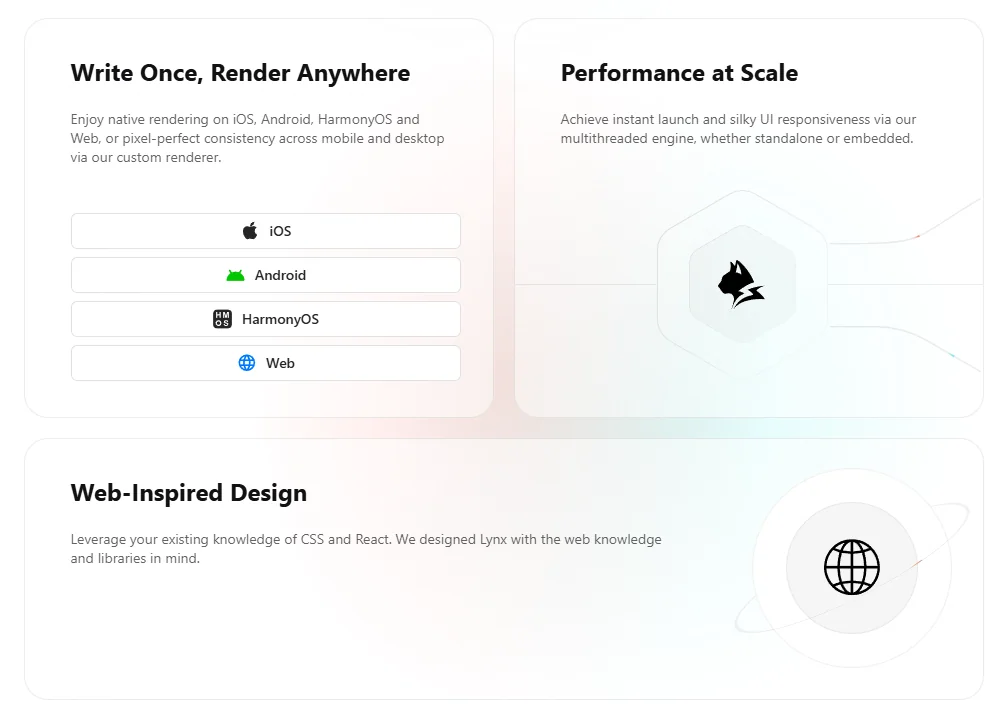 Empower the web community and invite more to build across platforms
Native Fidelity with CSS Simplicity
For years, mobile developers have had to choose between the performance of native code and the agility of the web. Lynx aims to bridge this gap by supporting real CSS, including complex transitions, animations, and Grid/Flexbox layouts. This allows developers to apply the same styling logic used in web browsers directly to native mobile components.
"Native is a necessity, not a luxury," the development team noted during the January 2026 update. By leveraging Rust-based tooling—specifically Rspack—the framework ensures that the build pipeline is as fast as the runtime itself. While ReactLynx is the flagship flavor, the core engine remains framework-agnostic, meaning it can eventually integrate with any modern JavaScript library.
Lynx vs. The Web Giants: A Structural Comparison
While Next.js, Angular, and Vue dominate the web, Lynx operates on a different architectural plane, focusing on native primitives rather than the browser's DOM.
| Feature | Lynx | Next.js | Angular | Vue |
|---|---|---|---|---|
| Primary Target | Native Mobile/Web | Web (SSR/Static) | Enterprise Web | Modern Web |
| Rendering | Native UI Elements | Browser DOM | Browser DOM | Browser DOM |
| Styling | Full CSS | CSS/Sass/Tailwind | CSS/Sass | CSS/Scoped |
| Architecture | Dual-Threaded | Single-Threaded | Single-Threaded | Single-Threaded |
| Owner | ByteDance | Vercel | Community |
The Roadmap to Global Adoption
Despite its technical prowess, Lynx faces the classic "cold start" problem of new open-source projects: ecosystem maturity. While it powers massive-scale features for TikTok Shop and LIVE, the library of third-party plugins is currently a fraction of what is available for Angular or Vue.
Critics argue that unless ByteDance can foster a community as robust as Meta's React Native, Lynx may remain a "power tool" for enterprise-level players rather than a default for solo developers. However, with the January 2026 rollout of Lynx for Web, the framework's ability to render pixel-perfect consistency across mobile, desktop, and even HarmonyOS makes it a formidable contender for the future of "write once, render anywhere."
References: lynxjs.org.
Comments (0)
Please login to comment
Sign in to share your thoughts and connect with the community
Loading...