
Alibaba AgentScope Technical Deep Dive: AOP and Fault Tolerance

The shift from simple Large Language Model (LLM) wrappers to autonomous agents has introduced a "complexity wall" in software engineering. While frameworks like LangChain focused on sequential chains and AutoGen on conversational patterns, Alibaba’s DAMO Academy has released AgentScope to address a more fundamental problem: the lack of a robust, production-grade application architecture for multi-agent systems. By treating agent interactions as a distinct paradigm called Agent-Oriented Programming (AOP), the framework moves beyond "prompt chaining" toward a distributed, message-passing system.
A three-layered architecture for distributed agentic logic
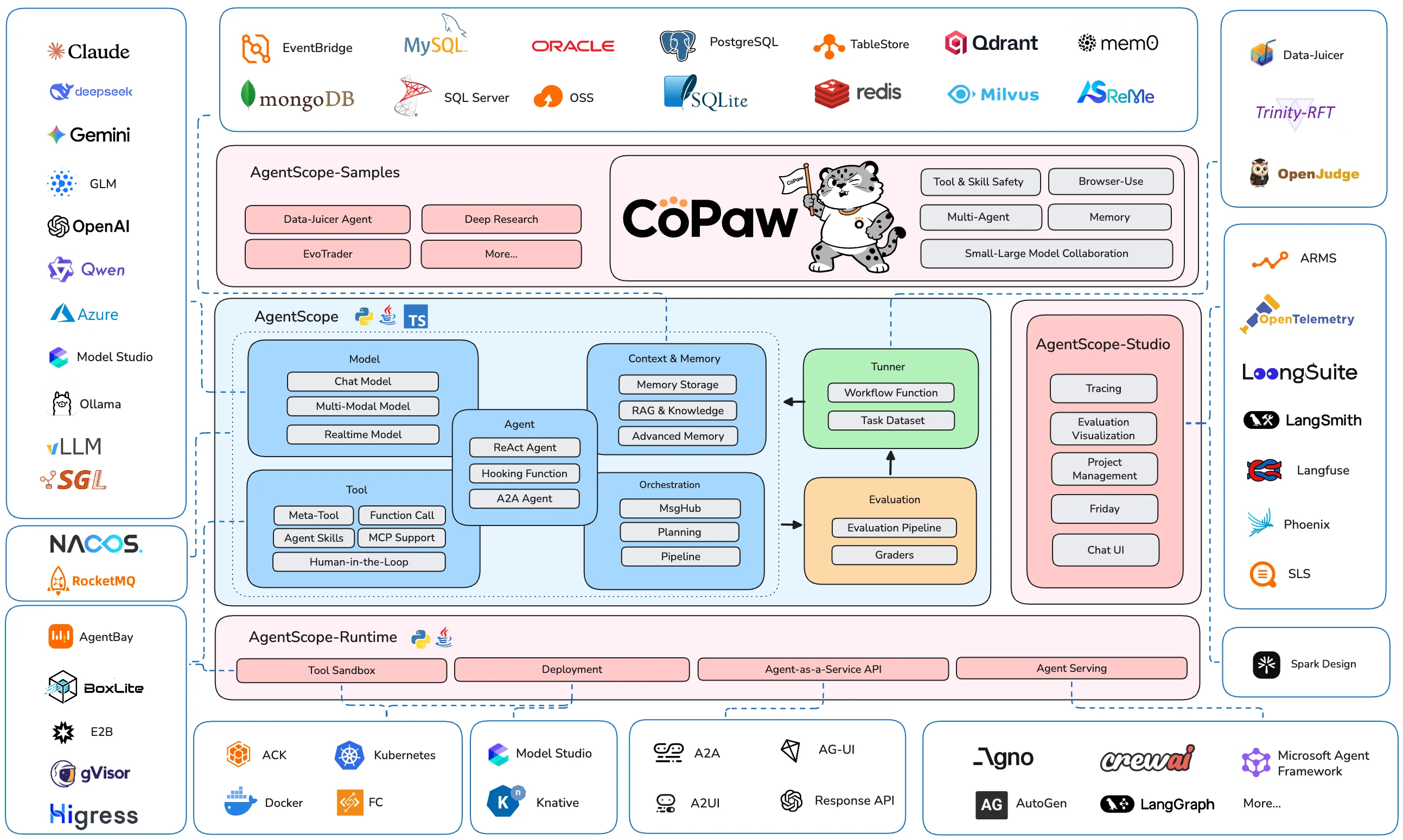
The core of AgentScope is built on a three-layered stack designed to decouple low-level model utilities from high-level agent logic. At the base is the Utility Layer, which handles raw model API invocations, code execution, and database operations. Above this sits the Manager and Wrapper Layer, which acts as the system's "operating system," managing resources and providing the hooks for advanced reasoning models to interact with infrastructure safely.
 The AgentScope Ecosystem
The top Agent Layer is where developers define the specific roles and workflows. Unlike previous frameworks that often relied on static graphs, AgentScope utilizes an actor-based distribution framework. This allows a single agent to be initialized locally and then transitioned to a distributed mode with minimal refactoring. For engineers, this addresses the "scale-out" problem where local prototypes often break when moved to a cluster-based production environment.
Four-tier fault tolerance to combat LLM unreliability
One of the most significant engineering hurdles in agentic workflows is the inherent "fuzziness" of LLM outputs. AgentScope implements a systematic four-tier fault tolerance mechanism to maintain system uptime when agents encounter errors.
-
Accessibility Errors: Handled by customizable auto-retry logic at the model wrapper level.
-
Rule-Resolvable Errors: For format-related failures (like unclosed JSON braces), the framework uses rule-based correction tools to fix the output without a second API call, reducing both latency and cost.
-
Model-Resolvable Errors: More complex semantic errors trigger "self-critique" or "pairwise critique" cycles where agents audit their own logic before finalizing a response.
-
Unresolvable Errors: These are escalated to a specialized logging system featuring a
CHATlogging level and a WebUI for human-in-the-loop intervention.
This hierarchy ensures that system-level failures do not cascade, a critical requirement for enterprise-grade automation where deterministic error handling is mandatory.
Multimodal support via unified ContentBlock abstraction
Handling non-textual data—images, audio, and video—has historically required custom pipelines for every model provider. AgentScope solves this by introducing a unified ContentBlock system. Within this architecture, all data types are treated as modular blocks (TextBlock, ImageBlock, AudioBlock, etc.) that can be mixed within a single message object.
This decoupled approach uses URLs to reference heavy media files, preventing the message-passing system from becoming bogged down by large binary payloads. By integrating this with Alibaba's Qwen3 voice technology and other vision-capable models, developers can build agents that "see" and "hear" without rewriting the orchestration logic. The framework’s Formatter mechanism automatically converts these ContentBlocks into the specific input format required by different LLM providers, ensuring high interoperability across the model landscape.
Engineering viewpoint: Moving from chains to messages
From a software engineering perspective, the most important contribution of AgentScope is the move toward explicit message passing. In many early agent frameworks, state management was often hidden behind "deep encapsulation," making it difficult to debug where a reasoning loop went wrong. AgentScope’s design principle of "transparency first" ensures that every state change and message exchange is visible and controllable.
The v1.0 release, which introduced full asynchronous execution, further optimizes performance for large-scale simulations. By allowing agents to operate non-blockingly while maintaining a shared "Message Hub," the framework effectively replicates the efficiency of traditional distributed systems. For teams building complex automation, AgentScope represents a shift from "AI that talks" to "AI that functions" as a reliable part of the software stack.
Comments (0)
Please login to comment
Sign in to share your thoughts and connect with the community
Loading...