
Quantum Computers Scale with Four-State Photonic Gate

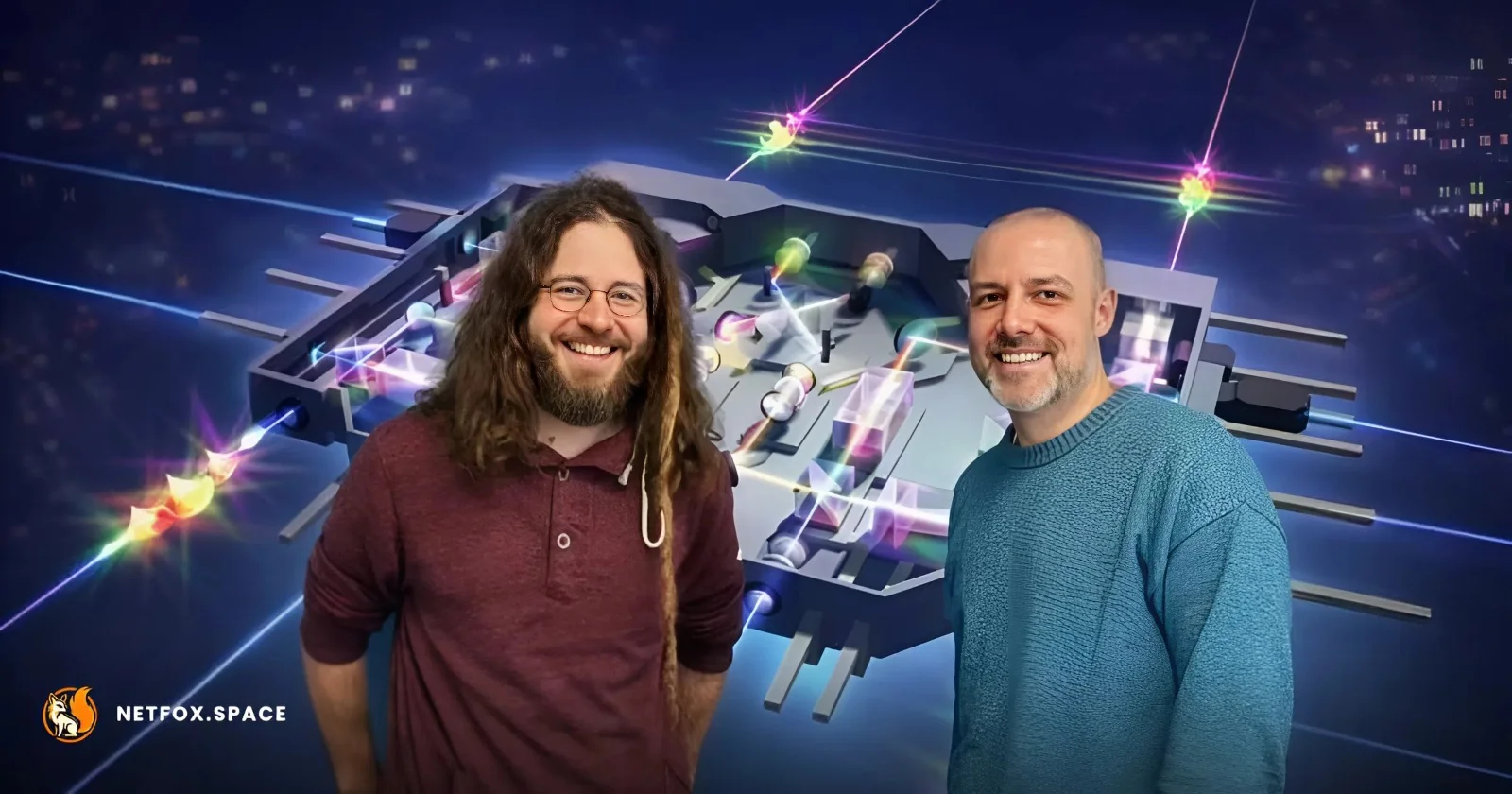
Beyond Binary: The Emergence of High-Dimensional Qudits
Traditional quantum computing has long been anchored to the "qubit," the quantum equivalent of a binary bit that exists in a superposition of two states: 0 and 1. However, a recent breakthrough led by researchers at TU Wien and a team from China has successfully demonstrated a quantum logic gate that utilizes "qudits"—quantum units that can occupy more than two states simultaneously.
By using pairs of photons that each inhabit four distinct quantum states, the team has effectively doubled the information density per particle compared to standard binary systems. This high-dimensional approach allows complex algorithms to be executed with significantly fewer physical components, addressing one of the most persistent bottlenecks in the race to build functional quantum hardware.
Engineering a Multi-State Optical Logic Gate
The implementation of this four-state gate, detailed in the latest issue of Nature Photonics, relied on sophisticated quantum entanglement between two photons. Unlike previous experimental setups that struggled with the stability of multi-dimensional states, this collaboration leveraged the spatial waveforms of light to maintain coherence across the four dimensions.
According to the research team, led by Hui-Tian Wang and colleagues in Vienna, the gate operates by precisely manipulating how these photons interact and interfere. This "two-photon, four-state" gate is essential for the reliable entanglement and disentanglement of complex data strings, a requirement for any architecture intended to perform error-corrected universal quantum computation.
| Specification | Standard Qubit System | New Four-State Gate |
|---|---|---|
| States per Unit | 2 (0, 1) | 4 (High-Dimensional) |
| Information Density | 1 bit per unit | 2 bits per unit |
| Primary Medium | Superconducting/Trapped Ion | Photonic (Light) |
| Resource Efficiency | Linear Scaling | Logarithmic Scaling |
Scalability and Noise Resilience in Photonic Systems
One of the most significant advantages of this photonic breakthrough is its inherent resistance to environmental noise. In many quantum systems, such as those using superconducting loops, the "fragility" of qubits leads to high error rates that require massive overhead for error correction. High-dimensional qudits, however, exhibit a higher tolerance for certain types of signal degradation.
Because a single qudit can carry the same amount of information as multiple qubits, the total number of physical particles required for a calculation is drastically reduced. This reduction in hardware complexity minimizes the potential points of failure within the system, suggesting that optical quantum computers may reach "quantum advantage" sooner than previously estimated for specific cryptographic and simulation tasks.
Redefining the Future of Optical Architectures
The successful demonstration of a four-state gate represents a fundamental departure from the binary logic that has dominated computing since the mid-20th century. As researchers move toward even higher dimensions, the traditional limitations of "qubit counts" may become a secondary metric to "state dimensionality" and gate fidelity.
The next challenge for the TU Wien and Chinese collaboration involves integrating these high-dimensional gates into a multi-gate circuit. If successful, this would validate a new roadmap for quantum infrastructure—one where the complexity of the universe is mirrored not by a sea of binary switches, but by the rich, multi-dimensional geometry of light itself.
Comments (0)
Please login to comment
Sign in to share your thoughts and connect with the community
Loading...