
NullClaw Lobster: Minimalist AI Infrastructure for $5 Boards

Engineering Efficiency for the Low-Cost Edge
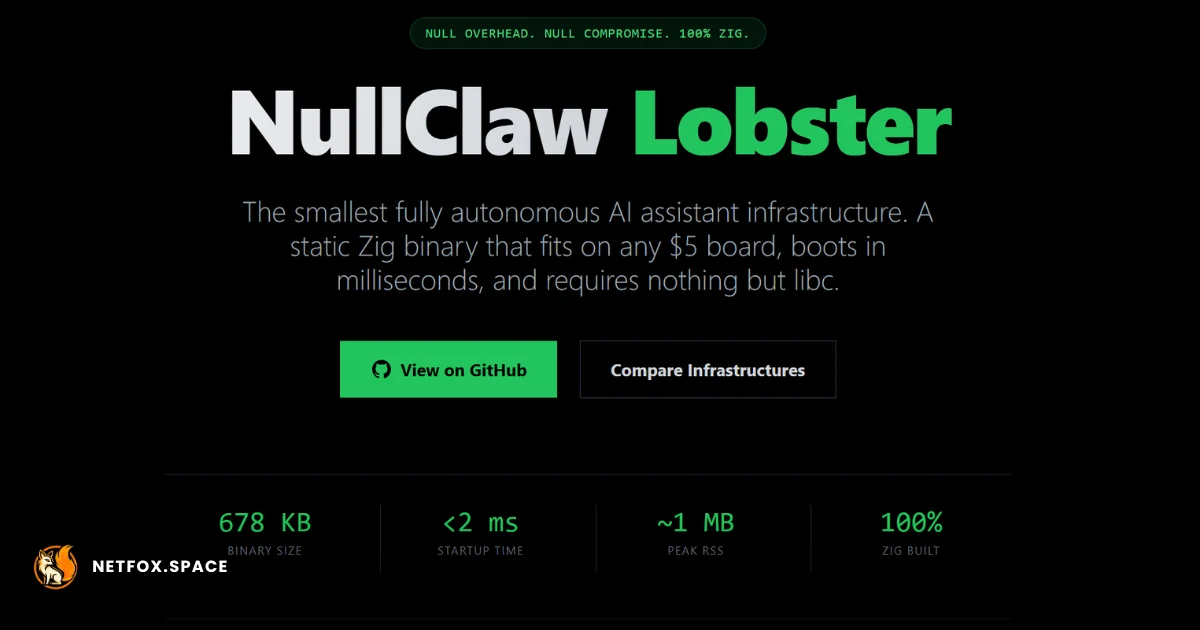
The developer team behind NullClaw has released Lobster, a static Zig binary designed to serve as the smallest fully autonomous AI assistant infrastructure currently available. Weighing in at just 678 KB, the binary is engineered to run on hardware as inexpensive as $5, requiring nothing more than libc to function. This minimalist approach targets the growing demand for "local-first" AI that can operate on microcontrollers and budget single-board computers.
The decision to utilize Zig follows a broader industry debate regarding the trade-offs between memory safety and binary overhead. While the Rust revolution continues to dominate large-scale systems in 2026, NullClaw engineers argue that the minimalist speed of Zig is necessary for hardware where every kilobyte of RAM is a constraint. By avoiding the overhead of heavy runtimes or virtual machines, Lobster achieves near-instant boot times that were previously impossible for agentic AI stacks.
Performance Benchmarks vs. Industry Standards
Internal testing conducted in February 2026 highlights a stark performance gap between NullClaw and its predecessors. While traditional TypeScript-based assistants like OpenClaw—which recently stabilized after a viral rebranding from Moltbot—require upwards of 1 GB of RAM, NullClaw operates comfortably within a ~1 MB footprint. This efficiency allows the infrastructure to be deployed on 0.8 GHz edge hardware that would otherwise fail to initialize modern Python or JavaScript runtimes.
| Metric | OpenClaw (TS) | ZeroClaw (Rust) | NullClaw (Zig) |
|---|---|---|---|
| Binary Size | ~28 MB | 3.4 MB | 678 KB |
| Peak RAM | > 1 GB | < 5 MB | ~1 MB |
| Startup Time | > 500 s | < 10 ms | < 8 ms |
| Hardware Cost | $599 (Mac Mini) | $10 | $5 |
The benchmark results suggest that while Rust remains competitive in terms of startup speed, the Zig implementation provides a significant advantage in binary size and total memory pressure. This makes NullClaw the primary candidate for embedding AI agency into industrial sensors, smart home appliances, and low-power wearable devices.
The Shift Toward Autonomous Local-First Architecture
The release of NullClaw Lobster coincides with a period of massive expansion for high-tier models like GPT-5.2 and Claude 4.5. While these frontier models provide the "brains" of AI interaction, infrastructure like NullClaw acts as the "nervous system," handling the local execution of tools, memory, and hardware peripherals. By reducing the infrastructure to a single static binary, developers can now deploy agentic capabilities without managing complex dependency trees or cloud-based execution environments.
Architectural stability is a core focus for the NullClaw project, moving away from the volatile naming conventions seen in the early 2026 AI assistant market. The infrastructure provides a multi-layer sandbox and hybrid vector memory as standard features, despite its small footprint. This allows for persistent, high-agency performance on devices that were previously limited to simple, non-autonomous tasks.
The emergence of ultra-low-cost, high-efficiency AI infrastructure raises a fundamental question for the industry: as the barrier to entry for autonomous agents drops to the price of a $5 board, will the primary bottleneck for AI adoption shift from hardware availability to the regulatory challenges of securing millions of decentralized, unmonitored devices?
References:
Comments (0)
Please login to comment
Sign in to share your thoughts and connect with the community
Loading...