

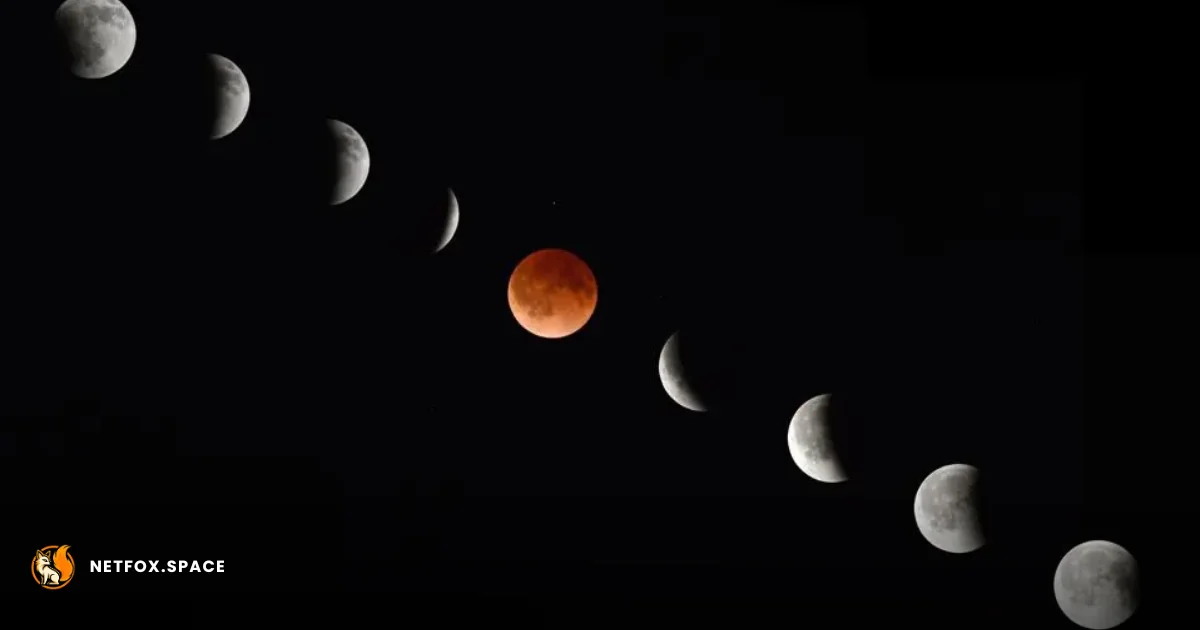
Mechanics of the March 3 Total Lunar Eclipse
On Tuesday, March 3, 2026, the Earth will pass directly between the Sun and the Moon, casting a deep crimson shadow across the lunar surface. This event, known as a Total Lunar Eclipse, will be visible in its entirety across most of North America, including all 50 U.S. states. Unlike solar eclipses, this phenomenon requires no specialized eye protection and lasts for several hours as the Moon traverses the Earth's umbra.
The eclipse cycle begins with the penumbral phase, where the Moon enters the outer edges of Earth’s shadow. However, the primary interest for observers lies in "totality" the period when the Moon is fully engulfed in the darkest part of the shadow. For this 2026 event, the duration of totality is expected to provide ample opportunity for high-resolution astrophotography and atmospheric study.
Chronology of Totality Across U.S. Time Zones
The timing of the eclipse is simultaneous globally, but the local clock time varies significantly by state and time zone. Observers in the Eastern Standard Time (EST) zone will see the eclipse peak in the early morning hours, while those in Hawaii-Aleutian Standard Time (HST) will witness the event during a more convenient evening window on Monday night leading into Tuesday.
| Phase of Eclipse | ET Time | CT Time | MT Time | PT Time |
|---|---|---|---|---|
| Partial Eclipse Begins | 5:51 a.m. | 4:51 a.m. | 3:51 a.m. | 2:51 a.m. |
| Totality Begins | 6:58 a.m. | 5:58 a.m. | 4:58 a.m. | 3:58 a.m. |
| Maximum Eclipse | N/A (Moonsets) | 6:34 a.m. | 5:34 a.m. | 4:34 a.m. |
| Totality Ends | Moonset | 7:11 a.m. | 6:11 a.m. | 5:11 a.m. |
Note: For the East Coast, the Moon will set while still in totality, creating a "Selenehelion" opportunity where the eclipsed moon and rising sun may briefly be visible simultaneously.
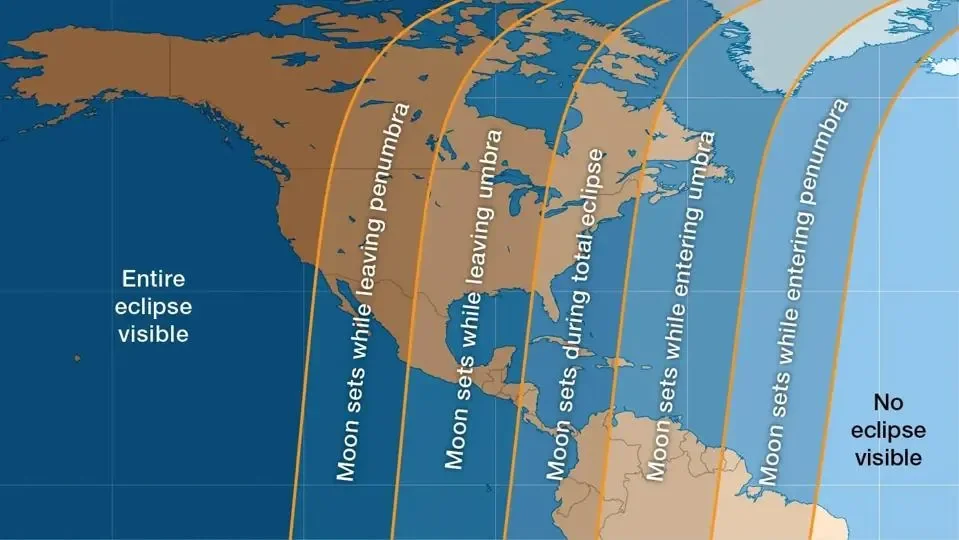 At least a portion of March 2026’s total lunar eclipse will be visible across North America, but on the East Coast the Moon is just starting to exit Earth’s umbral shadow when it sets before dawn.
Atmospheric Filtering and the Rayleigh Scattering Effect
The copper-red hue of a "Blood Moon" is not a property of the Moon itself but a byproduct of Earth’s atmosphere. This differentiation block clarifies the physics: the Earth’s atmosphere acts as a lens, bending (refracting) sunlight around the curvature of the planet. Shorter wavelengths of light such as blue and violet are scattered outward, while longer wavelengths red and orange are bent inward toward the Moon.
What many observers overlook is that the specific shade of red depends on the current state of Earth’s stratosphere. Recent volcanic activity or significant wildfires can increase particulate matter in the upper atmosphere, resulting in a much darker, almost brownish eclipse. Conversely, a clear global atmosphere produces a bright, vivid orange. The March 2026 event serves as a visual barometer for the current "transparency" of the global atmosphere.
Orbital Geometry and the Lunar Nodes
This eclipse occurs when the Moon is at a specific intersection of its orbit known as a lunar node. Because the Moon's orbit is tilted roughly five degrees relative to Earth's orbit around the Sun, eclipses do not happen every month. The March 3 event aligns perfectly with the descending node, marking a period of high orbital symmetry.
For the aerospace sector and satellite operators, these windows are more than just visual events. The sudden drop in solar radiation hitting the lunar surface causes a rapid thermal contraction of lunar regolith. This "thermal shock" is a critical data point for organizations like NASA and private firms under the Artemis Accords as they plan long-term infrastructure on the lunar South Pole.
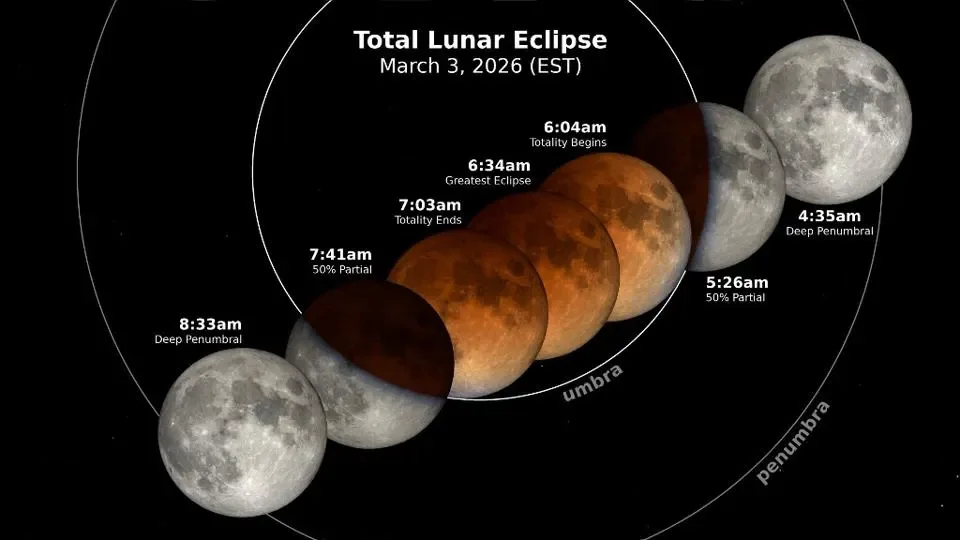 Eastern Standard Time (EST). The Moon moves right to left, passing through the penumbra and umbra, leaving in its wake an eclipse diagram with the times at various stages of the eclipse.
Regional Visibility and Local Weather Risks
While the entire U.S. is positioned to see the eclipse, coastal cloud cover and seasonal weather patterns in the Pacific Northwest and Great Lakes regions pose the highest risk for obscured viewing. Inland deserts in the Southwest remain the premium locations for clear-sky probability.
The next total lunar eclipse of this magnitude will not occur until late 2027, making this 2026 window the primary focus for North American astronomical societies. Professional observatories will be monitoring the "lunar limb" during the transition into totality to measure the exact diameter of the Earth’s shadow, which fluctuates slightly based on solar activity levels.
Forward Tension: The Path to Lunar Colonization
The 2026 Blood Moon arrives at a pivotal moment in the transition toward a cislunar economy. As international competition for lunar resources intensifies, these natural phenomena highlight the extreme environmental shifts specifically the 200-degree temperature swings during shadows that future habitats must endure. The data gathered during the thermal transition of this eclipse will likely inform the engineering requirements for the next generation of lunar landers and life-support systems.
Comments (0)
Please login to comment
Sign in to share your thoughts and connect with the community
Loading...